
Who and What - Vietnam for Beginners
Scooters Why walk when you can ride a scooter? Westerners who are not leisurely strolling or shopping on the crowded sidewalks filled with mopeds, but rather purposefully...

Published: 23.09.2025
'An' is the name of the hotel operator, as in 'Hoi An', she explains to me. She spreads out the brochure with the map of the namesake city in front of me. Like a doctor during a beauty surgery consultation, she circles the relevant parts that need to be addressed. 'The bamboo circus show is here. There is the restaurant recommendation for Cao Lau. This is the tailor who can fix your clothes.' Luckily, my plans for the next two or three days in Hoi An overlap with her beliefs about how a tourist should best spend their time in the city. Most hotels offer all kinds of services for their guests, including laundry, organizing tours, and booking rides to the next destination. It’s best to take advantage of these services; otherwise, trouble might arise.
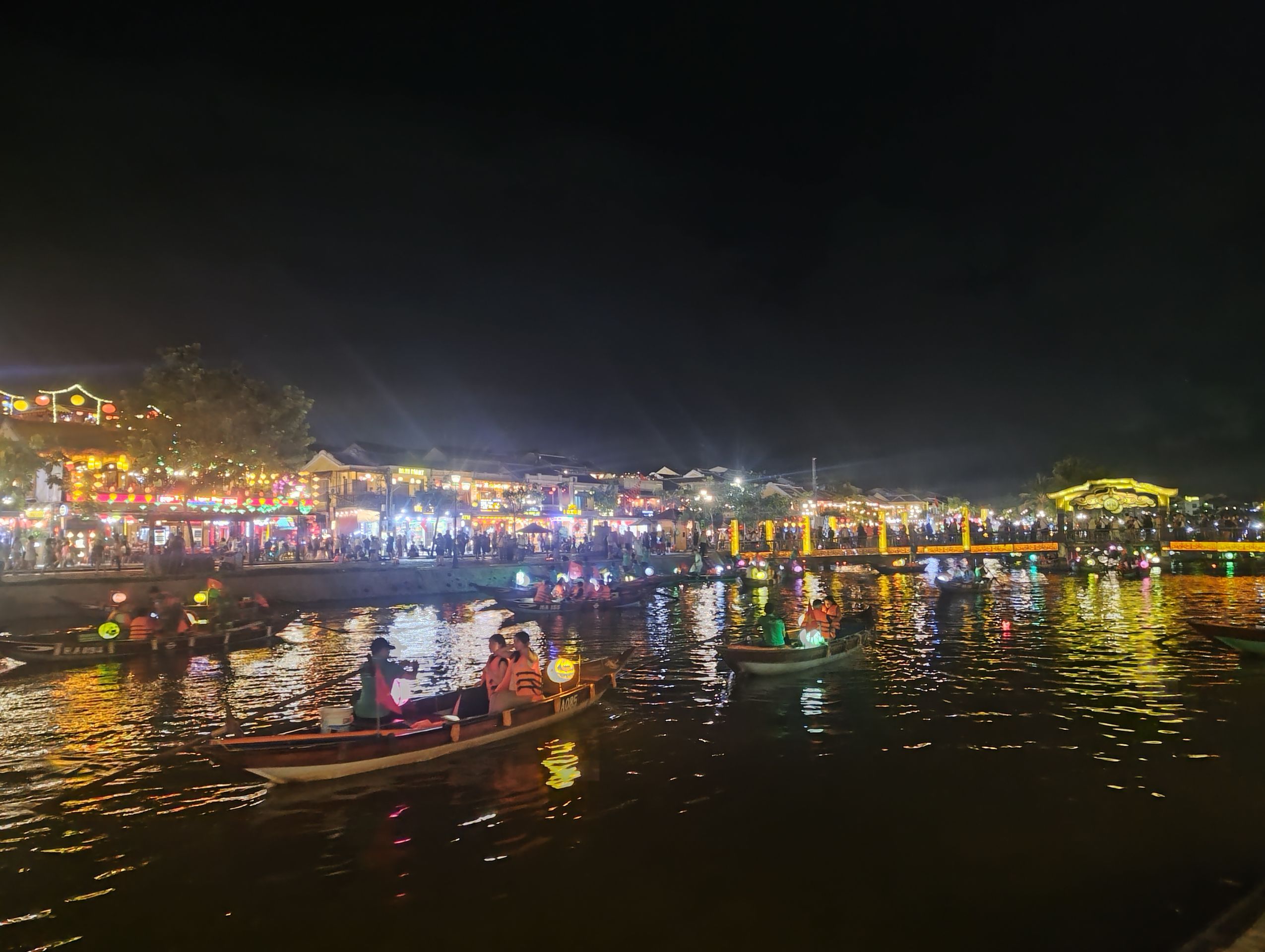
The first tour that An organizes for me is a city tour through the picturesque old town of Hoi An. If one delves into Hoi An beyond the hype, one can certainly recognize the charm of this tourist magnet. The Pole Kazimierz Kwiatkowski felt similarly when he first visited Hoi An in 1985. While he found only a sleepy fishing port and dilapidated houses at that time, instead of noble shops with tailors and karaoke bars. From then on, he advocated for the old town to be named a UNESCO World Heritage site. Unfortunately, he didn’t live to see the success of his efforts, as he died in 1997, two years prior to the award. The residents of Hoi An expressed their gratitude for his efforts and support in restoring the 400-year-old houses and refurbishing the old city skyline with a life-size bust of the architect. The bearded Kwiatkowski has been smiling kindly in the center of the old town ever since, and his admirers still light scented candles in front of the monument.
I also learn that my birth year is the year of the horse. In the Japanese and Chinese quarter, we visit Buddhist pagodas and houses of foreign merchants. Hoi An was a famous trading city 400 years ago. After that, the rivers dried up, and similarly to Bruges at around the same time, the bloom of maritime trade here ended within a few years.
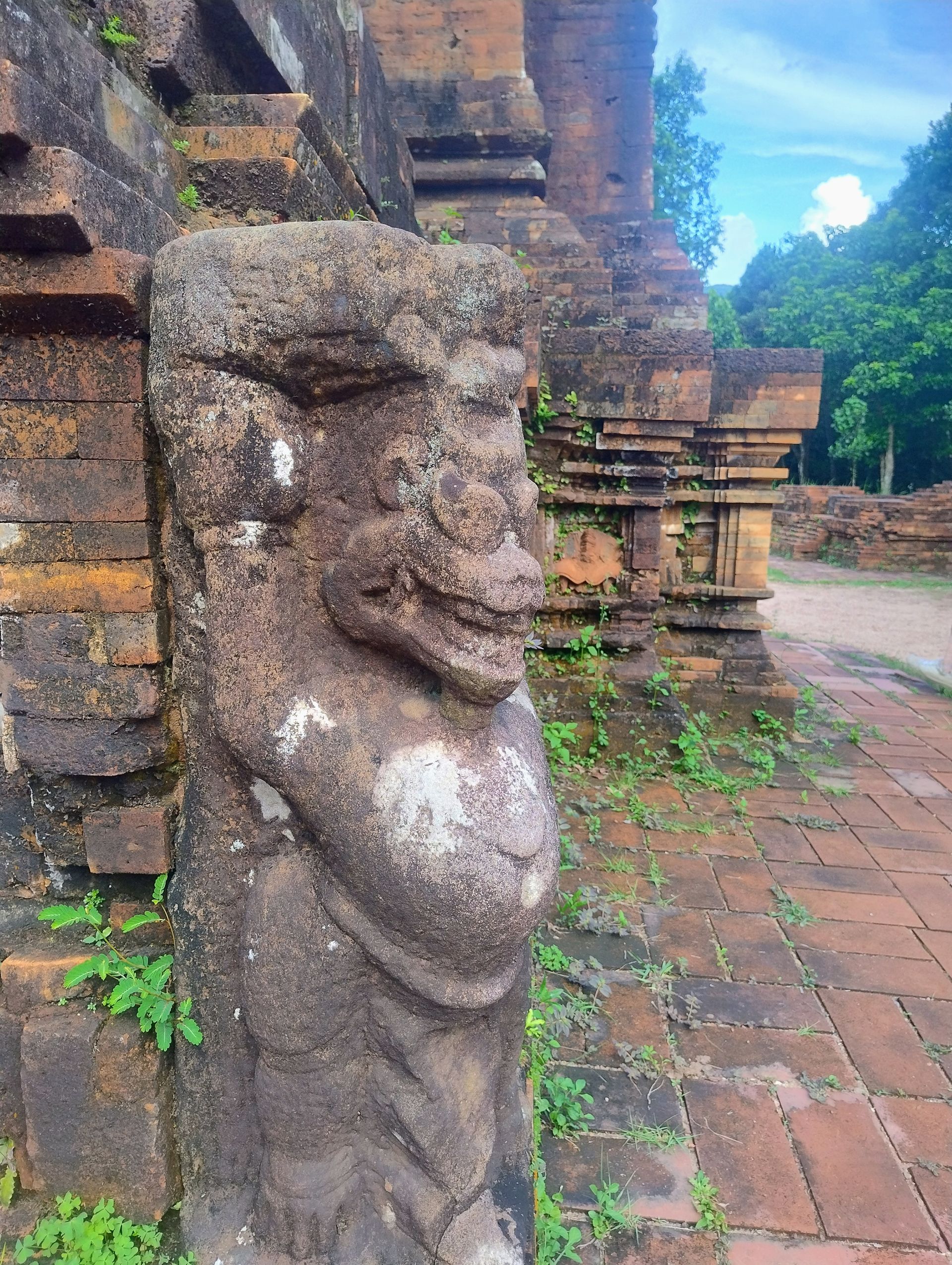
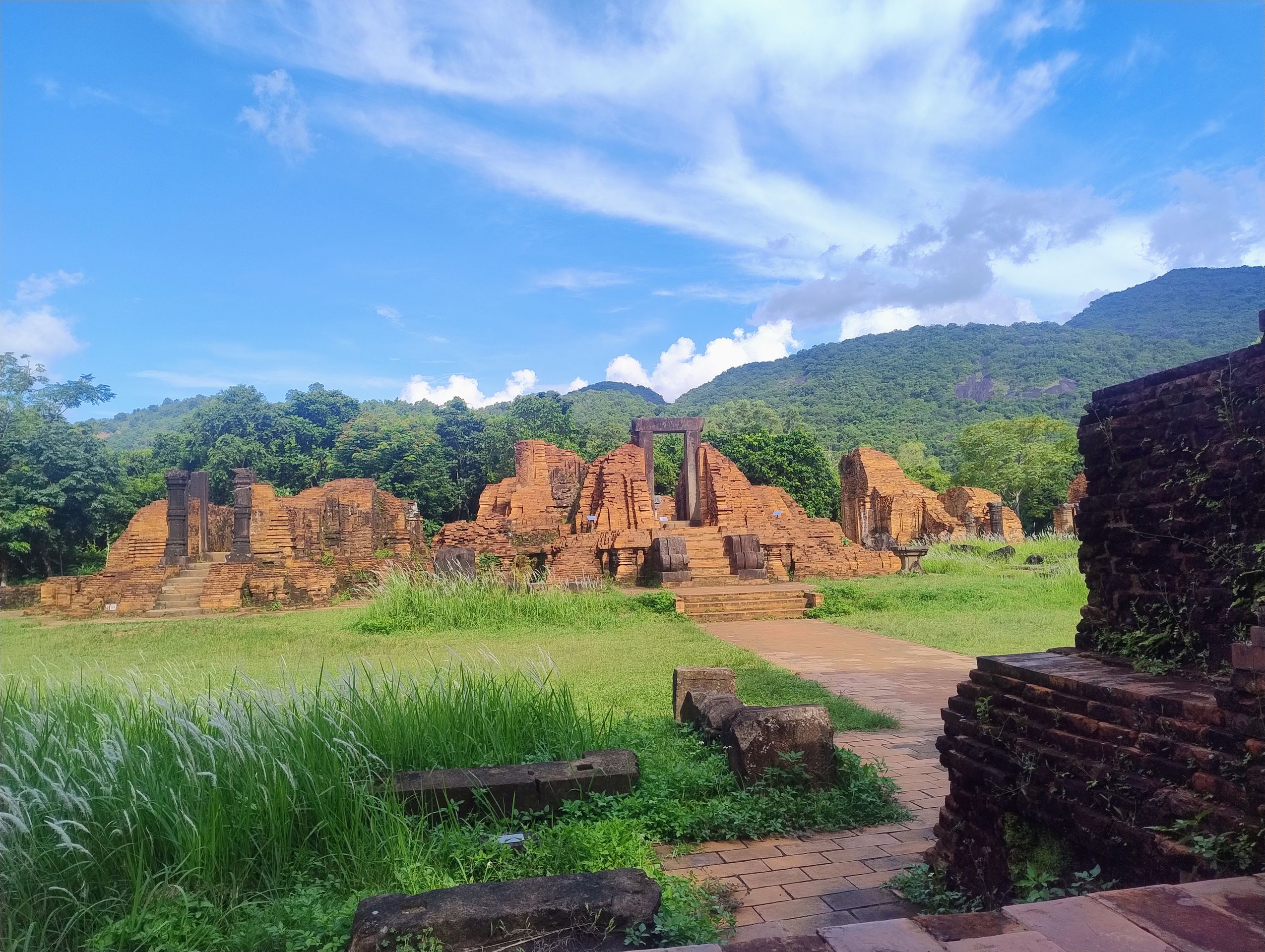
If you go further back on the timeline, you land with the Cham, who dominated the area around Hoi An and originally immigrated from Indonesia. The next tour takes me to the Hindu temples of the Cham from the 10th century, in My Son. Thanks to the Polish architect, this temple complex is also on the UNESCO list. A large part of the complex was bombed by the US Army. The Vietcong used it as a military headquarters. Now international archaeologists are working to restore the ruins.
After admiring Angkor Wat, I feel a bit underwhelmed in My Son. But it is interesting to see the traces of another high civilization that was in constant conflict with the Khmer of Angkor. I also ask our tour guide, and she corrects the guide’s statements in Angkor Wat. Contrary to what he claimed, the Cham were not Muslim but Hindu when they fought against the Khmer. It was much later that some of the Cham converted to Islam, most of them now live in Cambodia. Hence, that might be the reason for the misinformation from the Cambodian tour guide.
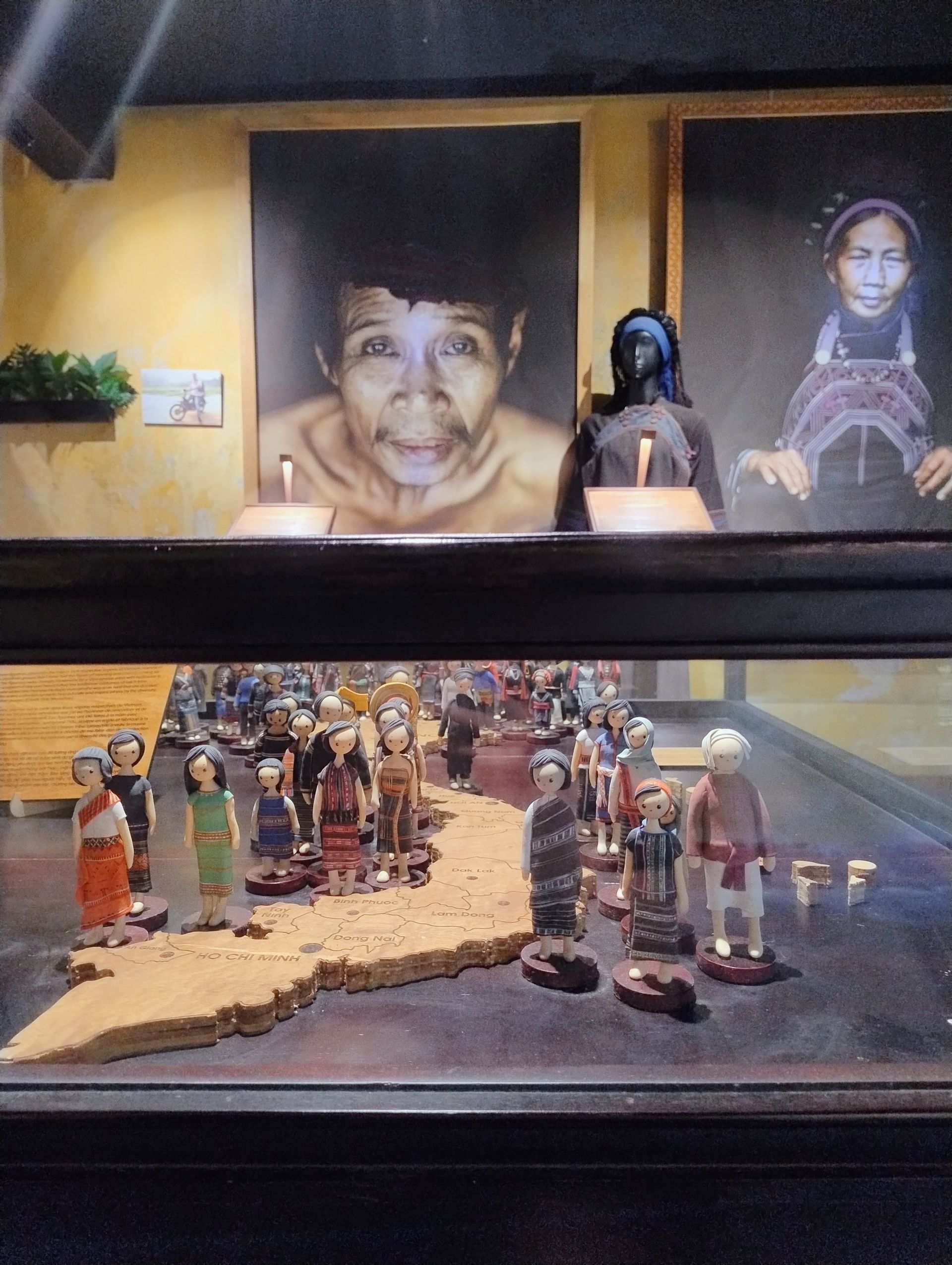
Back in Hoi An, I learn more about the 53 different ethnic minorities of Vietnam. A Frenchman has captured all these ethnicities in a photo exhibition. Over the last three decades, he has traveled throughout the country, needing to gain trust from many tribes in inaccessible places before he could document life as authentically as possible. Therefore, it is a very personal ethnological exhibition. In addition to landscape photos and costumes, it is primarily the portraits that linger in my memory. 100-year-old wrinkled faces grin into the camera. The photographer quotes a woman: 'Why didn't you come here when I was young and beautiful.'
With 84% of the population, the Kinh are the largest ethnicity in Vietnam. They were also the people who established the Viet Empire. It makes its appearance in the Hoi An Memories Show in the evening. Over 500 people are involved in the performance show full of dramatic songs and impressive dance performances. The city’s history is lavishly staged five times a week and draws largely Vietnamese patriots to Hoi An. Throughout the five parts of the show, a Vietnamese woman dressed in white spins the metaphorical thread of memories at a loom.
In one chapter of the show, the handover of the city from the Cham to the Viet is depicted. As a wedding gift for his Kinh bride, the then king of the Cham handed over the city to the Vietnamese. Under the subtitles 'the cultural harmony between the Vietnamese and Cham civilizations through the wedding', bride and groom ride in on elephant props. The court dances and celebrates peace. The violent destruction of the Champa Empire by the Viet Empire 1 1/2 centuries later and the expulsion of the remaining Cham to the south is not mentioned. That can’t be included in the one-hour choreography, and it wouldn't fit very well with dance and song either. Instead, the show ends with water and fire fountains. Hoi An has successfully navigated through the thread of memories in history and is proud of it. The audience is too.
On the second evening, I visit the Bamboo Circus Show with Leo, a Slovak I met on the My Son tour. The stage is smaller and indoors, but the circus is at least as impressive as the dance performance. This time, all the acts are entirely handmade, unlike the previous evening's performance with canned music and light and fire effects as if Helene Fischer and Rammstein were performing simultaneously. The bamboo circus is accompanied live by drums and horns. The athletes swing themselves across the entire structure made of bamboo, which is continually re-tied with ropes. At the end, the main artist jumps blindly from rod to rod with his eyes bound, while his colleagues below hold the structure together with all their might.
After I have completed the full tourist program in Hoi An, I pick up my participant medal from the hotel manager An as a farewell. A series of clay animals stands in front of me on the reception desk. 'In which year were you born?' she asks me. 'In the year of the horse!' At least something stuck with me during the tours. I put my figure in my backpack and get on the bus. This was of course arranged by An as well.
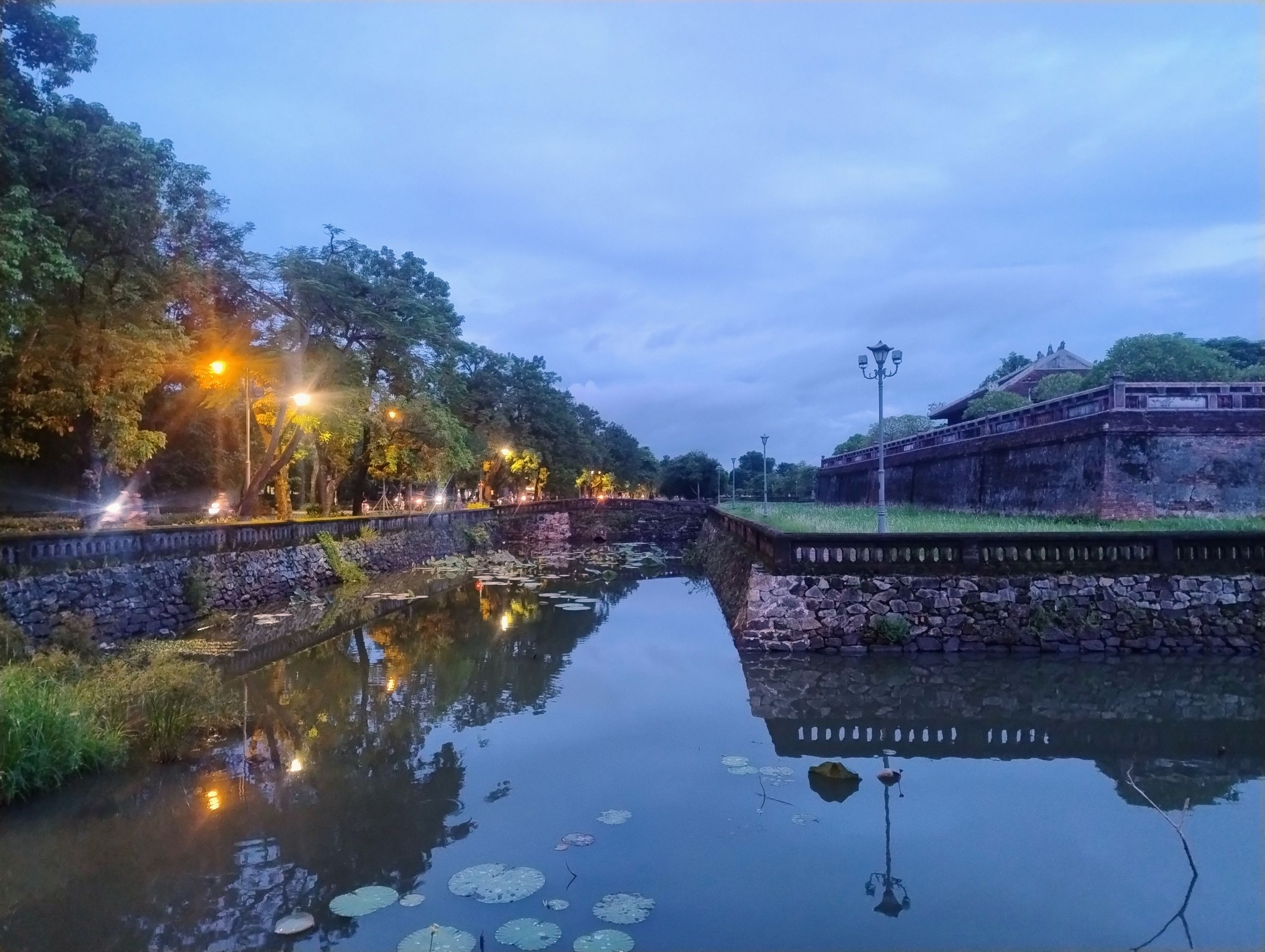
I am traveling north to Hue. Here, I am on my own again. However, I have little time in the former South Vietnamese border town before switching to the train to Ninh Binh. So I spend the four hours reminiscing about my trip seven years ago. 'Seven years ago!' becomes the mantra of my journey through the country. When people ask me if I have been here before or even unprompted, I enthusiastically throw the info back at them. Perhaps I want to tell people how much I like their country, that I’m even here for the second time. Perhaps I also want to show off a little as a supposed 'Vietnam expert' and distinguish myself from the other party tourists who ride through once like Mongols. In any case, the reactions are often very warm-hearted. I return to a restaurant where I was given free green tea in 2018 because my eyes were watering after a bite of a green chili. When the waitress shows me how to roll rice paper properly, I acknowledge that I have been here before. However, I still manage to fumble at rolling just as awkwardly as I did seven years ago. The waitress gives me a promotional keychain from the restaurant as a farewell. 'A little souvenir. Seven years ago.', she smiles at me. I could cry, but this time it wouldn't be the green chili's fault.
Hue was the last bastion of South Vietnam during the war. Anyone who has ever watched the movie Full Metal Jacket to the end and beyond the famous training scene ('You are so ugly, you could be a modern art piece.') will remember the battle scenes of the Tet Offensive in Hue. Kubrick had a fear of flying and hated traveling, which is why the scenes were not filmed in Southeast Asia but in London. Many veterans take the long flight to Hue to confront their trauma. I sat on a bus in 2018 with a US Marine who took us, among other places, to the former airbase Khe Sanh. The about 70-year-old American pointed at a neighboring hill and briefly described how he, along with other special forces, cleared the way through the jungle with machetes. I believe it was something about securing a hill or spotting Vietcong; that was his mission, but my memory of it is hazy.
A meeting point for veterans is the 'DMZ Bar,' where a three-dimensional map of the Demilitarized Zone between North and South Vietnam is mounted on the ceiling. I am also certain that when I was at the bar, I saw a real American helicopter hanging from the ceiling. I want to see the helicopter again and ask the staff about it. They seem a bit confused but lead me to another room after communicating via the translation app, where a small model of the 'Huey,' no more than a meter long, hangs. In disbelief, I search the internet for photos. Surely there must have been one, or did the TÜV put an end to it all? Only then does the realization dawn on me that I stored the whole thing completely incorrectly. There was never a helicopter hanging there. I wasn't even at the bar; I just read in Lonely Planet that there was this little prop. My brain then turned it into a complete original helicopter, which would be too hot even for the lenient Vietnamese building laws. My thread of memories is apparently even more patchy than that in the Memories Show of Hoi An.