'Do you have to fill that out?', a fellow traveler, whom I estimate to be in his early twenties, stands opposite me at the table. The Arrival Card, which I am currently filling out after landing at Incheon Airport, is actually standard for every entry, whether with or without a visa, based on my experience so far. 'I think so,' I reply in German. I've become quite good at recognizing Germans by their accent or appearance. 'Ah, okay,' he responds. Bingo! He understands me. I am getting better at guessing Germans.
He introduces himself as Leonhard from Bielefeld. After we had to actually submit our Arrival Cards at the Korean border control and retrieved our backpacks from the luggage carousel, we look around the terminal hall and consider how to get into the city. It is now past midnight. Incheon Airport is located on an island west of Seoul. A taxi would be far too expensive, and the train isn't running at this hour. At night, only buses operate, and you have to book them through a ticket machine. The next bus is fully booked, and the next one isn’t available for a few more hours. We first eat ramen at the only open snack bar. Leonhard, like me, has been to Taiwan, and we share our experiences about the kindness and warmth of the people. He generally wouldn’t travel to countries with a democracy index below 5. He doesn’t want to strengthen the regimes with his foreign currency. So, Taiwan instead of China. I find that impressive. An idealism that only those in their early twenties possess.
The ramen shop closes for half an hour, and we use the remaining time to catch a little shut-eye on benches in the airport entrance hall until the bus arrives.
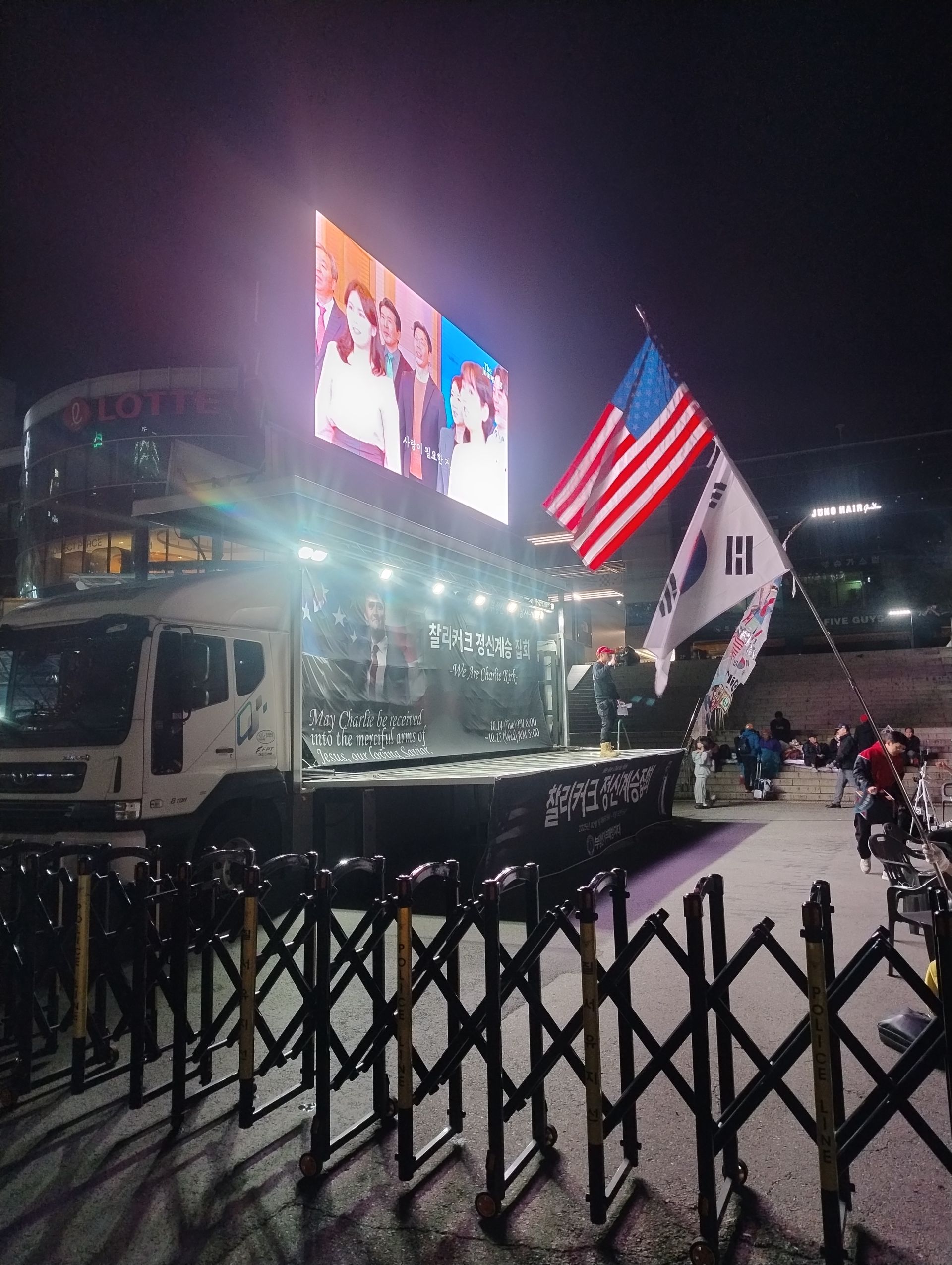
Leonhard has come up with a better plan than I have. While my journey to my accommodation located outside the city is not yet over, he has the idea to spend the night in a jjimjilbang. In Korean saunas, you can not only sauna but also stay overnight. There are special rooms where you sleep on mats on the floor with clothes provided to you. At 5:00 AM at the Seoul train station, Leonhard searches for his way to the jjimjilbang, while I desperately try to find a taxi that accepts credit cards. At the edge of the station, I notice a demonstration. I see
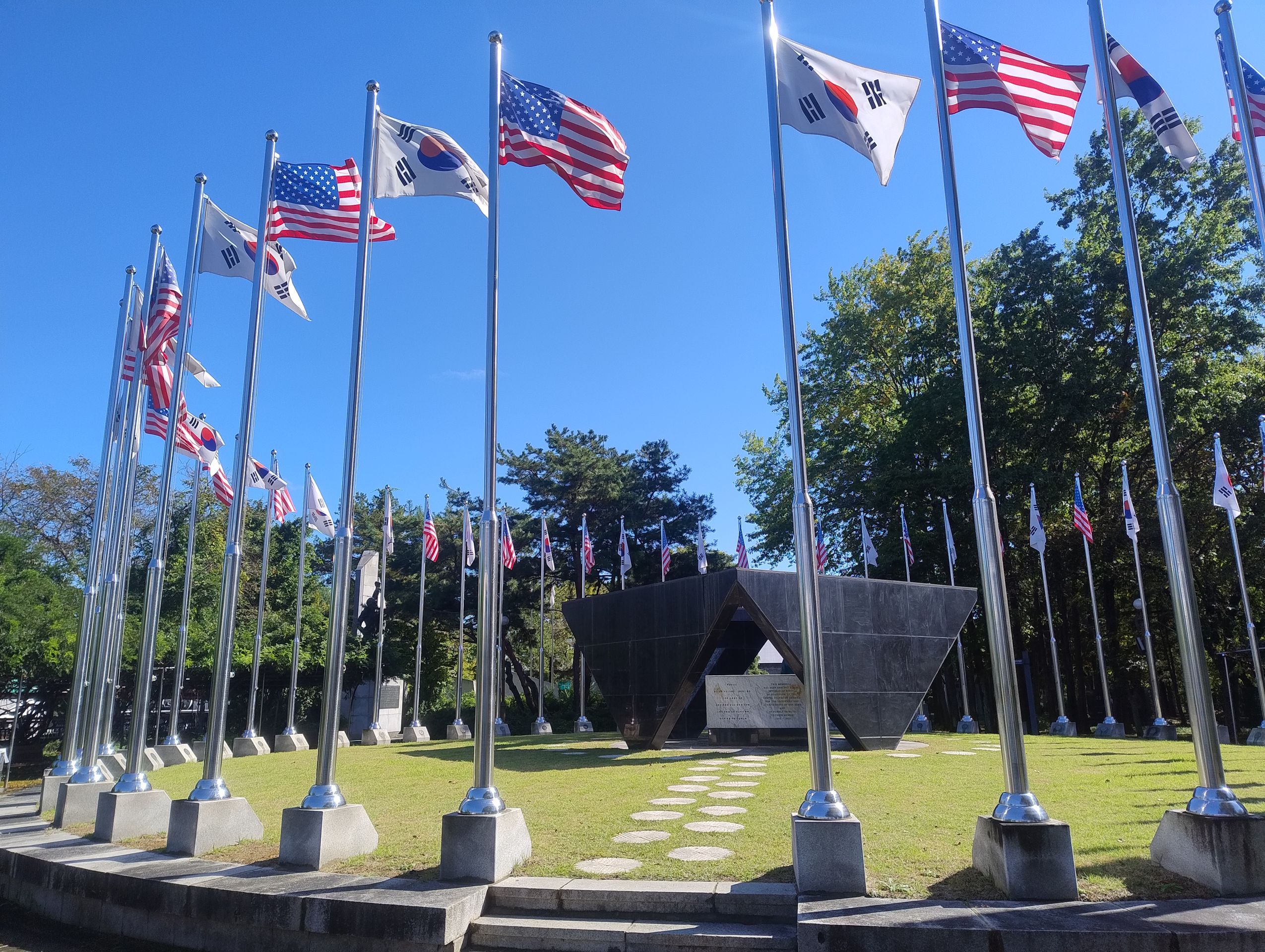
USA flags and a handful of people. Who goes demonstrating at half past midnight? Upon closer inspection, it becomes clear: Christian fanatics mourning over Charlie Kirk. They can do that. Apart from a few commuters on their way to work, no one here notices anyway.
A taxi drives directly towards me. The taxi driver calls out from the window: 'Are you Cedric?' I’m not. Too bad, that would have been my salvation, but the Uber taxi was probably ordered by Cedric. But as I walk away, he calls out to me again: 'Cedric has cancelled!' He takes credit cards, and I show him my far-off accommodation, which the approximately 80-year-old driver enters into his GPS. Under the night lighting, he drives like a lowered car over the highways of Seoul. My buddy Lukas, who knows a bit of Korean, had sent me a voice message upon arrival with the two essential words in travel vocabulary: Annyeonghaseyo - Hello and gamsahabnida - thank you. I have to listen to the message repeatedly throughout my whole trip in Korea. They are not easy words. 'Gahmsahmnida,' I say to the taxi driver when he ensures that he has taken me to the right hotel. He smiles and answers what I interpret as Korean 'You're welcome.' People seem to understand me.
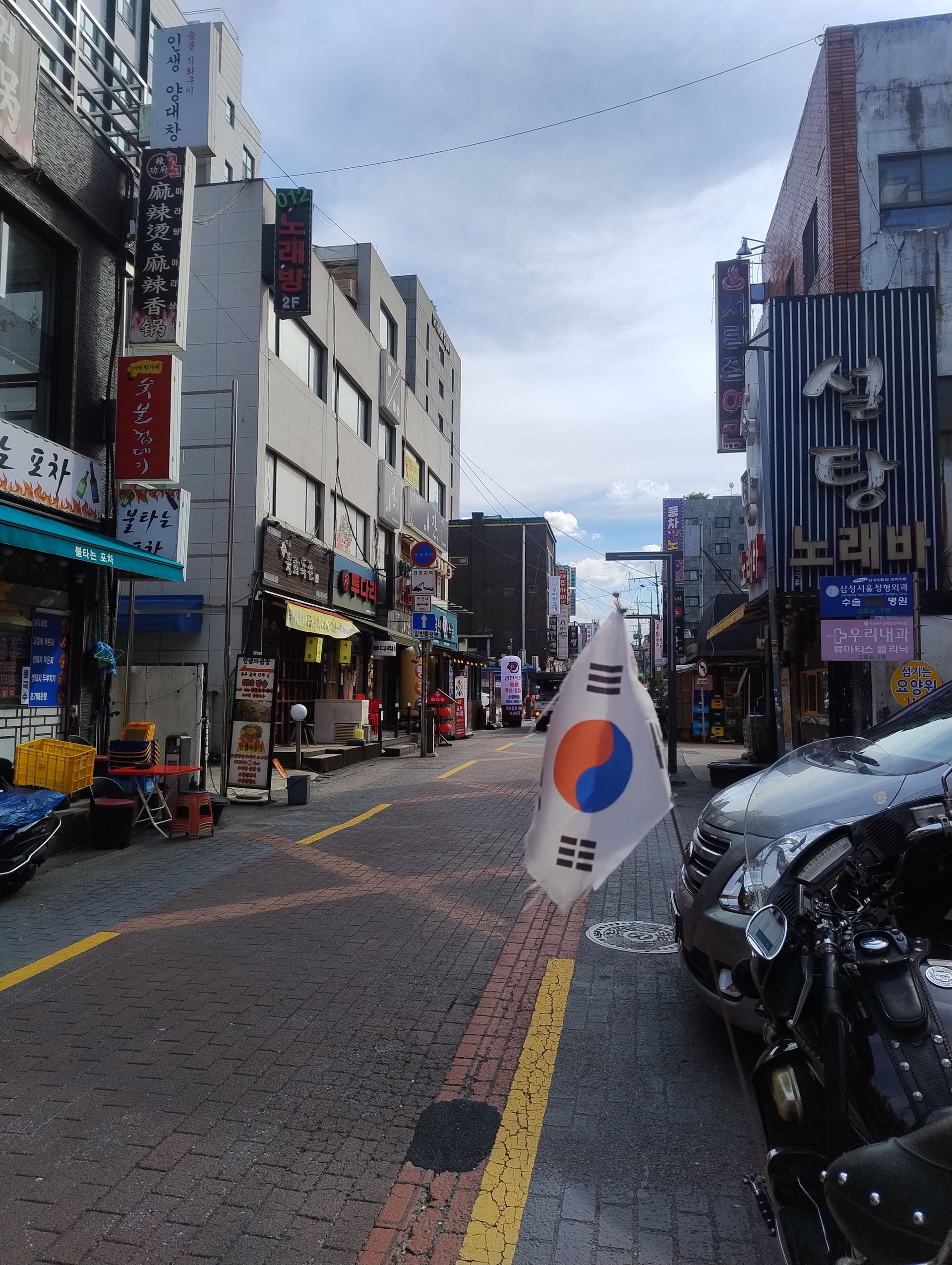
At just before noon, I wake up and groggily walk through the alleys looking for a 7-Eleven with coffee and a metro card. I pass by a Taekwondo training hall. A few children are practicing the steps and strikes that I performed myself when I was 11 years old. The board that I broke at a sports festival stayed long in my childhood room. Back then, with my already pronounced imposter syndrome, I always thought someone must have sawed it beforehand. As I think of this now, I feel a bit proud. Better late than never.
In my self-check-in hotel without staff, there are washing machines, but some pig has washed their sneakers in it. The old shoes are sitting in the washing drum, into which I no longer want to put my underwear. In search of a laundromat, I end up in a little shop owned by an older gentleman. He takes my underwear from the rest of the laundry pile and writes down the price and pickup time on a piece of paper. Only then do I realize that I haven't landed in a simple laundry service, but in a dry cleaner’s. Despite the language barrier and my laundry bag full of unsorted clothes, the man is very polite, and I can't bring myself to decline the price of almost €30. I treat myself to the small luxury of ironed elephant pants. I wash the remaining clothes by hand and with Rai from the tube in the hotel.
In the evening, I meet Leonhard in Seoul. He shares his jjimjilbang experience with me. At the counter in front of the gender-separated sauna area, he was repeatedly sent back to the changing room. He knew that you bath and sauna completely naked; still, it felt strange to walk past the dressed staff completely unclothed. Communicating without a translation app didn’t make the whole situation any easier. The only thing you wear on your body is the key to the changing room on your wrist. Bringing your own towel, let alone a swimsuit or underwear, is strictly prohibited due to the hygiene expectations of Koreans. Instead, you must shower thoroughly before entering the steam bath. During that, you walk on the wet tiles without slippers and share the same soap with everyone else. Dry towels are available at the entrance. Many jjimjilbang visitors don't stand while showering; instead, they sit on small plastic stools, on which the previous person sat with their naked butt. Some brush their teeth with disposable toothbrushes while hot water flows over their heads. Similar to Turkish hamams, one can also get scrubbed and massaged for an extra fee. It’s a wild world Leonhard is describing, but after a somewhat sleepy arrival day with minor setbacks, I would be up for some wellness.
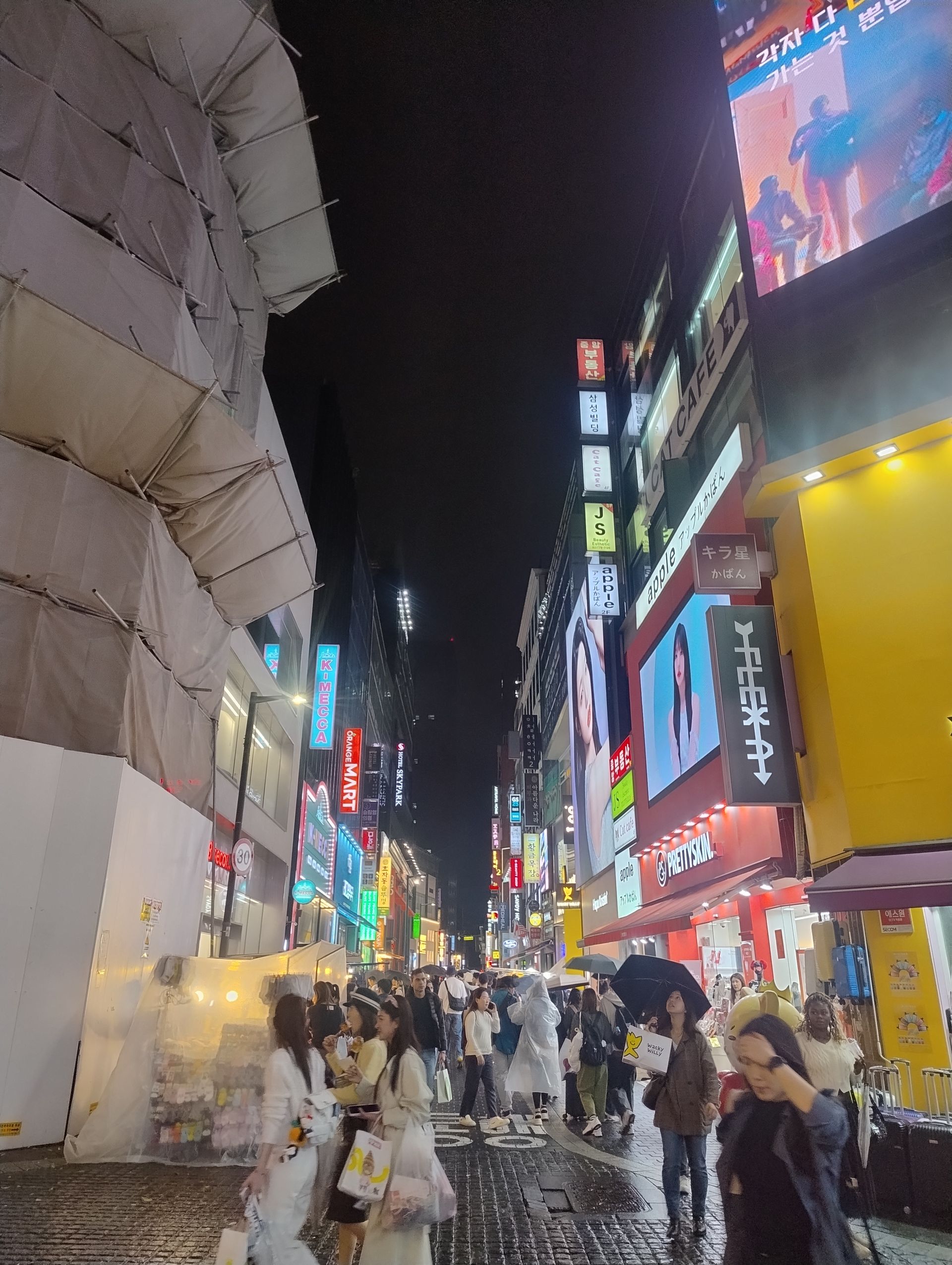
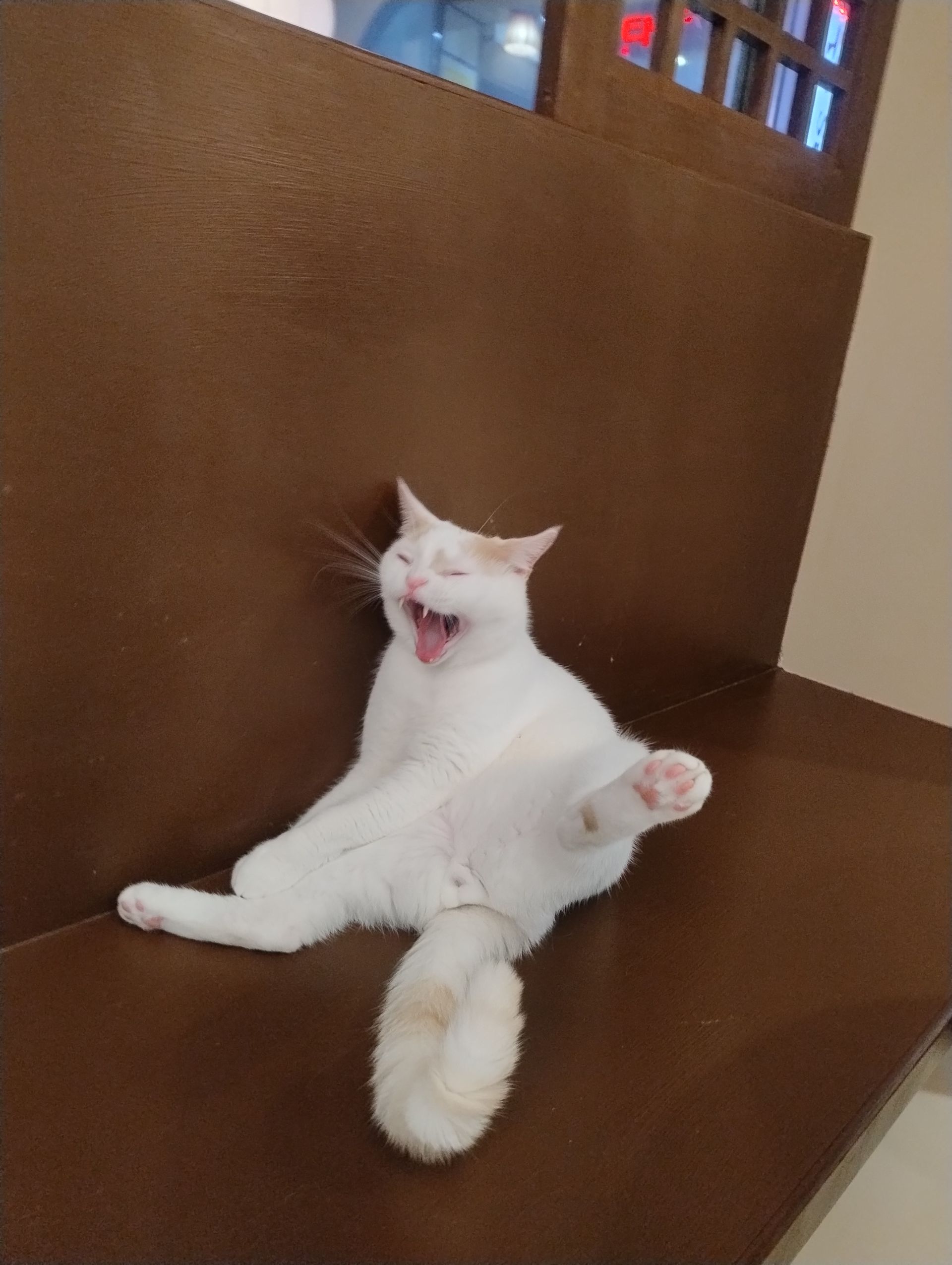
In the pedestrian zone, we stroll through the night market and treat ourselves to skewers of candied fruit. Colorful and loud, the downtown area of Seoul is filled with Nintendo sounds from the still open shops packed with electronic toys and Korean sweets. A mascot in a cat costume advertises for a cat café, and I persuade Leonhard to come along since he has never been to one. The calm atmosphere and a reddish-brown cat that makes itself comfortable on our table between two milkshakes reconcile me with the day.
In my early twenties, I had my North Korea 'era.' I absorbed every documentary about the probably craziest country on Earth. The propaganda and suppression apparatus known as the state captivated me in a way similar to people who can’t look away from car accidents. And as with Vietnam, I was fascinated by the parallels to Germany. A country torn and shaped by the Cold War - but in an extreme way. As travel trends would have it, North Korea is considered the ultimate boss level among bucket-list travelers. For the proud claim of having been to the most isolated country on Earth, one must fight hard for a visa and adhere to the rules and strict restrictions of the tour guides within the country. You don't want to end up like the American who died in North Korean custody due to a stolen propaganda poster. A true challenge, then, which wants to be earned for the craziest Insta travel story ever. But I follow Leonhard's example, who doesn’t want to throw a cent into the gullets of rogue states. The currency for these organized trips goes directly and without detours to the Kim family.
A tour to the border is thus a good compromise, and I choose an option where you can interview a defector from North Korea. Not everyone participating in the tour chooses this option, which surprises me because for me, this is the interesting point of the excursion. A woman around 40 gives a brief talk for twenty minutes, introducing herself and sharing her biography and escape story. A translator translates. She cannot speak English, which isn’t surprising since she had to initially learn a somewhat different Korean and navigate a completely opposing world of capitalism and democracy. What impressed her the most was how her new fellow humans in
South Korea express their thoughts freely without filters. In her hometown at the Chinese border, there was some trading with China. Using a smuggler from the neighboring country, she managed to organize her risky escape and create a new identity for herself. She then crossed through
China to
Laos and
Thailand before finally arriving in South Korea. There is now a larger community of North Korean 'defectors' who provide insights into the oppressive state on YouTube and social media. I ask how many North Koreans actually still believe the government’s lies. Her answer surprises me: Not even 30%, she estimates, would have been subjected to brainwashing. All the others only maintain the charade out of fear for themselves and their families. She believes it is only a matter of time before the system collapses.
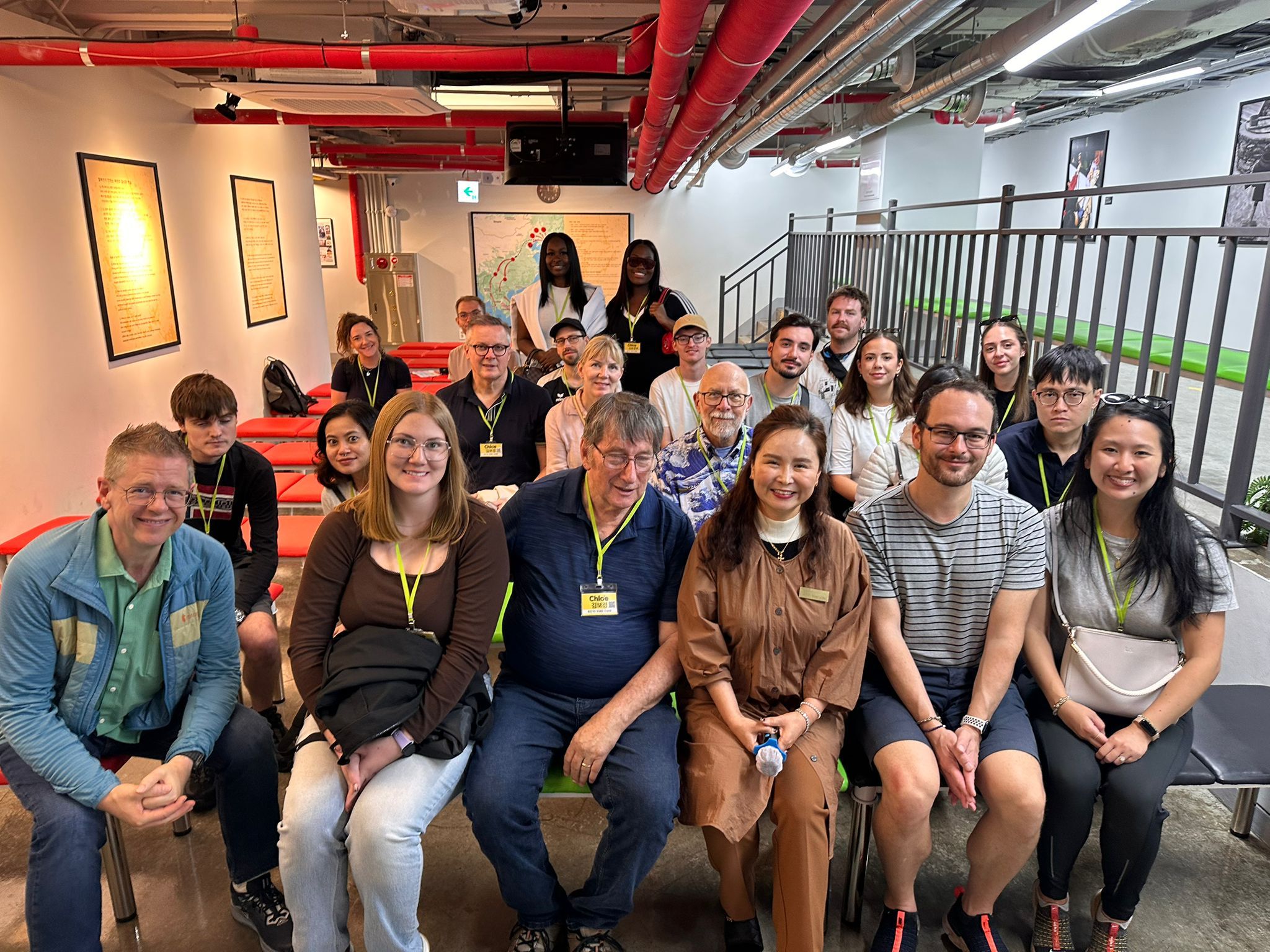
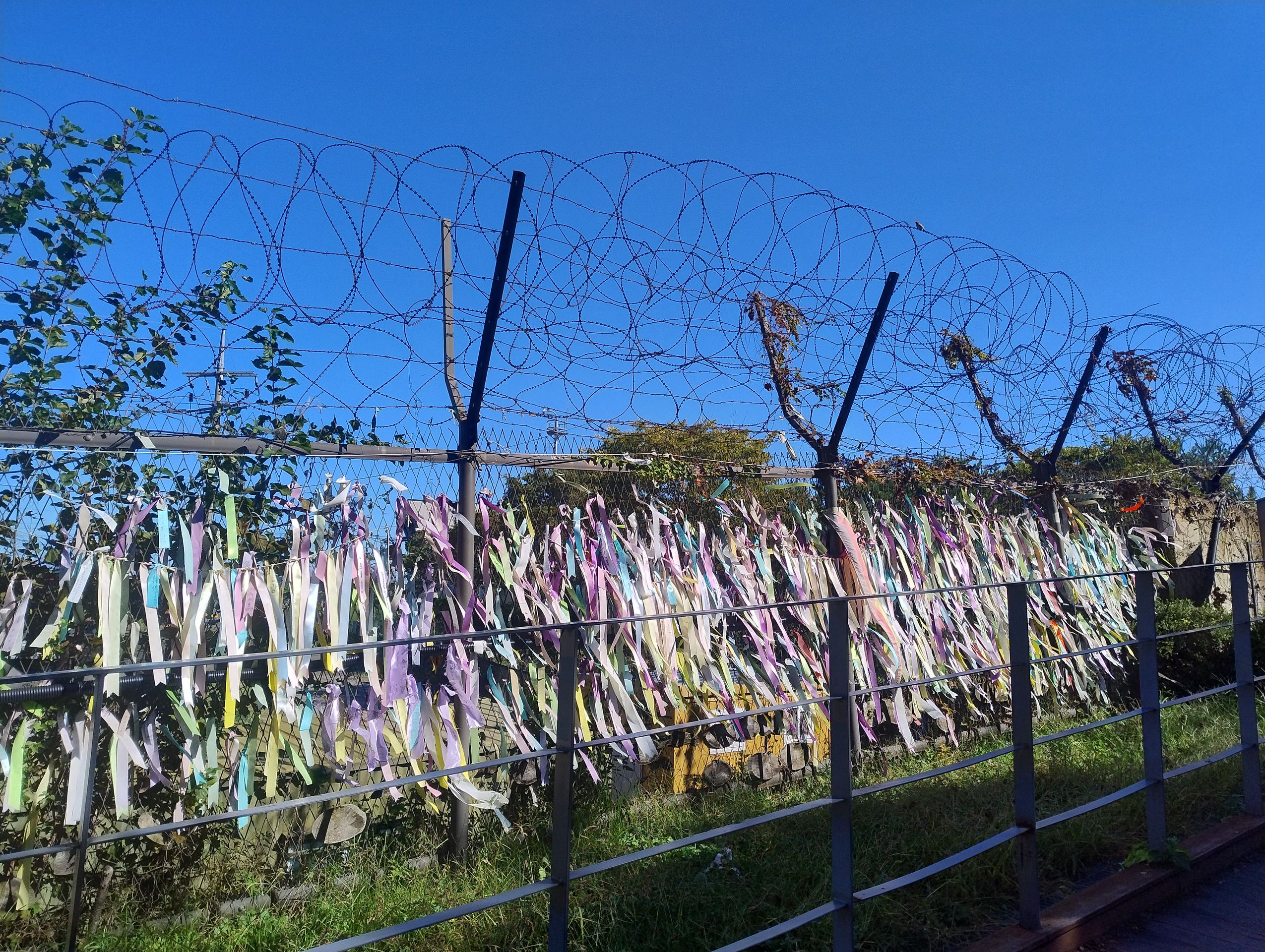
With Tim from Frankfurt, who works in development aid, I get into a conversation about the documentary that was shown before the interview with the North Korean woman, providing context to the story. 'A bit sensationalist,' I comment on the short film that reminded me with its quick cuts, effects, and the narrator with an American accent of D-Max formats. Tim tells me he wrestled with himself about participating in the tour at all. It does have a tinge of voyeurism. At the same time, he didn’t want to miss the opportunity to form an impression of the situation on-site. We have that impression the moment we stand at the viewpoint with a spectacular panorama view of the isolated country. The demilitarized zone, which is anything but demilitarized but completely mined, has been entirely cleared here. Thus, the view remains clear of a North Korean small town and an adjacent village that is entirely uninhabited. It was probably built to give Koreans in the south the illusion of a healed world. Chloe, our tour guide, instructs us not to take photos. If they appear in social media posts, it would provoke the North Koreans and further strain the already critical diplomatic relations. That would then be attributed to her. 'I don't want to lose my job,' she asks us to keep our phones tucked away. Standing in line, we take turns at the binoculars. Tim is right with the voyeurism thought. Like the West Germans in the film 'Sonnenallee,' we look down into the zone from above. We can’t see any Zonis. Too far away, or nothing happening in the communist part? Not even cars or horse-drawn carts are visible. In the picturesque landscape at the border strip, we see from afar a flagpole with the North Korean flag. At 160 meters, one of the tallest in the world, as Chloe explains. North and South Korea once vied to outdo each other in the 'who has the longest?' competition, and South Korea eventually stopped playing that silly game.
We cannot go to the border post. Last year, an American soldier stationed in South Korea who participated in a DMZ tour simply ran across the border. He apparently had difficulties with the law and the naive idea of being able to cross over to the North Koreans. Instead, he was turned back and handed over to the USA, where he is now in custody. The Americans again. Therefore, all visits to the border have been suspended for the time being.
Instead, we head to a village located directly in the demilitarized zone and primarily inhabited by older South Koreans. While there are financial incentives to live here, there are also strict curfews and marriage policies that discourage younger people from staying here. In the quirky souvenir shop, you can buy North Korean currency for which there isn’t even an official exchange rate. We are only allowed to move in a marked area around the visitor center. Too many tour participants in the past had peeked into the homes of residents and did not respect the people's privacy, Chloe says. There we have it again, the voyeurism.
On the last evening, I venture into the jjimjilbang. While I now know how things work after Leonhard's briefing, I still handle it as amateurishly as he did. Only when the sauna operator reprimands me in Korean and I see that others also enter the sauna area with nothing on but their locker key do I strip down and take off my boxer shorts. I first sit in the lukewarm pool and discreetly observe how the regulars do it. First sauna, then cold pool, then hot, then back to lukewarm. The whole experience is accompanied by old man noises - groans, grunts, loud exhalations. Most here are retirees. I am the only foreigner.
The small bath also has a smaller wooden sauna, although it is carpeted and smells quite like a doghouse. The steam sauna next to it is much hotter, and I can only withstand it for a maximum of five minutes. Overall, I rotate between the pools and the sauna for nearly four hours and also enjoy the digital detox effect.