
Easy Rider (Ninh Binh)
My new tour guide in Ninh Binh, unlike An, doesn't even introduce herself.

Published: 02.10.2025
Others have a bucket list. I have a 'fuck it' list. Ha Long Bay is definitely in the top 5. A three-hour bus ride each way, cramming myself into a small ferry with masses of Instagram tourists and being ferried from rock to rock. No, I'm not doing that. The hotel manager in the old quarter of Hanoi gets that impression from me and eventually gives up after several attempts to persuade me. We wait in silence until my room is ready for check-in. 'My Hanoi' is no longer the same. It has become a lot more touristy, that much is clear. And the more I fear places like the famous Ha Long Bay, which attracts millions of visitors every year. I consciously skipped it back then. Seven years later, I am again confirmed that it's not worth the stress. I meet Leo again, who took the bus from Ninh Binh at 4 AM. The bus should take him to Ha Long and then back to Hanoi after the tour. A 14-hour day. Overtime. When Leo saw the crowds at the harbor, still half-asleep, he realized he had overcommitted. Travel burnout. His pace - the often once-in-a-lifetime stays in one place followed by overnight trips to the next were just too much. He received half the price as a refund and a ticket to Hanoi. Now he wants to try it again the next day, but to a lesser-known bay towards Cat Ba Island with fewer people, but still with even more spectacular views.
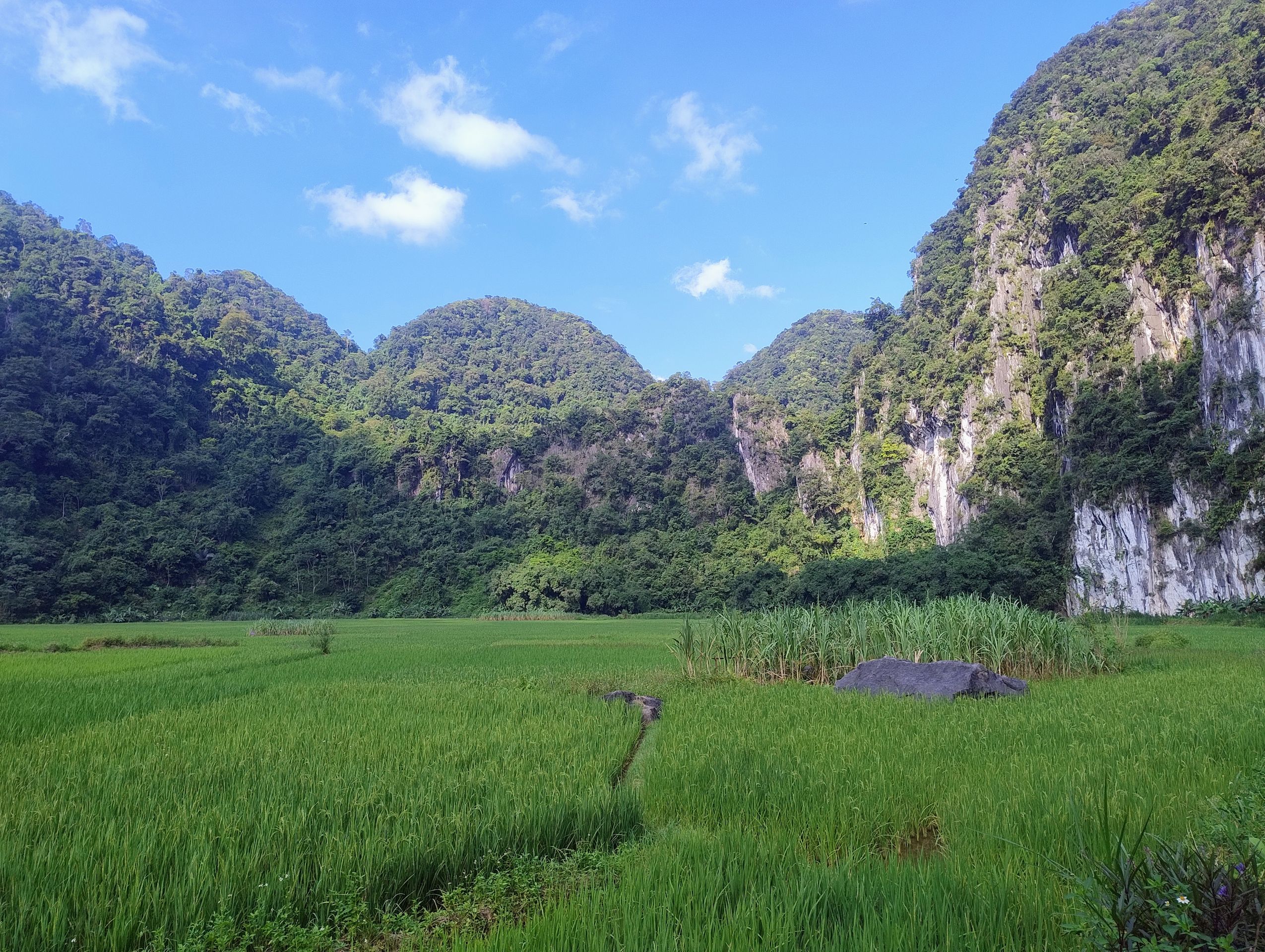
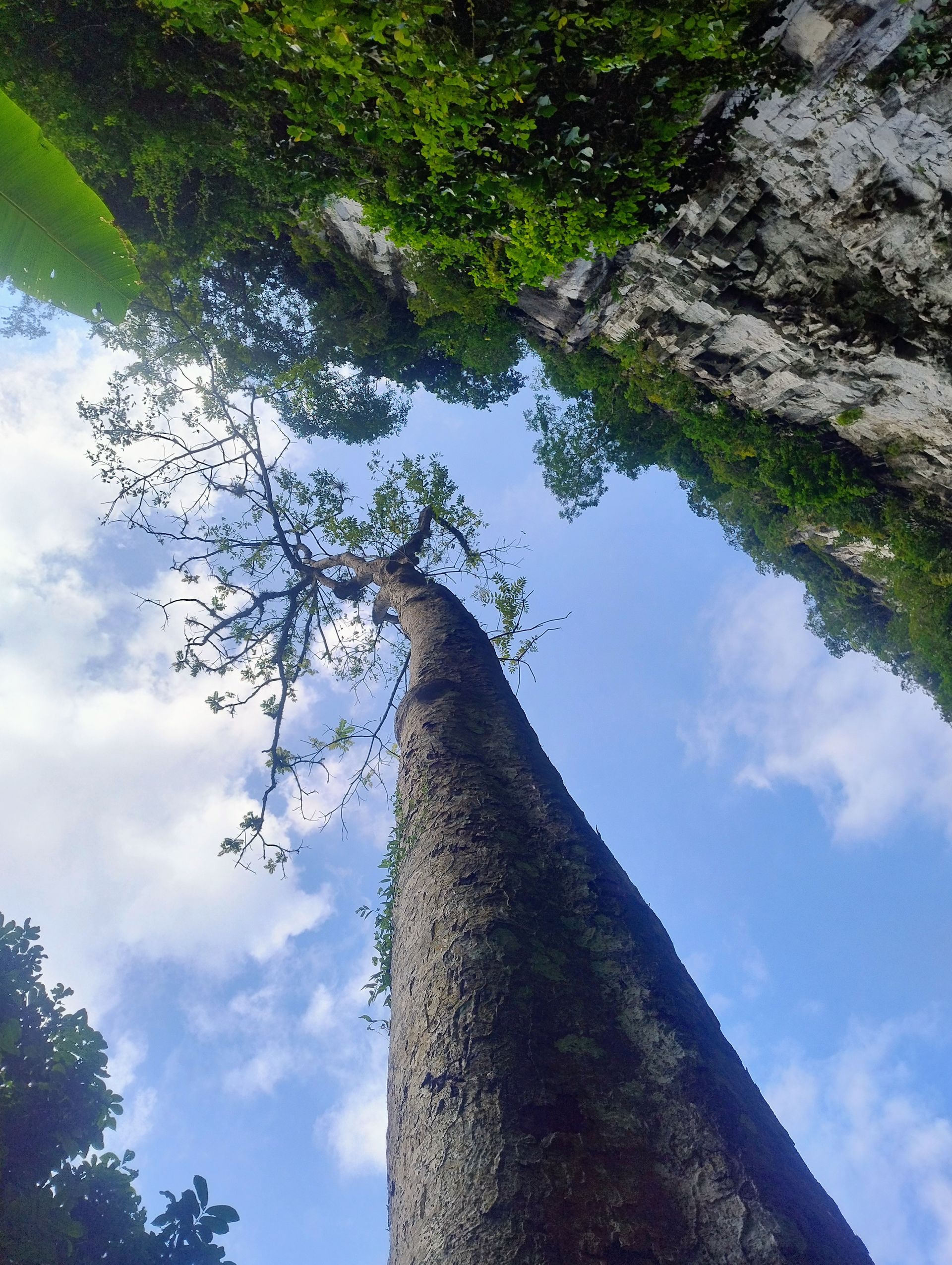
I also take a break from the hustle and bustle and book a two-day tour to Pu Luong, a national park east of the city. The landscape there is a combination of the soaring high cliffs from the otherwise flat area in Ninh Binh and the mountainous rice fields around Sapa, which I already visited on my first trip to Vietnam. Pu Luong is also exactly halfway between the two provinces. However, it is much less known. That might be one reason why my tour group consists only of me and an older French couple. After checking into my wooden bungalow, built on bamboo stilts right at the steep slope, we go on a hike with our guide Quoc through the remote villages to a cave and back.
Quoc belongs to the Thai minority. He would still speak Thai himself, but his daughter, for example, is no longer learning it in school, maybe later in the family. I ask him how he feels about his language and thus his culture disappearing over generations. On the one hand, it's a shame, but on the other hand, life would be simpler if they adapted. It is certainly easier to accept, as life in the province has visibly improved recently. We pass by paved roads and bridges, and Quoc proudly reports that these were only built in recent years. The harvest yields from the corn and rice fields are evenly distributed among the villagers. A hint of communism, but class differences still exist. Farmers who have made money from selling land have built fancy stilt houses from fine wood. Tourism has brought an upswing through the businesses with lucrative homestays, but the government is investing as well. Schools and kindergartens now exist in previously remote valleys that are now connected by roads that motorcycles can also use. However, the residents still use woven baskets on their backs as means of transport for fodder for their water buffalo, pigs, and chickens. An old woman grins at us as she walks by with one of these baskets. Her teeth are pitch black. Quoc points to a tree and explains that many Thai chew the leaves to turn their teeth black. This would keep evil spirits away from entering their bodies. However, younger Thai no longer chew the bitter leaves.
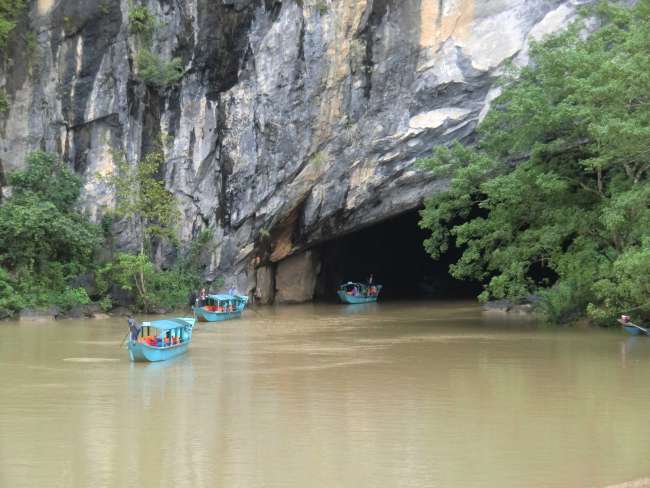
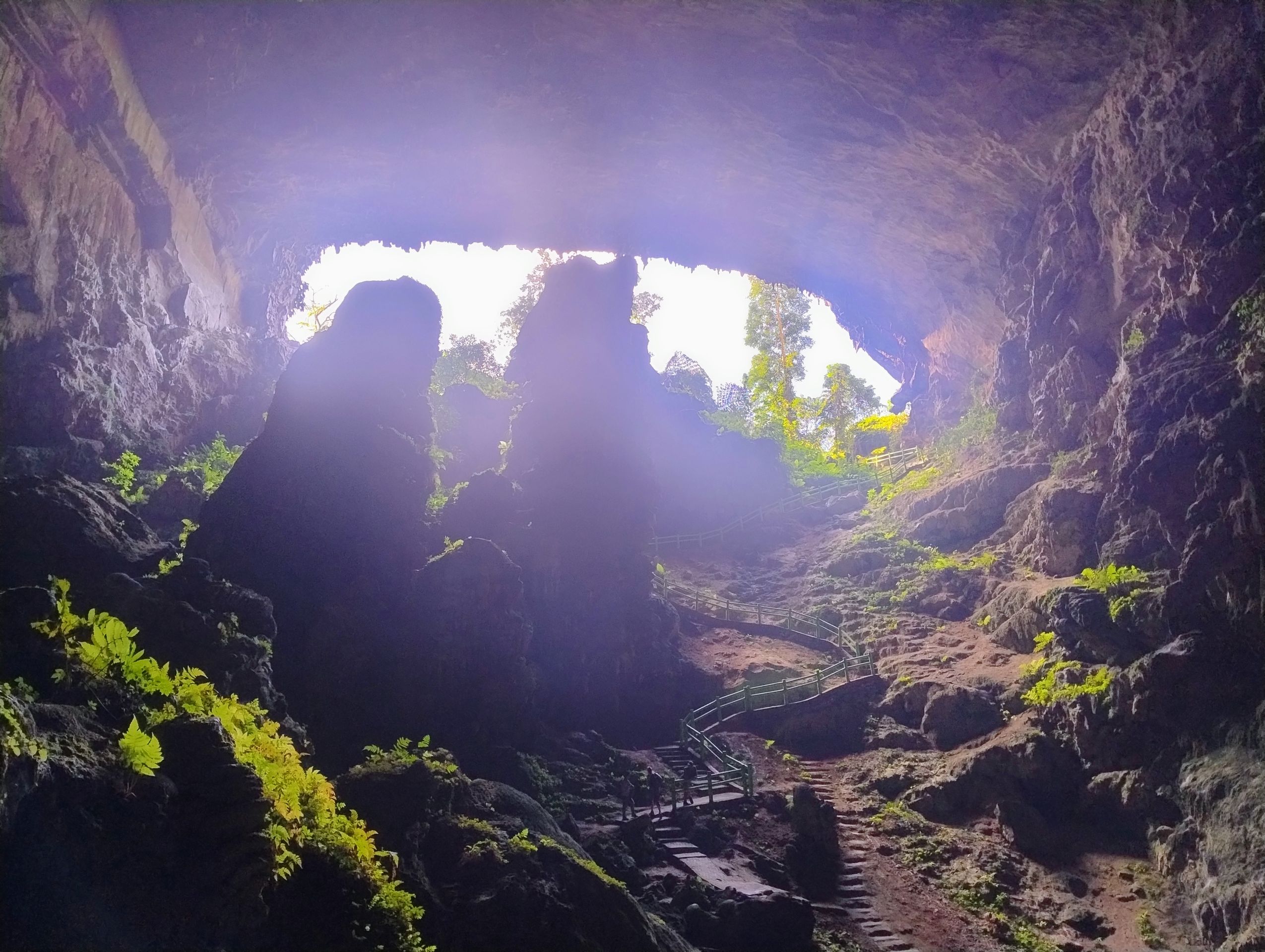
'Not another cave..', I think, but the largest limestone cave in the national park, which Quoc takes us to as a conclusion of the hike, is actually more spectacular than I had assumed. However, we are not supposed to go too deep inside, the steps are too slippery. So we stand reverently before the 200 x 200 meter wide entrance and listen to the bats squeaking.
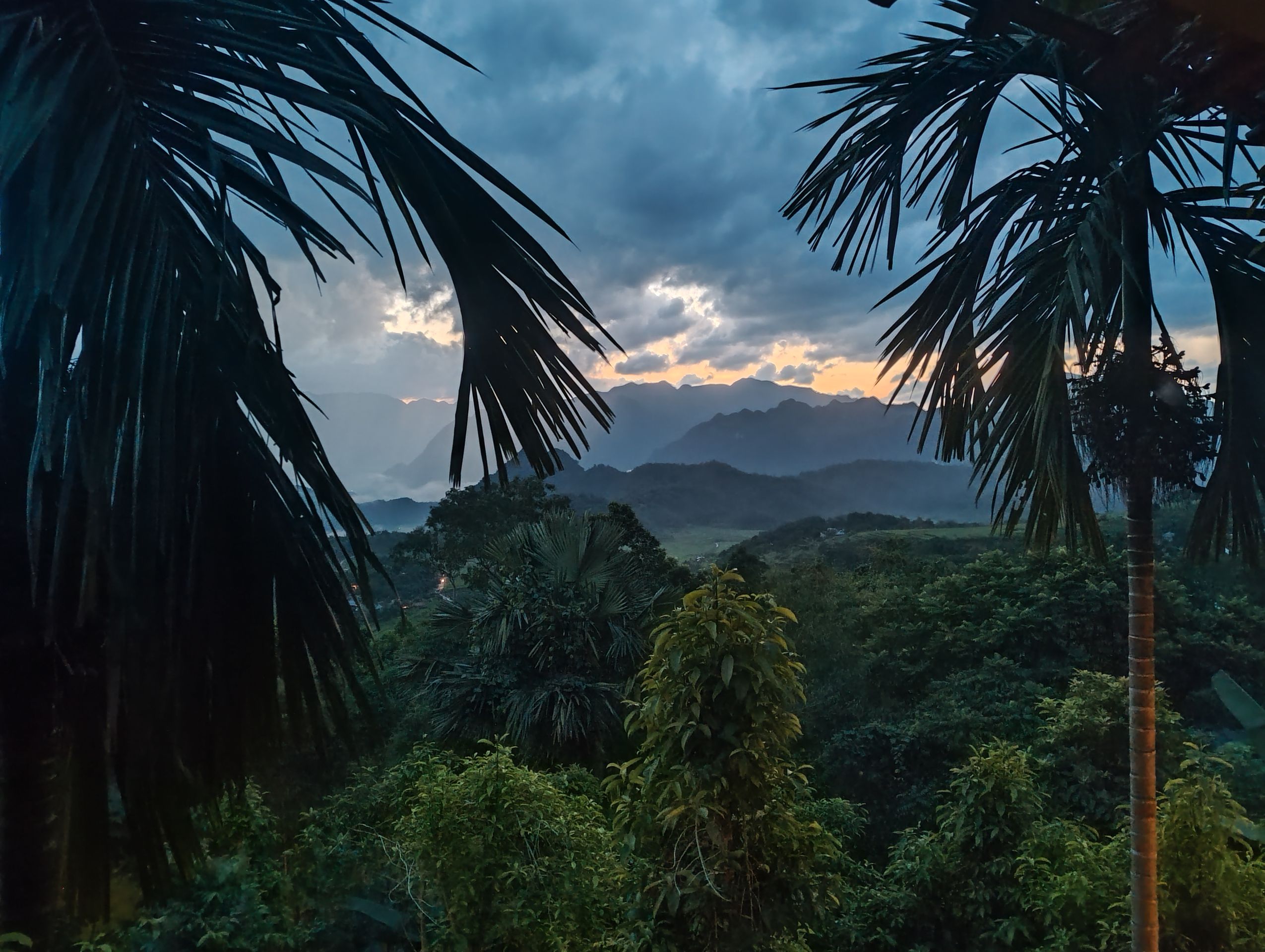
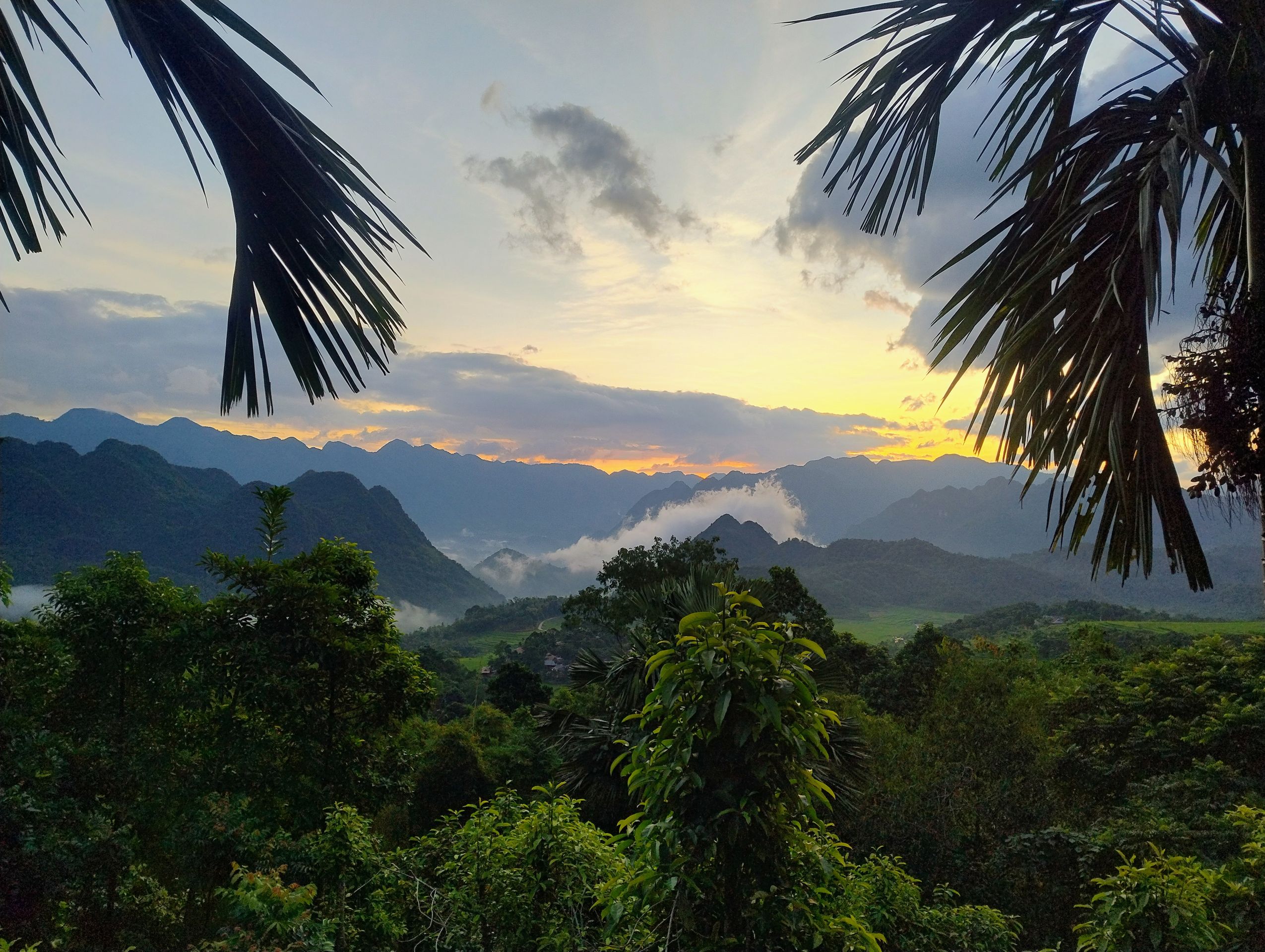
In the evening, I enjoy the no less impressive sunset over the valley, where scattered lights from houses and mopeds shine. Early at 4:30 AM, the roosters crow in time for the sunrise. So I sit back on the balcony and watch the sun rise. Low-hanging clouds break against the hills like waves in slow motion. After a short hike through the villages with a concluding boat ride, Quoc says goodbye to us and I take the bus back to Hanoi. I ponder whether I should have stayed longer.
After the idyllic excursion to Pu Luong, I notice even more the transformation of the old quarter upon my return, which seems to have taken place since 2018. Nostalgically, I walk through the streets. It no longer stinks, the streets look tidy, and where have all the little plastic stools gone? Instead, Western rolling suitcase tourists lazily sit in armchairs before clinically sterile restaurant chains. KFC, McDonald's, Haegen Daz, Zara. Saigon may have fallen in 1975, the Americans defeated. Capitalism has ultimately won in the end. The places I saved on Google Maps from before, mostly cafés and rooftop bars I found through my Lonely Planet guidebook, are either now just plain coordinates or 'permanently closed'. What was faster, corona or the travel hype? The rise is faster than some interior designers can keep up with. In a hotel I booked in the old town, the name on the glass door at the entrance is laminated. Where the 's' in Hostel used to stand, there's a gap. It was simply scraped off. That’s how you turn a hostel into a hotel.
To a Polish woman sitting in the same restaurant, I complain about my woes. She is in the country for the first time and has to listen to me lament. I tell her about 'back in the day'. How the chickens crossed the street, soups were sold from the open kitchen onto the street. About an elderly Vietnamese vendor where I put together a cola-chocolate bar breakfast for 40 cents at 4 AM near the train station. How we sat on the 20 cm high stools and communicated with gestures, my English, and his school French. How I sat at one intersection, which I no longer recognize, and watched Pho soup's chewy traffic. In it, a car had only moved 10 meters when I finished eating. I describe how when one saw another Western traveler on the street, one would briefly pause and sometimes nod, like bus drivers greet each other. I thank the Polish woman for the therapy session. Essentially, I am in the role of the Californian who told me in Tbilisi, shaking his head, how much the country has opened up to mass tourism after eight years.
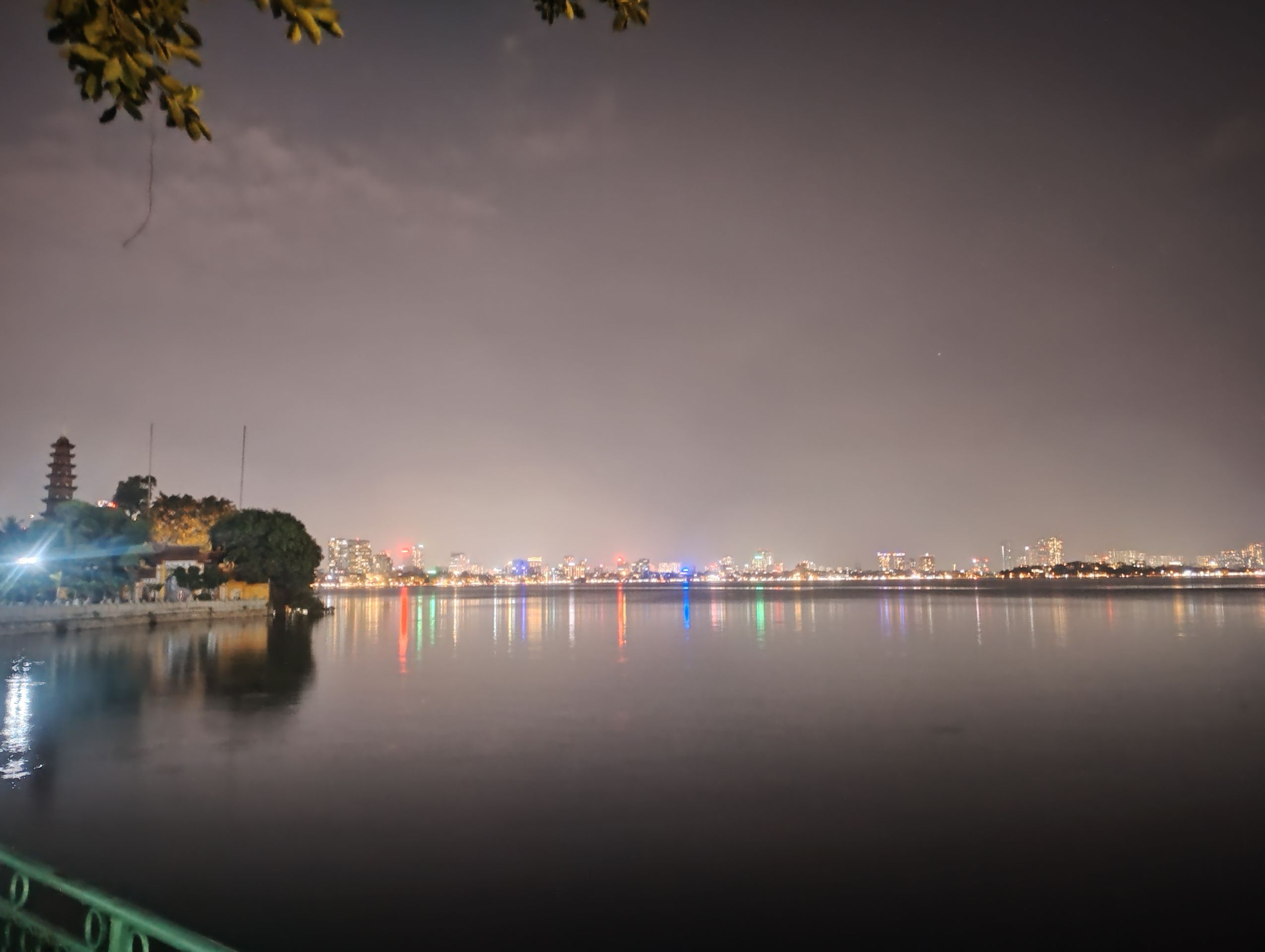
I walk through the center with misanthropic thoughts and observe the hustle and bustle. In a square, souvenir vendors throw the same neon-colored feathers into the air that are peddled in every European metropolis. Like on the Charles Bridge, caricaturists sit by the lake, ready to draw you. I could also be walking through Prague or Barcelona, the differences are marginal. A masseuse in front of her shop pauses in the middle of her video call argument and somewhat boredly speaks half in my direction her rehearsed sentence 'Hello Massahhh', only to continue in the same tone a second later. In the new 'Pubstreet', I am aggressively pushed into the generic clubs and pubs and asked if I want drugs. No thanks, that’s enough intoxication for me.
I sit in a park and watch a few Vietnamese of all ages dance. At least something has remained. The evening open-air dance lessons now take place not only to Vietnamese pop songs but also to Ace of Base. 'All that she wants', you can't have it all. And who am I to judge the changes in the country - another stone in the mosaic, that fuels demand with its travels. After all, it is also in Vietnam's mentality to adapt and utilize changes.
But does it always have to go hand in hand with gentrification, does a city have to let go of its cultural identity and sell itself to tourists and their soulless materialistic needs until it becomes unrecognizable? Can't it work differently..? Gentle tourism is possible, as I've seen in the national park of Pu Luong. In a big city, that might not be so easy.
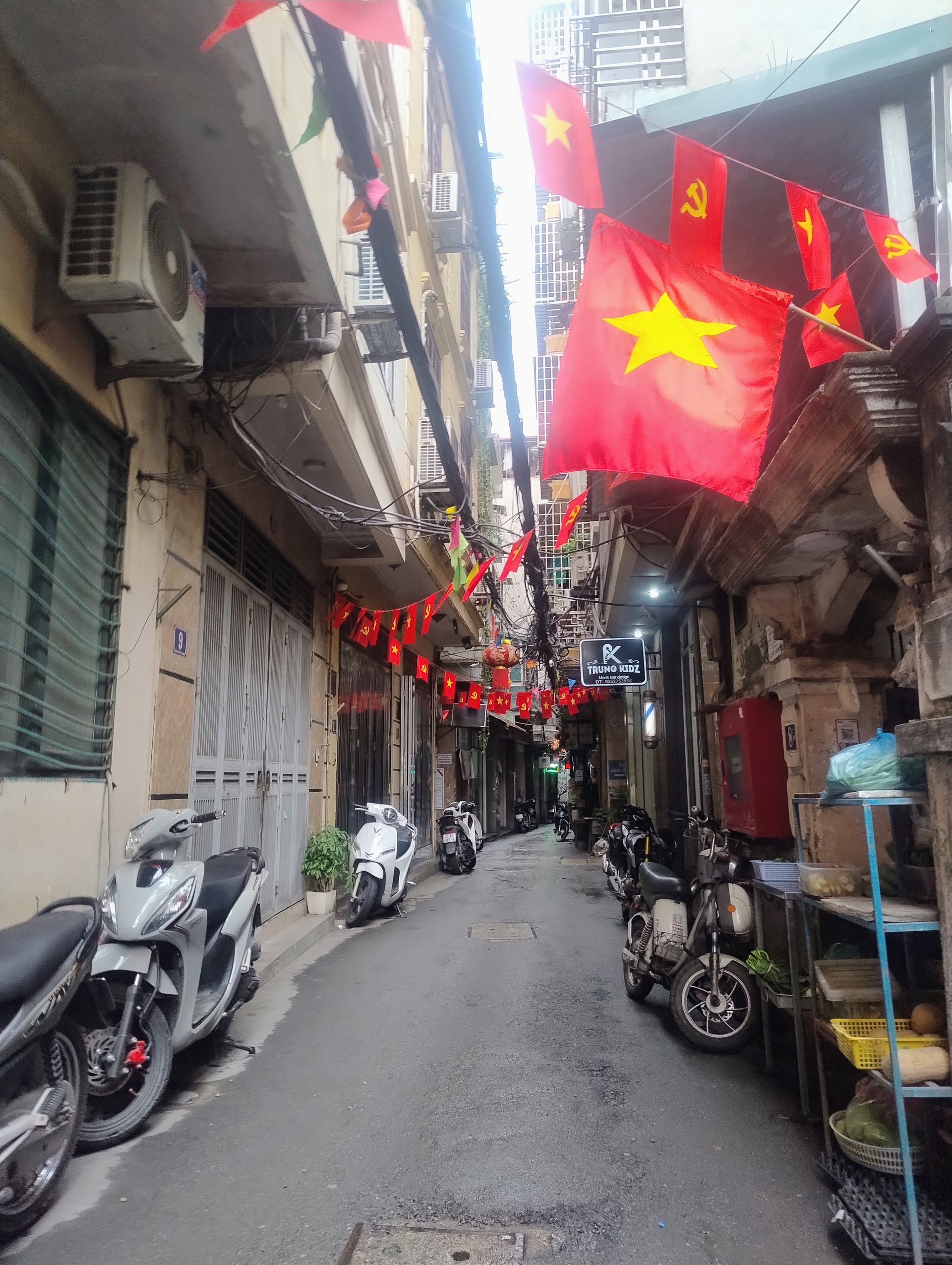
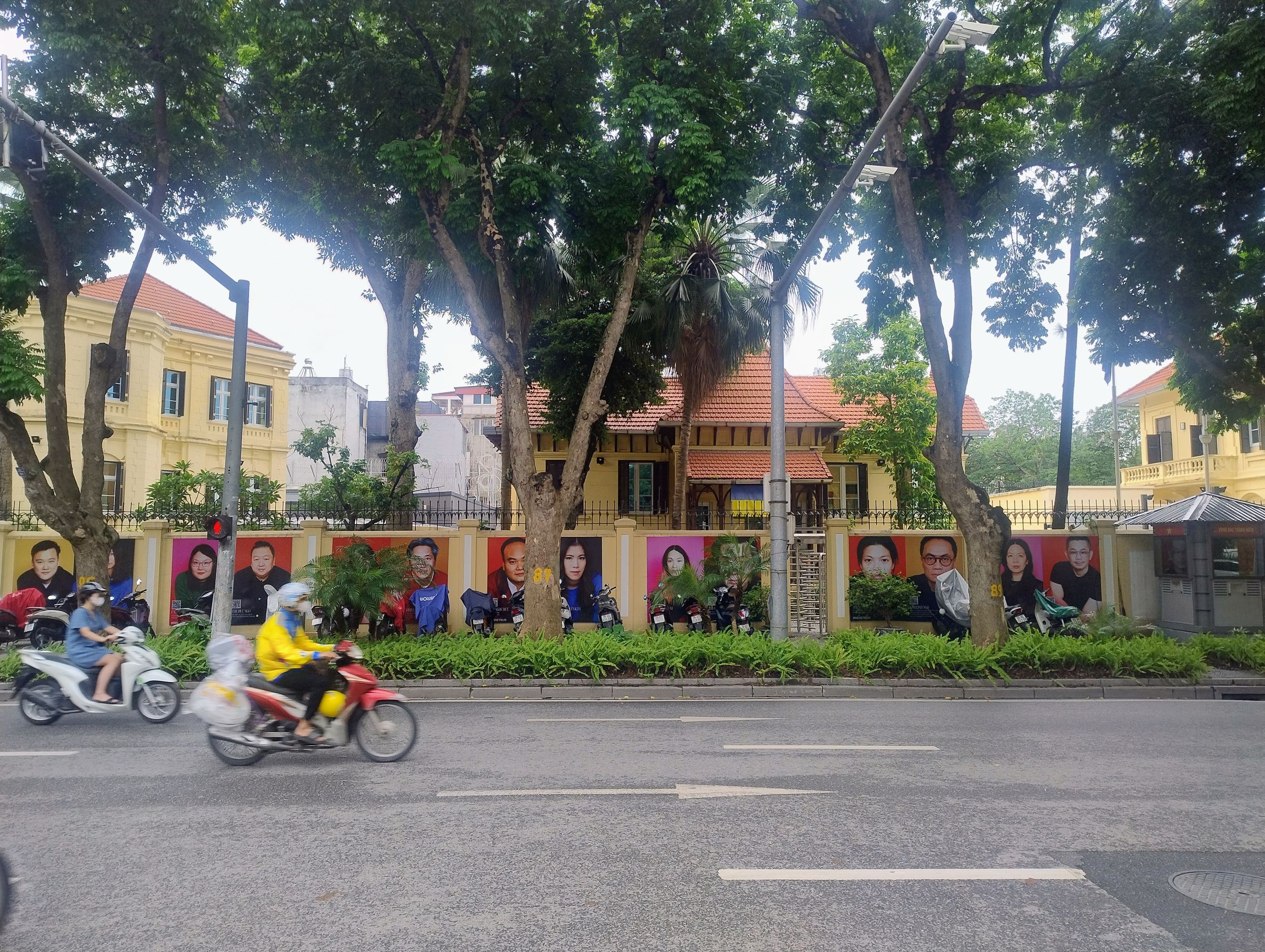
I decide to give Hanoi a second chance and book my next hotel in one of the suburbs. After all, there’s more than just the old town. I walk through winding alleys with simple shops and bistros, reminding me of the past, and I reconcile a bit with Hanoi again. In the diplomat district, I see a mural of my supervisor on a wall. The architect and vice president of the Academy of Arts Anh-Linh Ngo is represented there in front of the German embassy alongside Mai Thi, the famous YouTuber, and other German-Vietnamese celebrities.
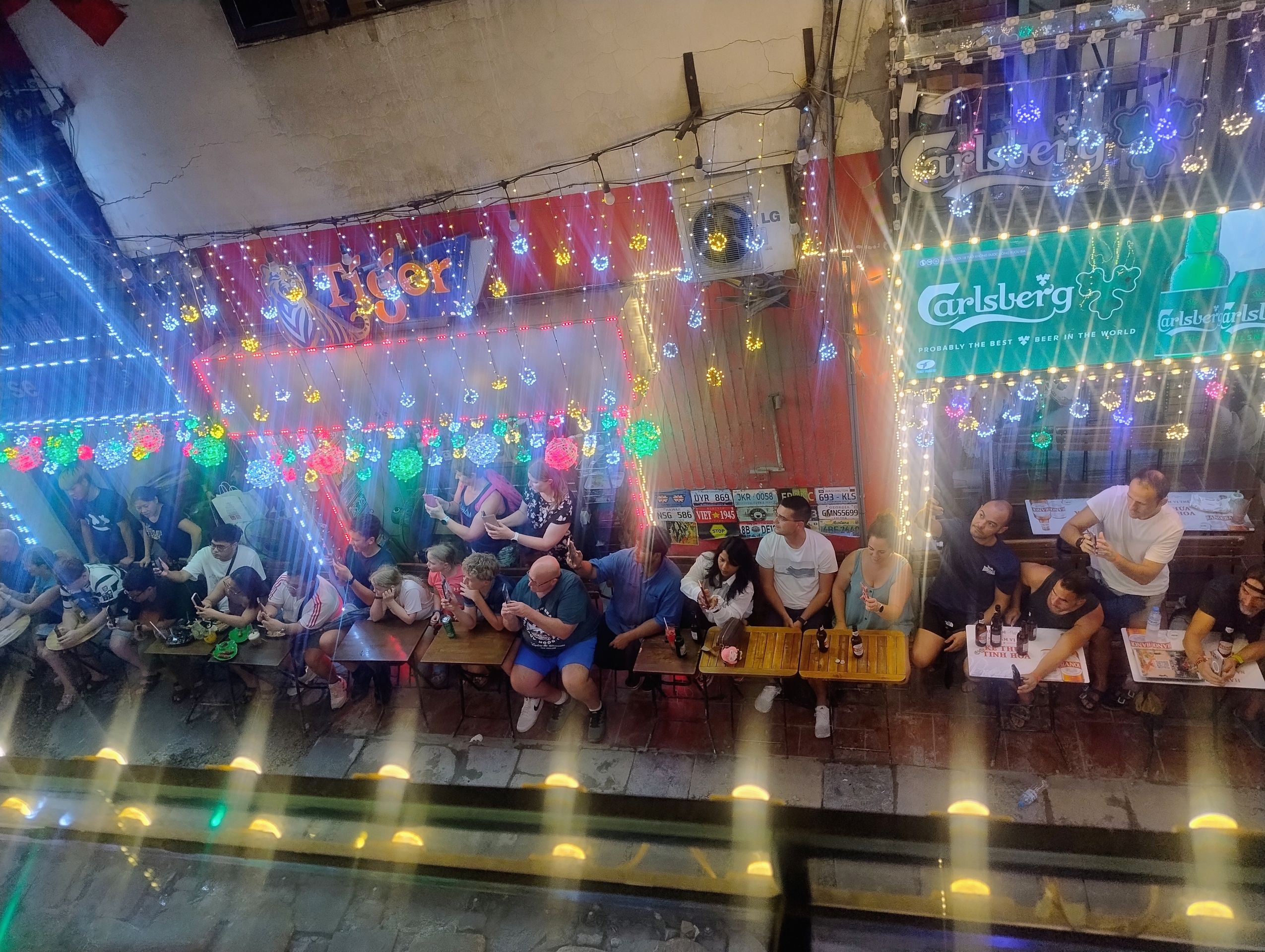
On train street, I meet the American Omar through nomadtable. We wait for the 7:30 PM train that goes through the well-known alley. Only a few centimeters away, the wobbling carriages rush past the tourists sitting in the front row with beers and cocktails. The train is twenty minutes late. Nonetheless, there is thunderous applause after it zooms by. And my poor ICE only gets annoyed eye rolls in Berlin.
Omar takes me to a language exchange. In a café, Vietnamese, foreigners living in Hanoi, and travelers regularly meet for language exchange. I hardly learn any Vietnamese but get to know Hau and Kirks. Kirks is his self-chosen nickname, which he believes sounds German. I let him stay in that belief. They both want to emigrate to Germany, she as a nurse, he as an IT worker. The Hanoians also give me a few tips for places outside the tourist zones.
I must note down the tips for next time, as my bus is taking me to Ha Giang the following day.
I was looking forward to Hanoi and found it different than I had previously known it. But I have also made peace with it. After all, it's primarily my idealized memory that has misled me. The city is not to blame for this.
As the train I took from Ninh Binh rolled into the capital, a song dramatically piped through the speakers. What sounded like a Schlager from the 70s, Shazam revealed to be a pop ballad from 2018: Le Quyen - Troi Ha Noi Xanh - 'The blue sky over Hanoi'. Much may have changed in Vietnam, but the kitsch remains the same.
May the blue sky of Hanoi always be blue, sings Le Quyen in her hymn to the city. May it be, I have never seen it blue. For me, it has always been rain-cloud gray or smog-infested.