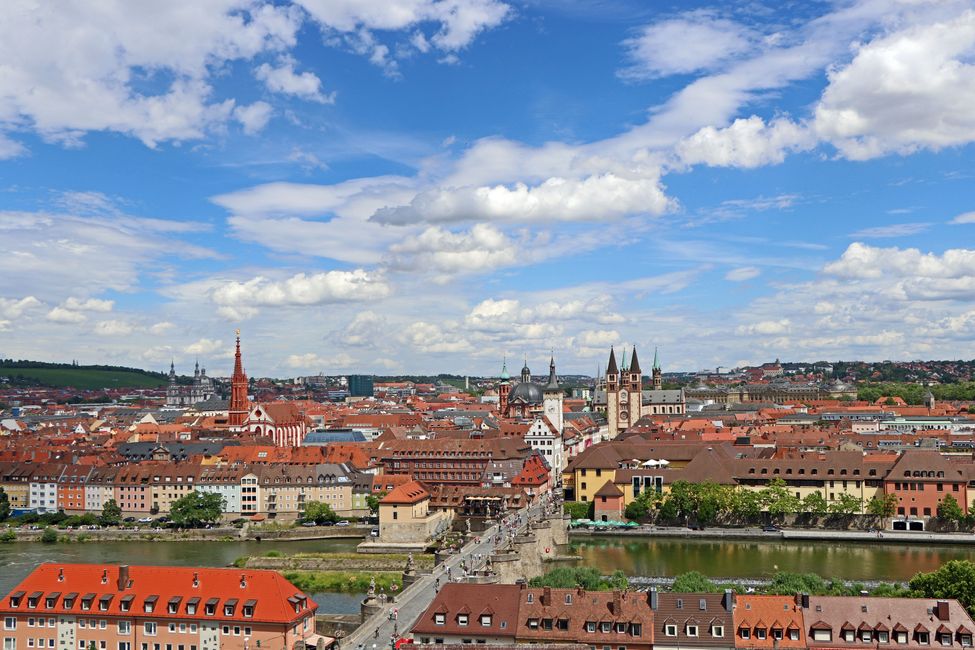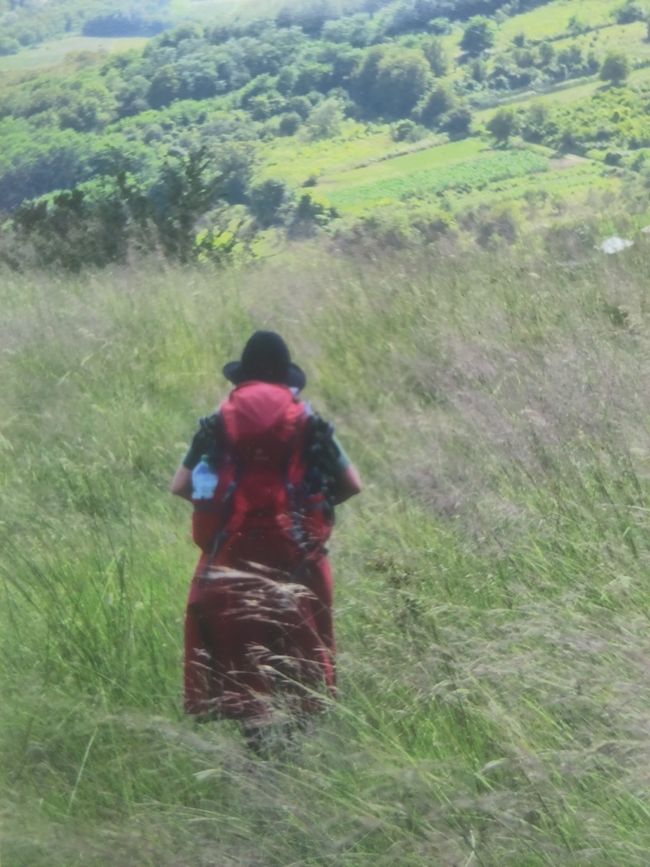
Harz National Park and further north in Germany
In the twilight of September 22nd, I was back in Niedergebra in Thuringia after yet another day of train adventures. Since it had gotten so late, I could only set up my...

Published: 15.10.2026
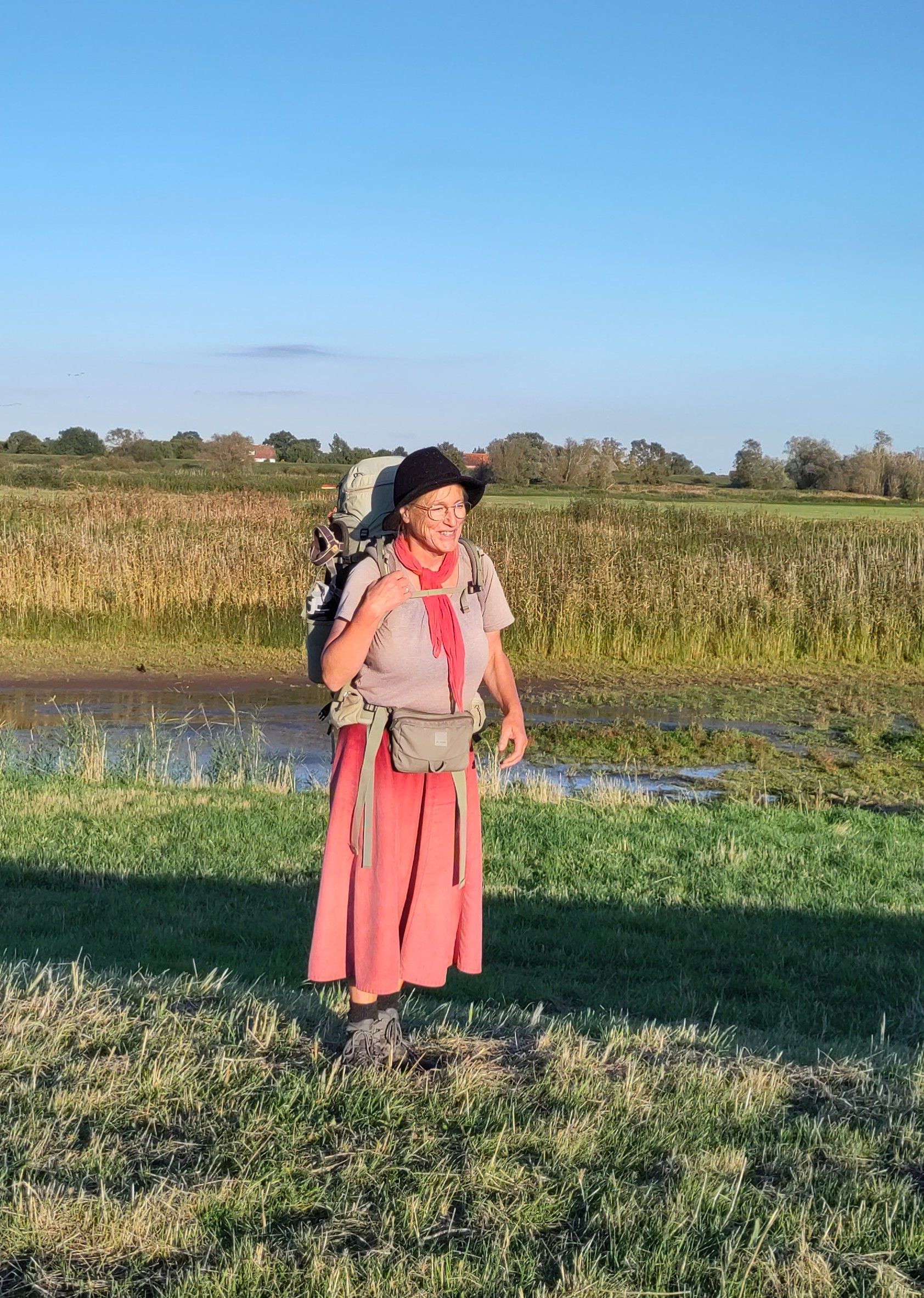
No, I did not encounter a wolf. Well, who knows, perhaps I did meet a wolf in the Göhrde, but though it was aware of me, it did not show itself. And if I'm honest, that relieves me. Although I read in the Naturum Göhrde (a lovingly furnished smaller forest museum, where I could have spent a few more hours) and at the nearby wolf center that it is a privilege to see such a shy and special wild animal, I think it may be true, but I'm still relieved not to be honored with this privilege... Likewise, I feel relieved to see vigorous wild boar tracks everywhere in the woods and fields, but none of the animals themselves. I see deer and hares more frequently, which feels neither dangerous nor unsafe, just beautifully thankful.
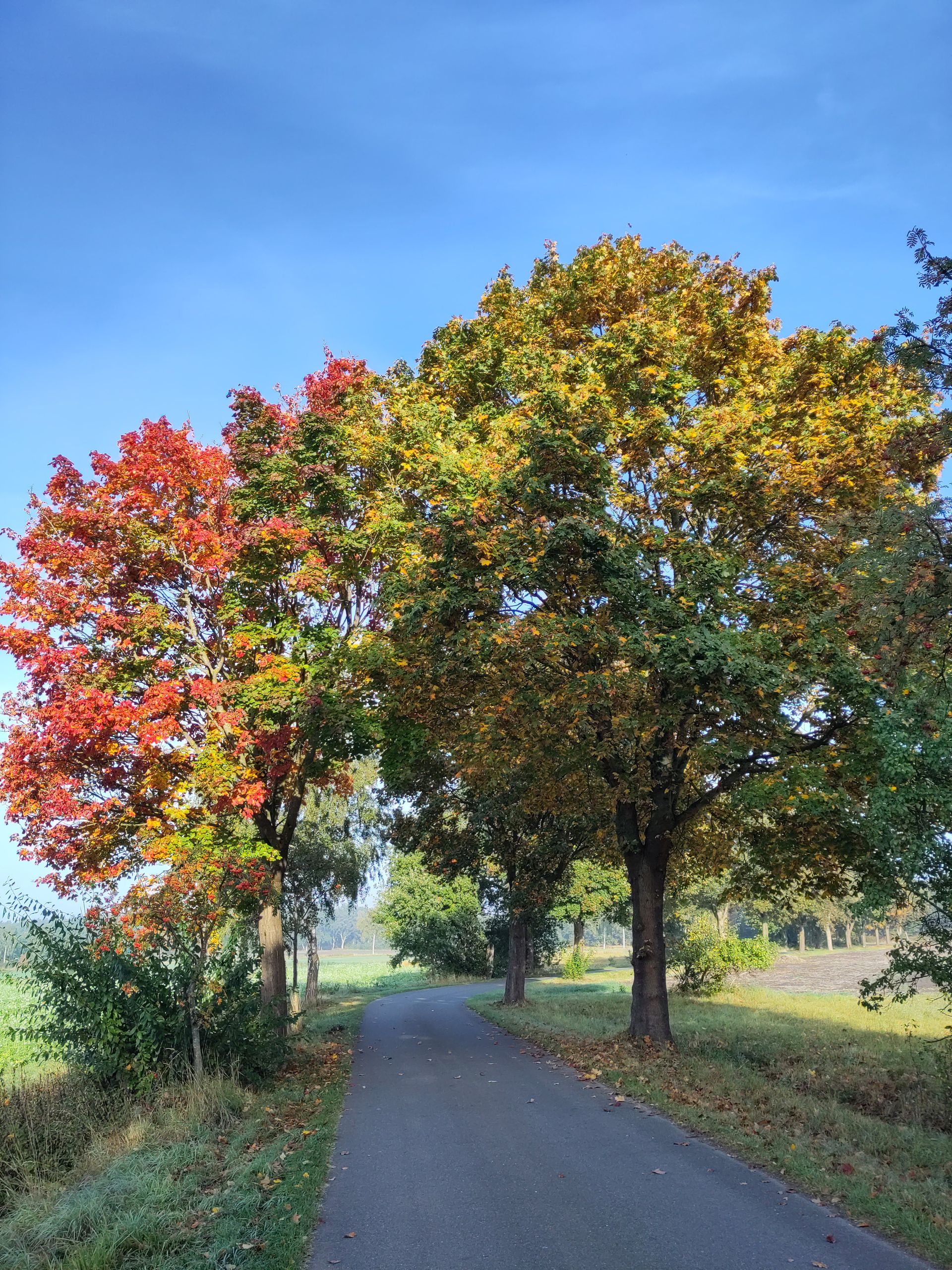
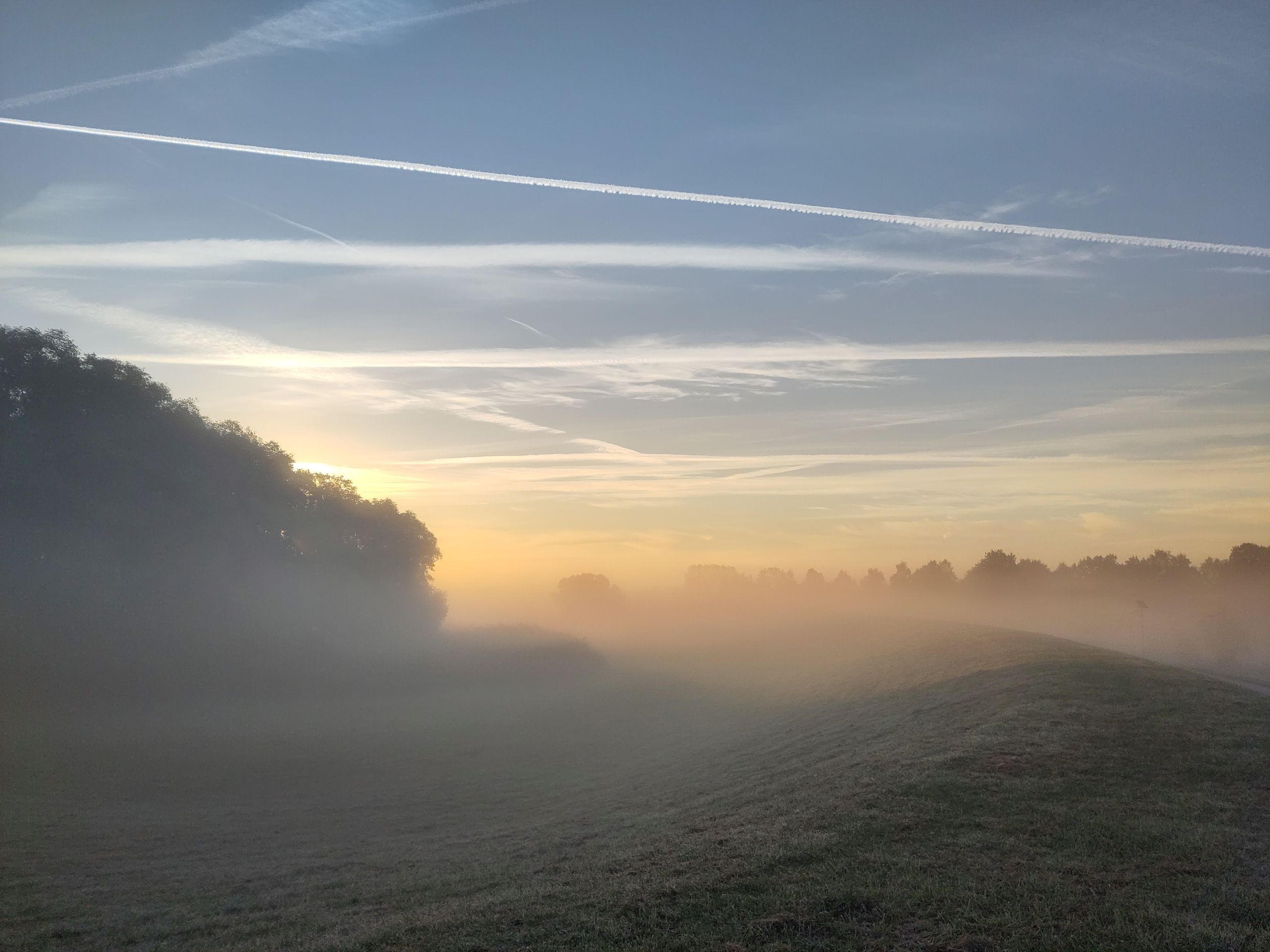
It's October now, definitely autumn. Thick morning fog, on some days golden sunshine, often only in the evening hours before it (ever earlier) sets. In this special landscape in the north of Germany, in Lower Saxony and then Schleswig-Holstein, the air these days is filled with the longing calls of wild geese, which form hundreds of long chains and arrows in the sky, especially over the Elbe.
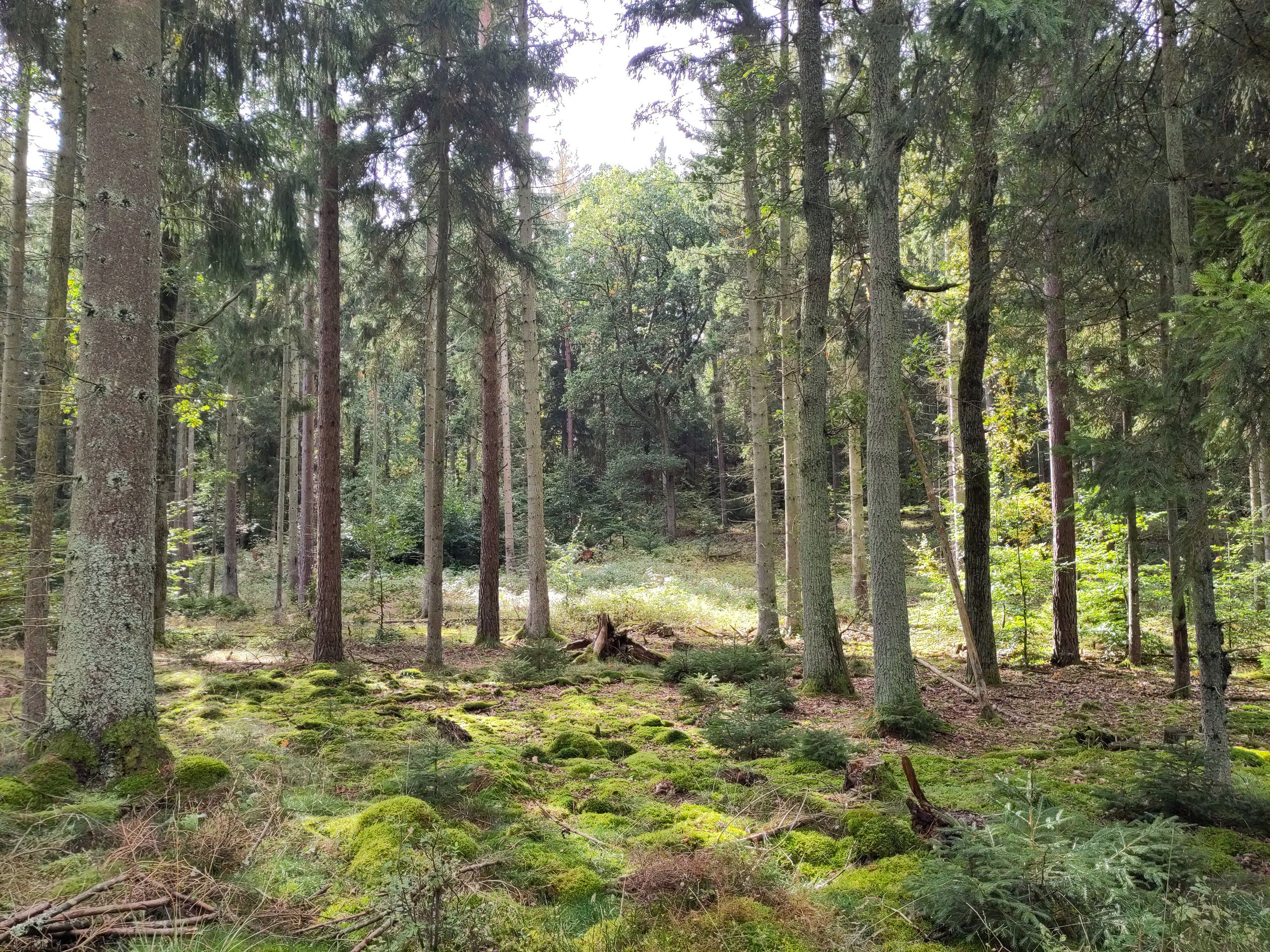
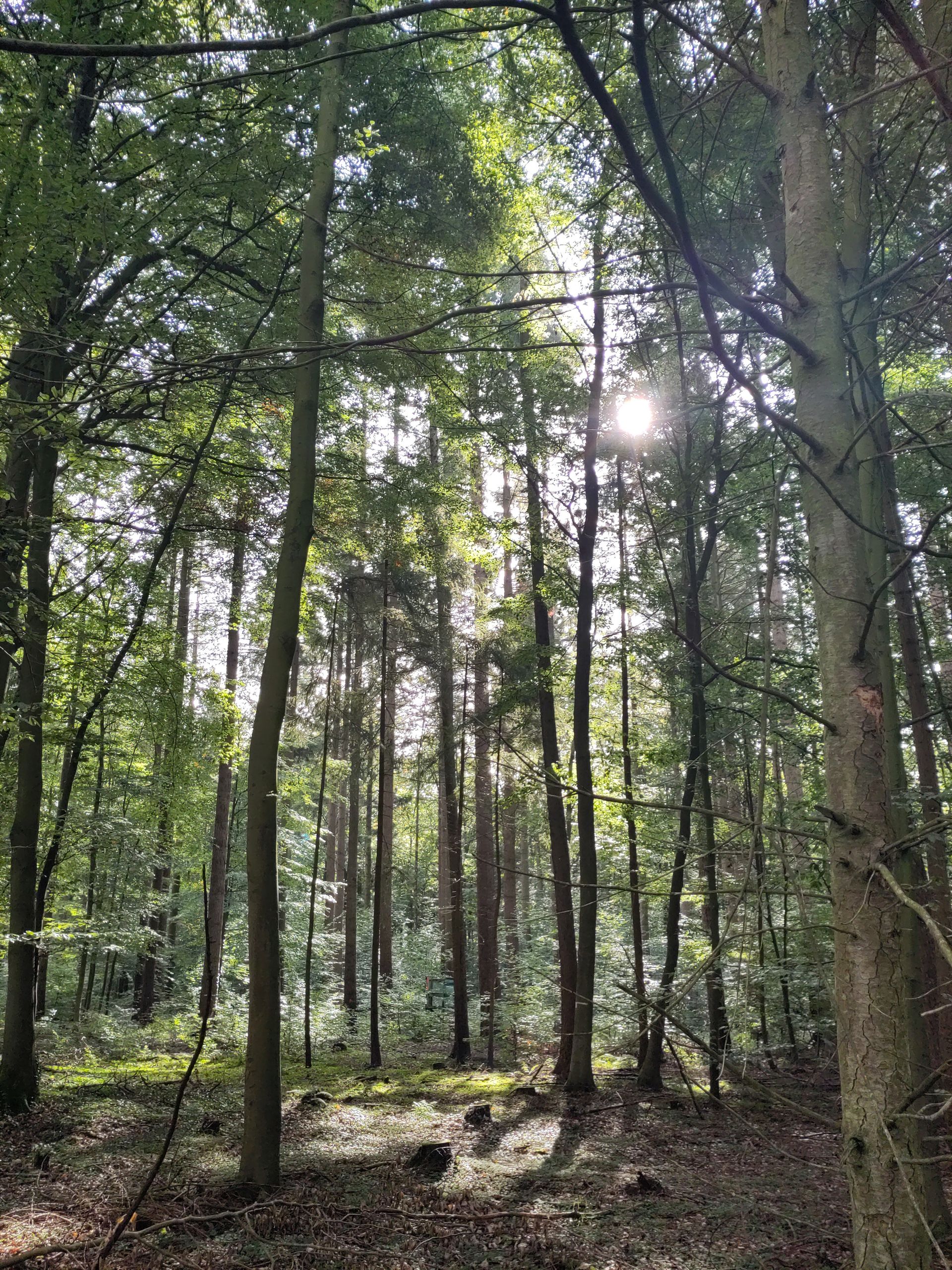
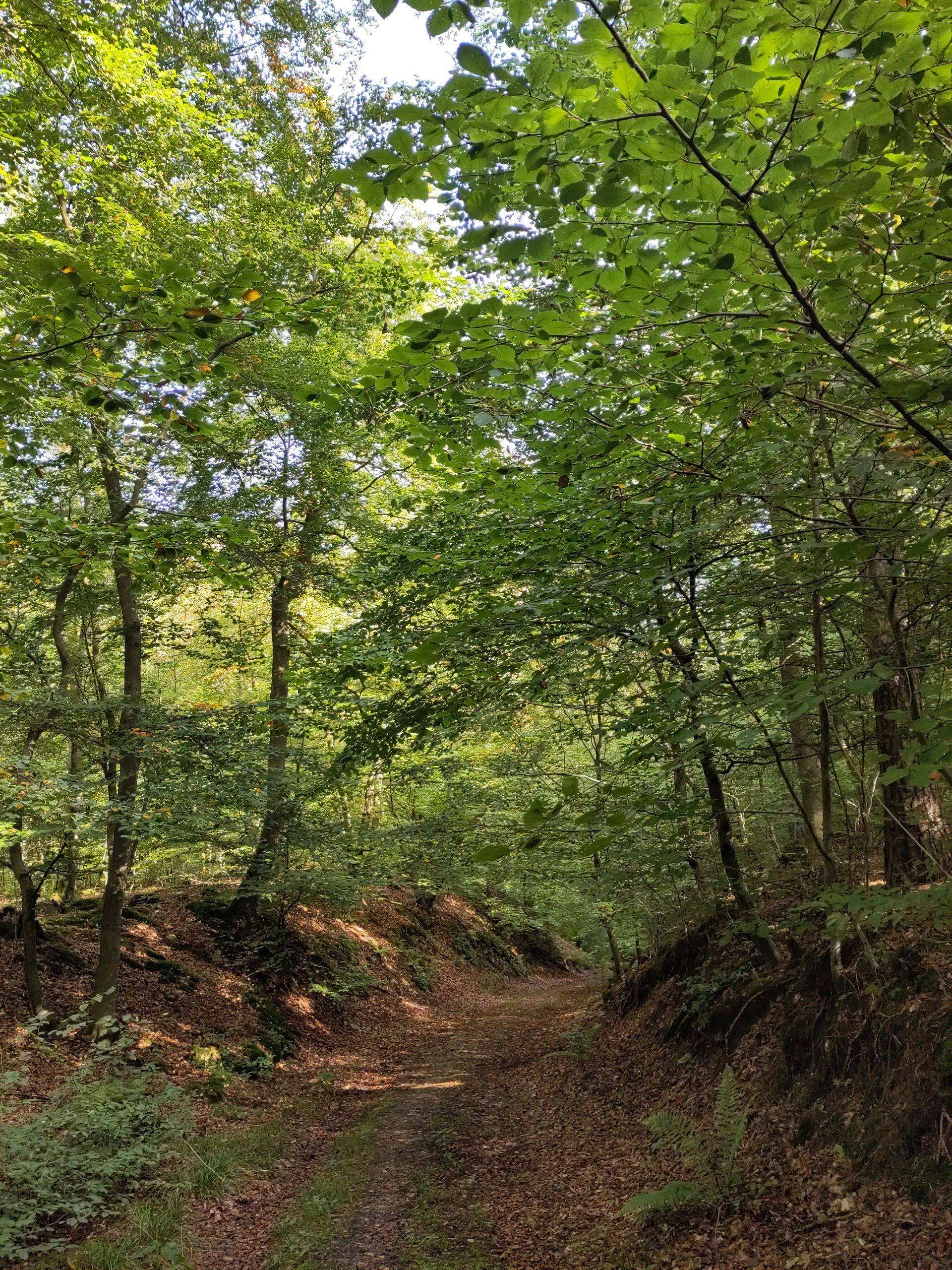
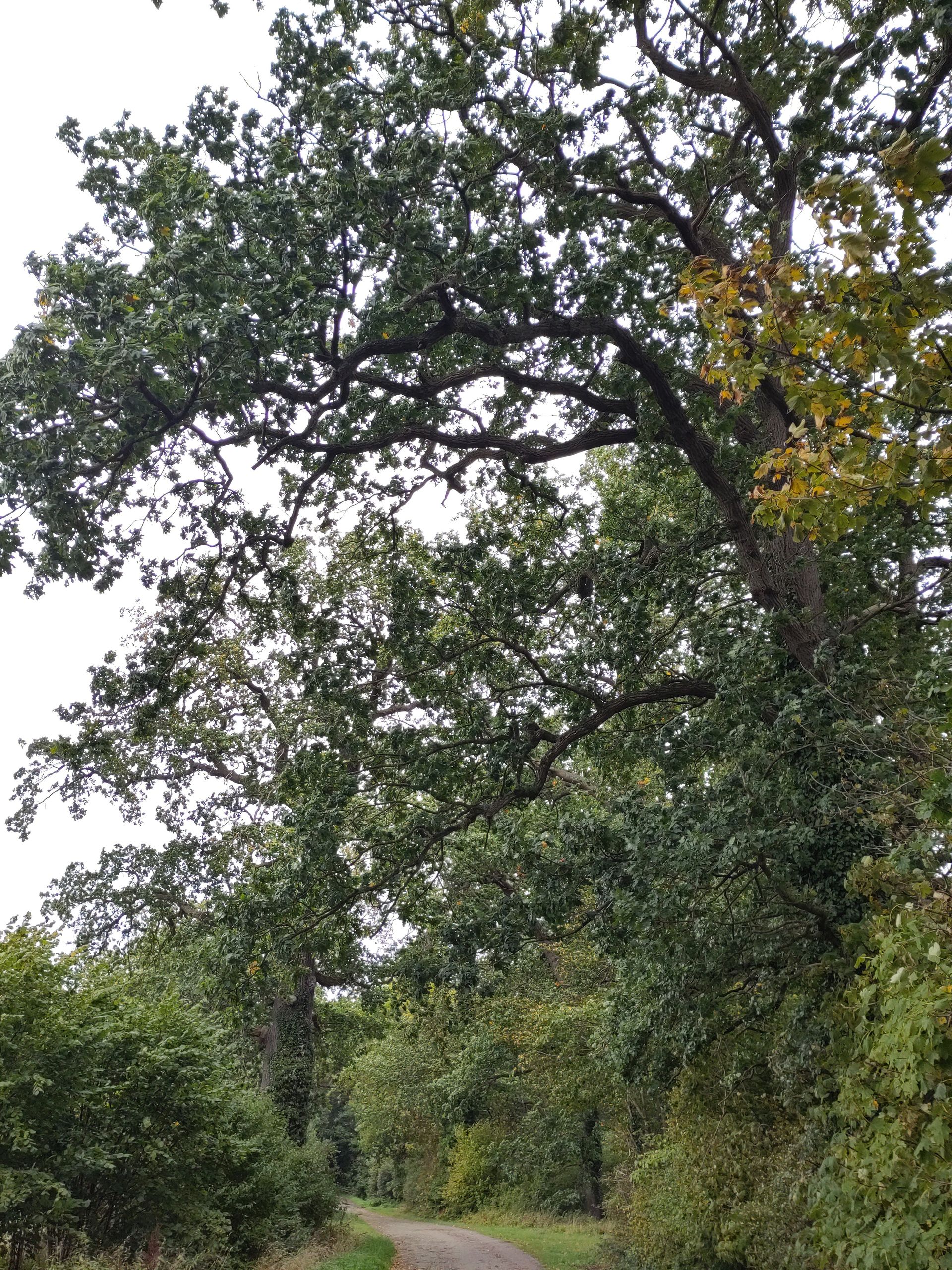
So, I wandered hour after hour through the Göhrde with its great old oaks and beeches. Heather, pines, mushrooms, sandy paths where rainwater stands in holes dug by wild boars. Darker, gloomy areas and bright spots where trees stand far apart, with grass or moss covering the ground. In such a bright fairy-tale forest area, I encounter an old couple gathering porcini mushrooms. A longer conversation ensues with the woman, at the end of which she confesses to me that she simply loves coming to this part of the forest, which she cherishes with all its moss and mystery: 'searching for mushrooms is much more important than finding or eating them' - and as she speaks, she shows me, almost apologetically, her nearly empty basket.
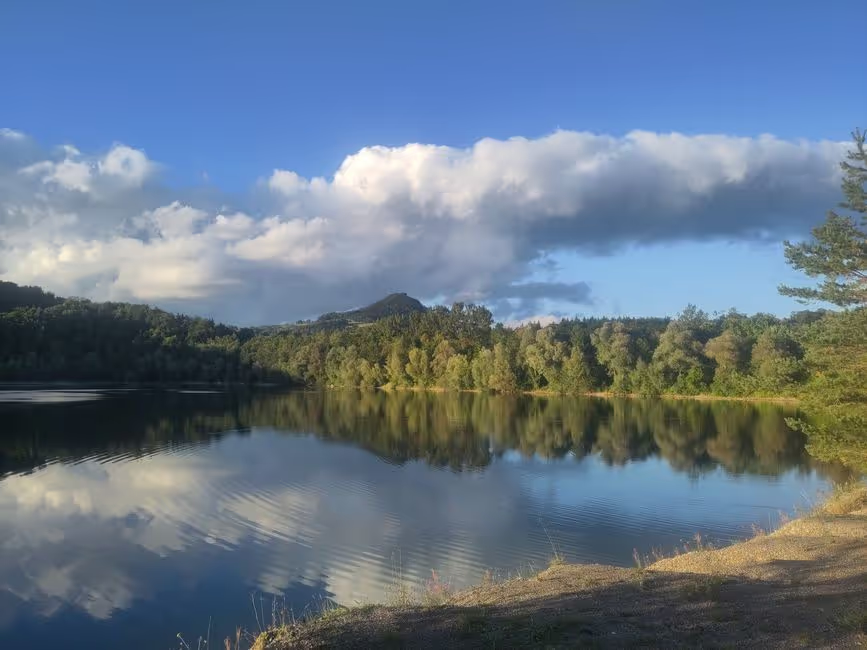
In the 'Naturpark Wendland-Elbe', I am allowed to spend the night quite uncomplicated and free of charge at Michaelshof in Sammatz, a large anthroposophical farm and garden community with beautiful gardens, a forest lake with a fountain, and (of course) an ancient oak. On a meadow, the surprising, comforting sign: 'Walking on the grass is permitted'! It is a holiday (October 3rd) when I arrive there in the evening, and many visitors are among the animals, in the gardens, at the courtyard café, and the farm shop. As the sun sets, it gets quiet, the parking lot empties, and I am thankful to still be able to sit by the forest lake in this descending tranquility until it becomes dark and cold, and I crawl into my sleeping bag.
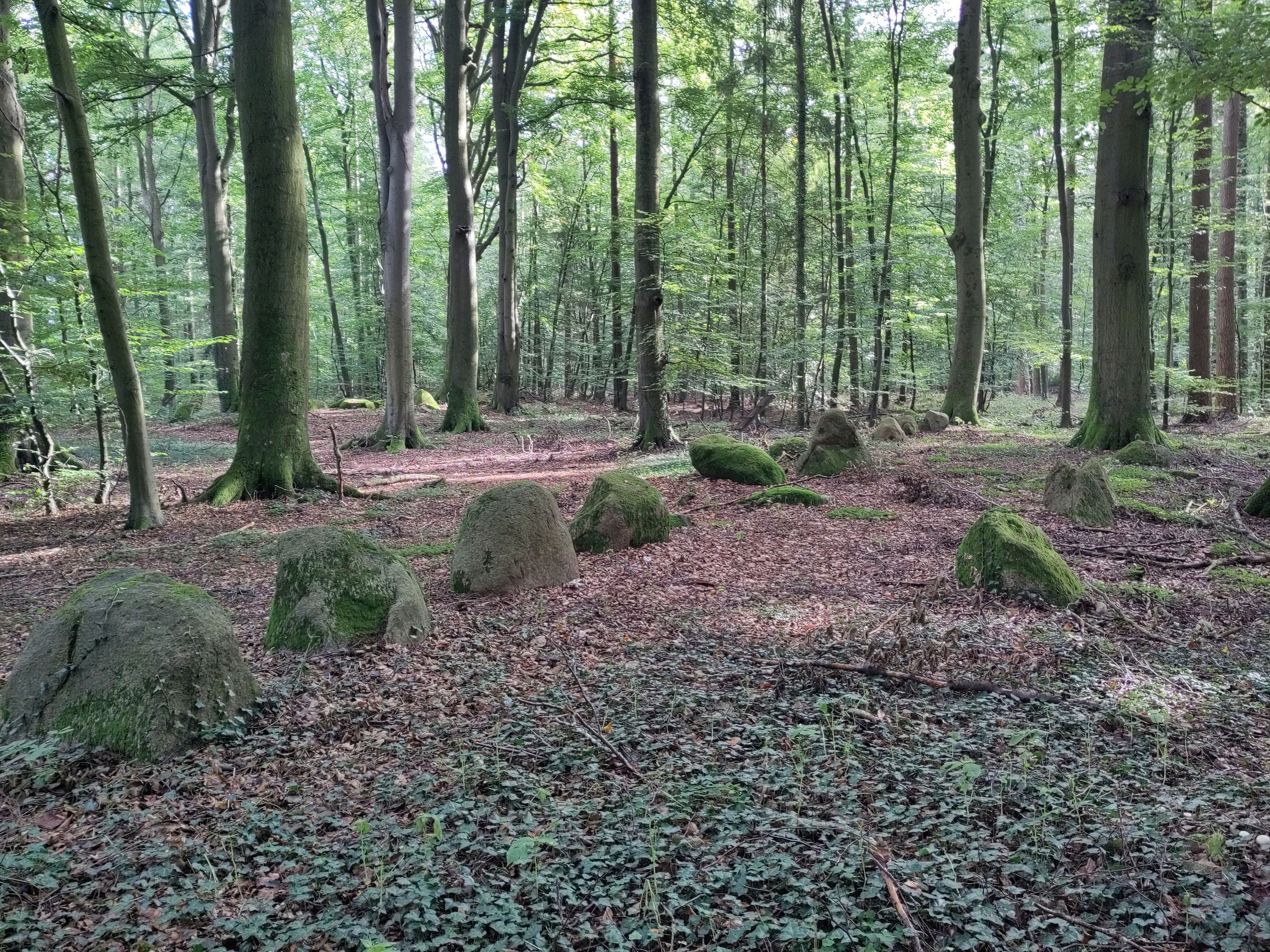
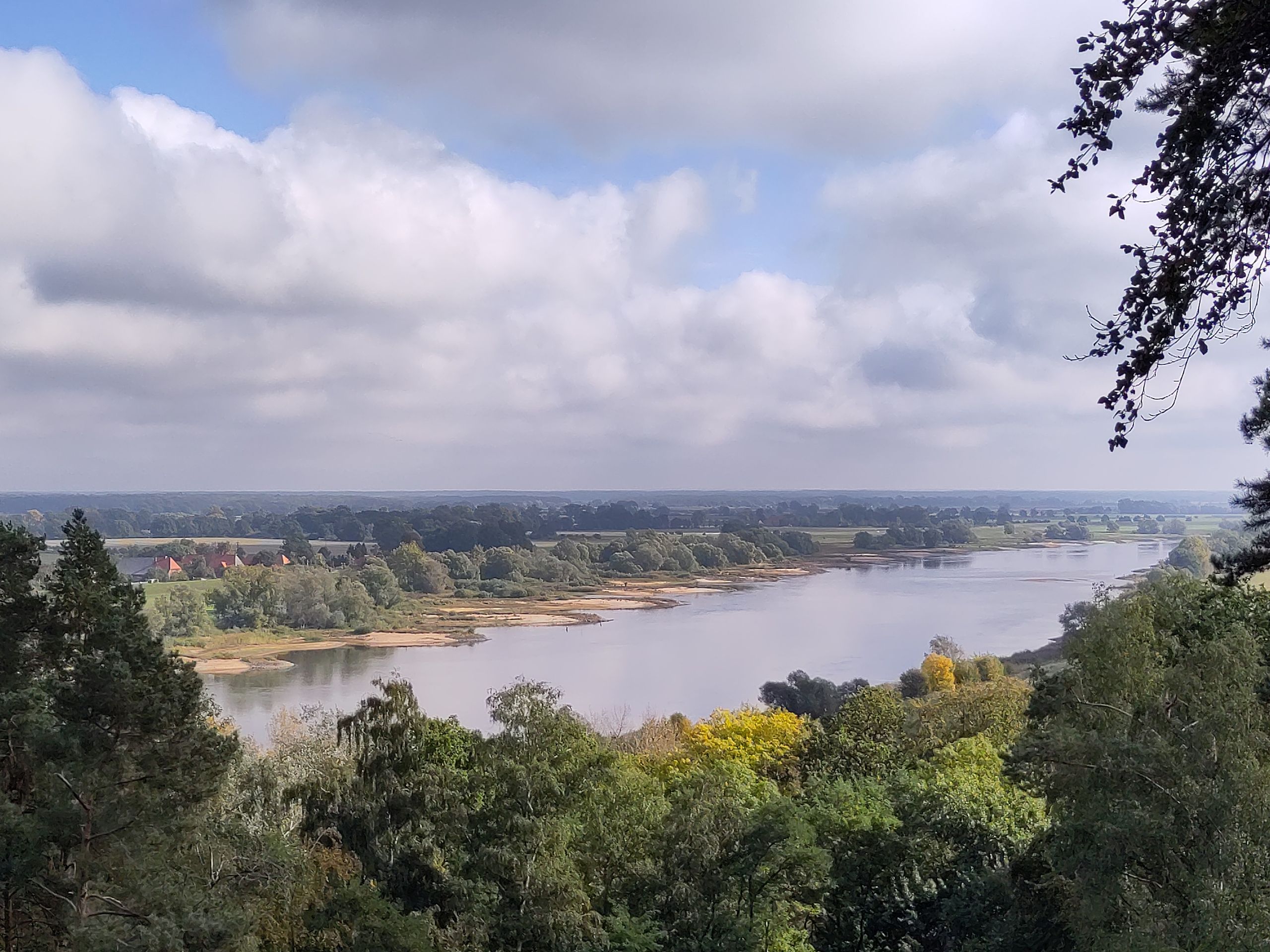
'Biosphere Reserve Lower Saxon Elbtalaue': The landscape becomes more undulating towards the Elbe, and at the 'Viehler Berge', it rises steeply in the forest to 60 m, before the view opens wide across the plain where the Elbe glimmers and shines at many spots. In the middle of the forest, in the Schieringer Forest, I find 'megalithic graves', heavily moss-covered round stones that form ovals of truly gigantic proportions. They are (at least in the damp, cold weather) mysteriously gloomy places full of ancient-moving energy, where I linger for a while to absorb and experience some of everything that still lives behind the present face of the landscape, in terms of history and past...
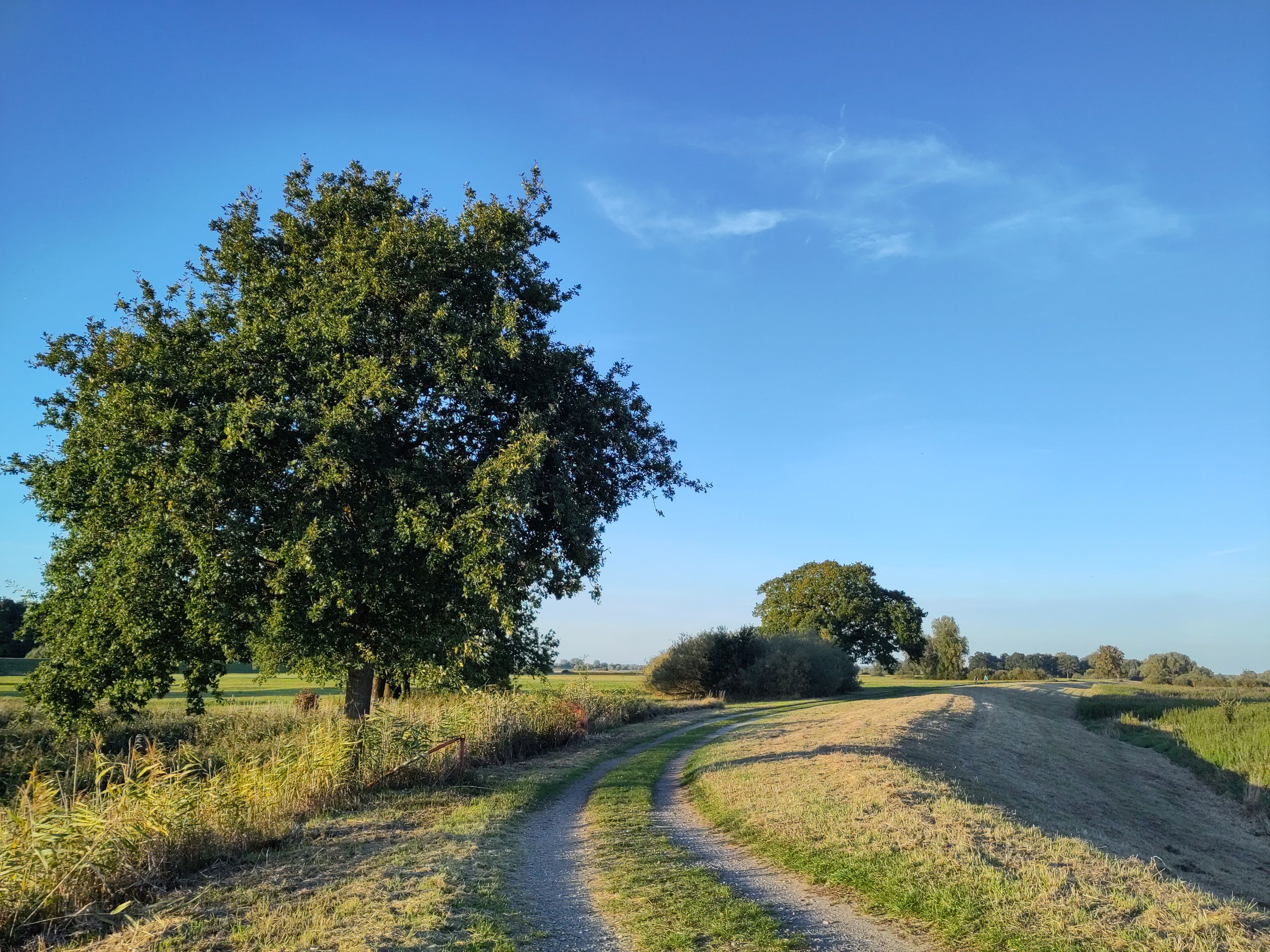
I descend again from the Viehler Berge below 20 m elevation and reach the dyke. A sign for the E 6 states: 'The European long-distance trail is led along or next to the dyke until the railway crossing in Bleckede. There are hardly any options for markings. Therefore, the dyke serves as a help for orientation.' In Bleckede, a harvest festival is just finishing when I take a look into the brick church. The altar area is beautifully decorated, and the older celebrants warmly invite me to join them for tea and sandwiches. Wandering in the now still October-golden evening light on the 'Sommerdeich' through the solitude of the Elbtalauen: sheep, herons, and other waterfowl, with the air constantly filled with the calls of migrating birds, sparkling water surfaces, large old willow trees, and now and then, I am startled when a hen pheasant takes off loudly and with a fluttering noise right next to me. As it gets dark, I fortunately find an open door at a shed, where agricultural tools are, but which, according to the posters and drink price lists on the wall, belongs to the fire department. Even a broom is ready so that I can nicely clean the concrete floor for my bed...
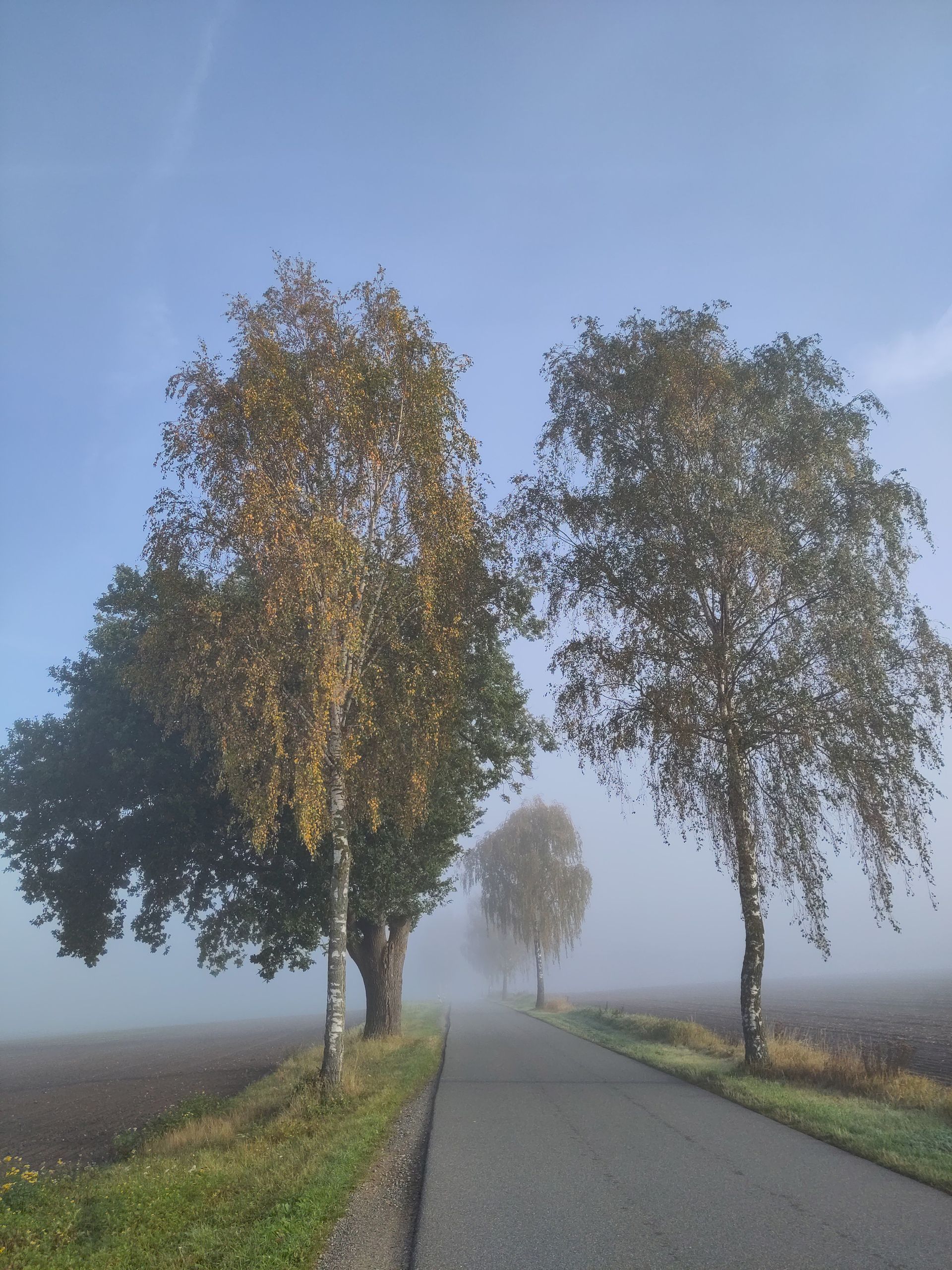
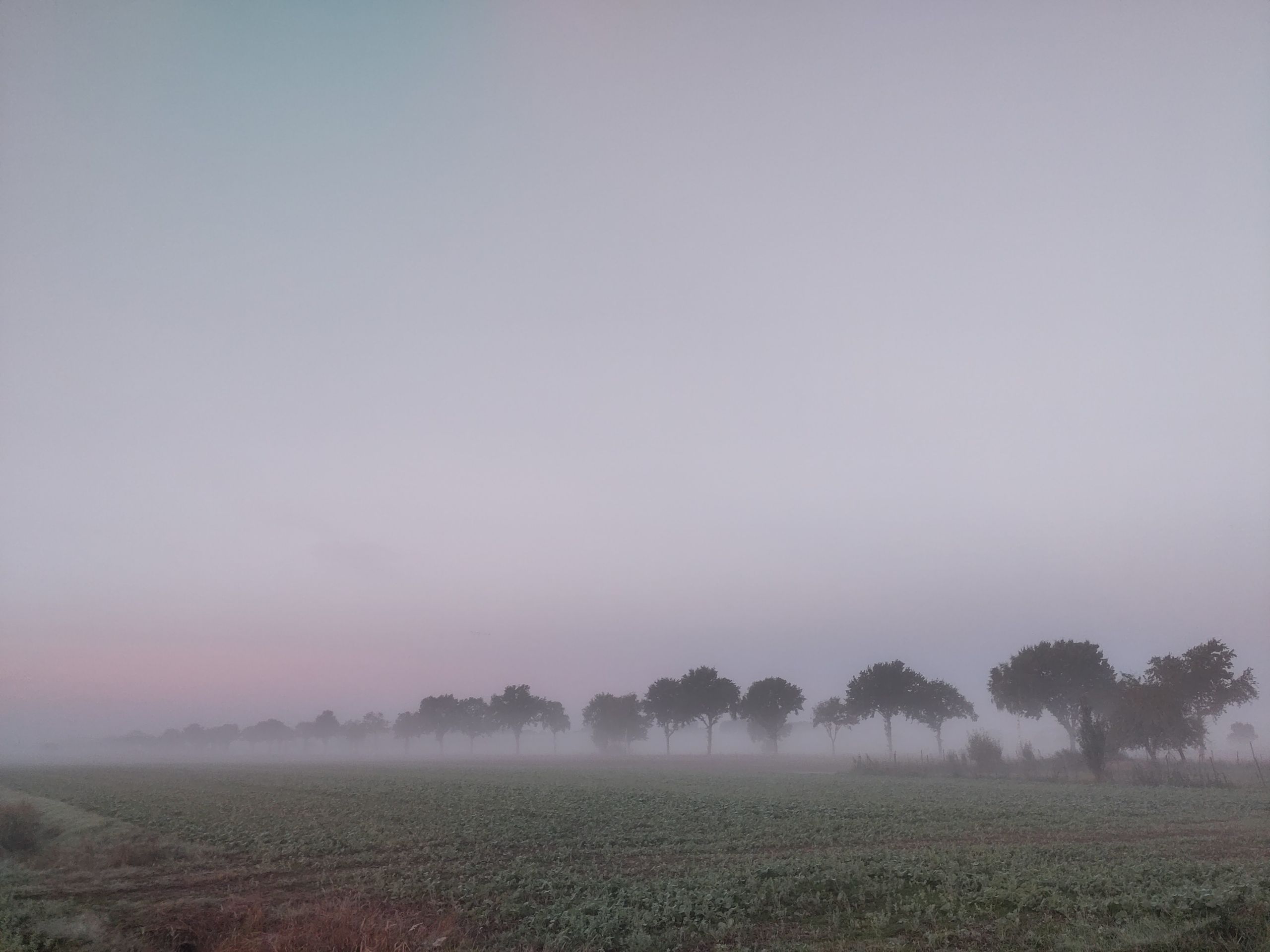
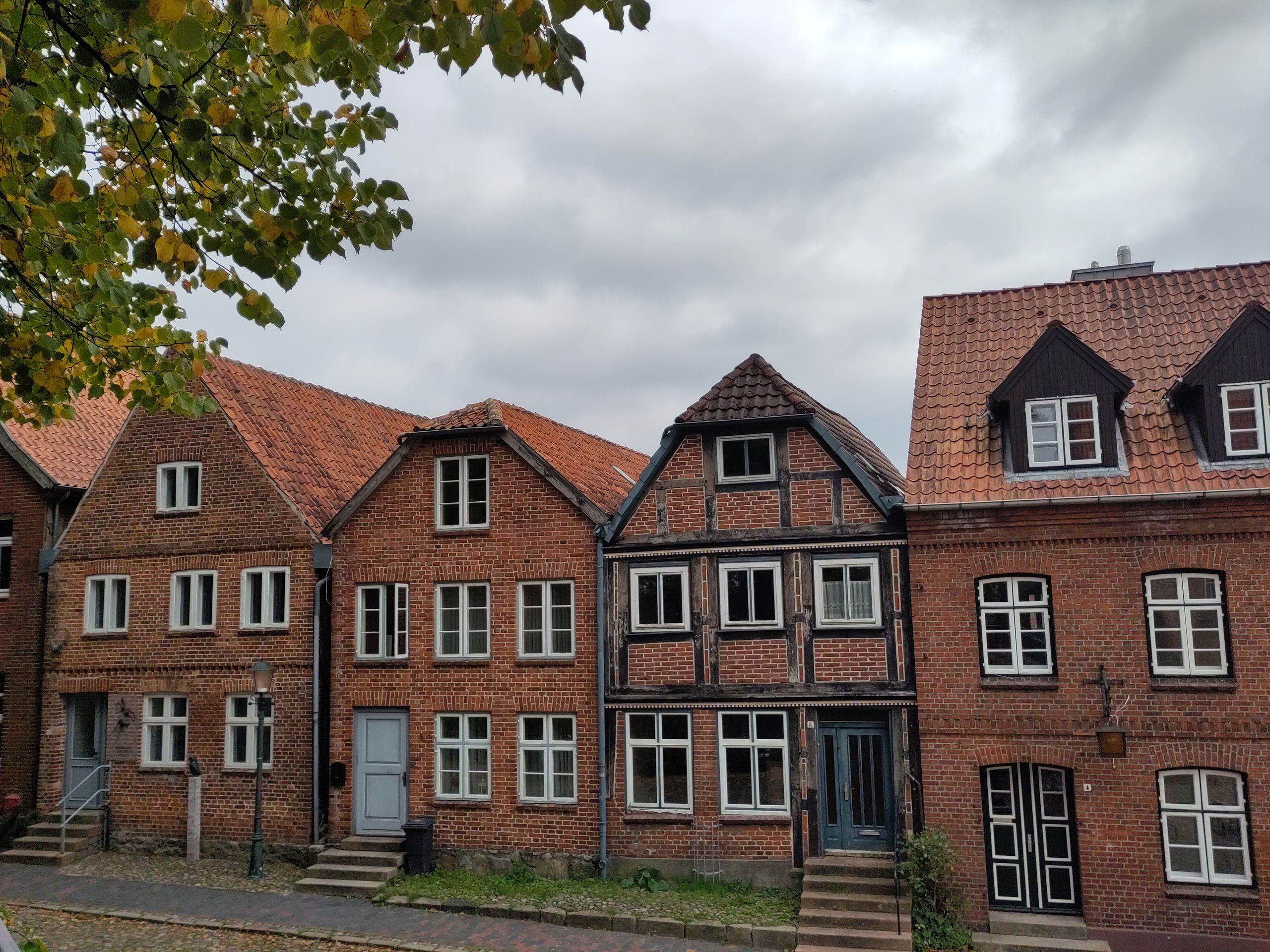
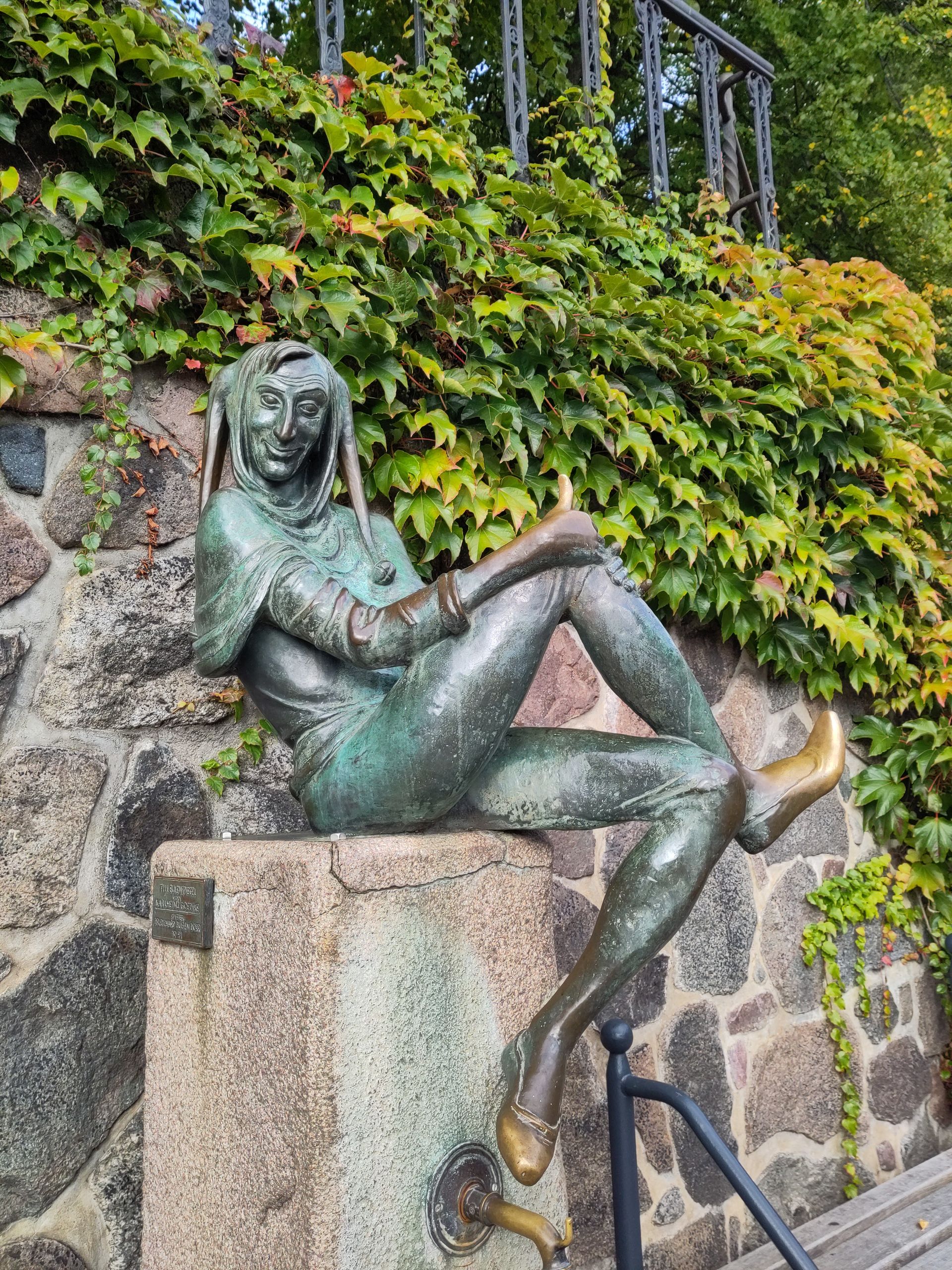
And again all the cold beauty of an autumn fog morning over bare fields, where the rows of trees ghostly vanish into nothingness. In the tiny village of Radegast, next to the pretty (unfortunately closed) church and the former stately parsonage, stands a low, gloomy thatched house: the pastor's widow's house. It reminds me once again how fortunate I am to be a widow today (if it has to be that way) and not in earlier times! How different my widow's life would have looked just a few generations ago... So I am much more than happy to be out with (all day long) wet shoes, greeting the hare and the deer, who do not let me disturb them, and quickly walking 'Up, n Diek' towards Lauenburg. Just before eleven o'clock, already in sight of the large Elbe bridge and in the now shining sun, a camper invites me for breakfast coffee. Another one of those lovely encounters on the way, before I cross the Elbe, along with the Elbe-Lübeck canal and thus head to Schleswig-Holstein. Picturesquely, Lauenburg’s brick old-town houses are lined up along the shore. The stately church: of course closed! Similarly, and that really annoys me, the church in Mölln, where the tombstone of Till Eulenspiegel is located. According to the tourist office, the lady who voluntarily opens and closes the church is ill. So I only greet the monument of the famous 'fool' under the linden tree named after him (a modern, somewhat tasteless joker has adorned him with a pink lace bra - when I pass by there again an hour later in a nice little tea house, Till is again 'unclothed'. However, there are many beautiful hiking kilometers between Lauenburg and Mölln, by lakes and in the woods, and for me, a night in Götin. Oddly enough, this hamlet is pronounced Götin (like Eutin), as I am told by a local who should know. Why it is written like a goddess but not said as one remains a mystery of the Schleswig-Holsteiners; I am just grateful that the fire department built a semi-open pavilion on the meadow behind its fire station. I arrived in the darkness, found nothing suitable beforehand, circled around the forest at the edge of the field, since it was already too dark within the woods, I saw this 'shelter' on the map - and now I could settle into a spacious accommodation, even a table stood on one side so that I didn't have to sleep on the ground. A nighttime view of the wonderful starry sky directly while lying down included. In the just-brightness of the next morning, I take a photo of a stately large organic farm building. I must have come too close to the farm property for the taste of a big black dog, anyway, he appears quickly and silently and startles me no less than the wolf at the forest edge did in the darkness of the previous evening - with the difference that I had internally calculated this fright covertly and was relieved when the streetlights of Göttin shone in the distance, while now I feel completely carefree and think myself safe in the light of day and the village. Growling threateningly, he guides me a good way down the little village road away from his farm, before finally turning around, and I leave the place relieved, though still with a heart pounding with fright, without looking at any more houses for their photographic suitability...
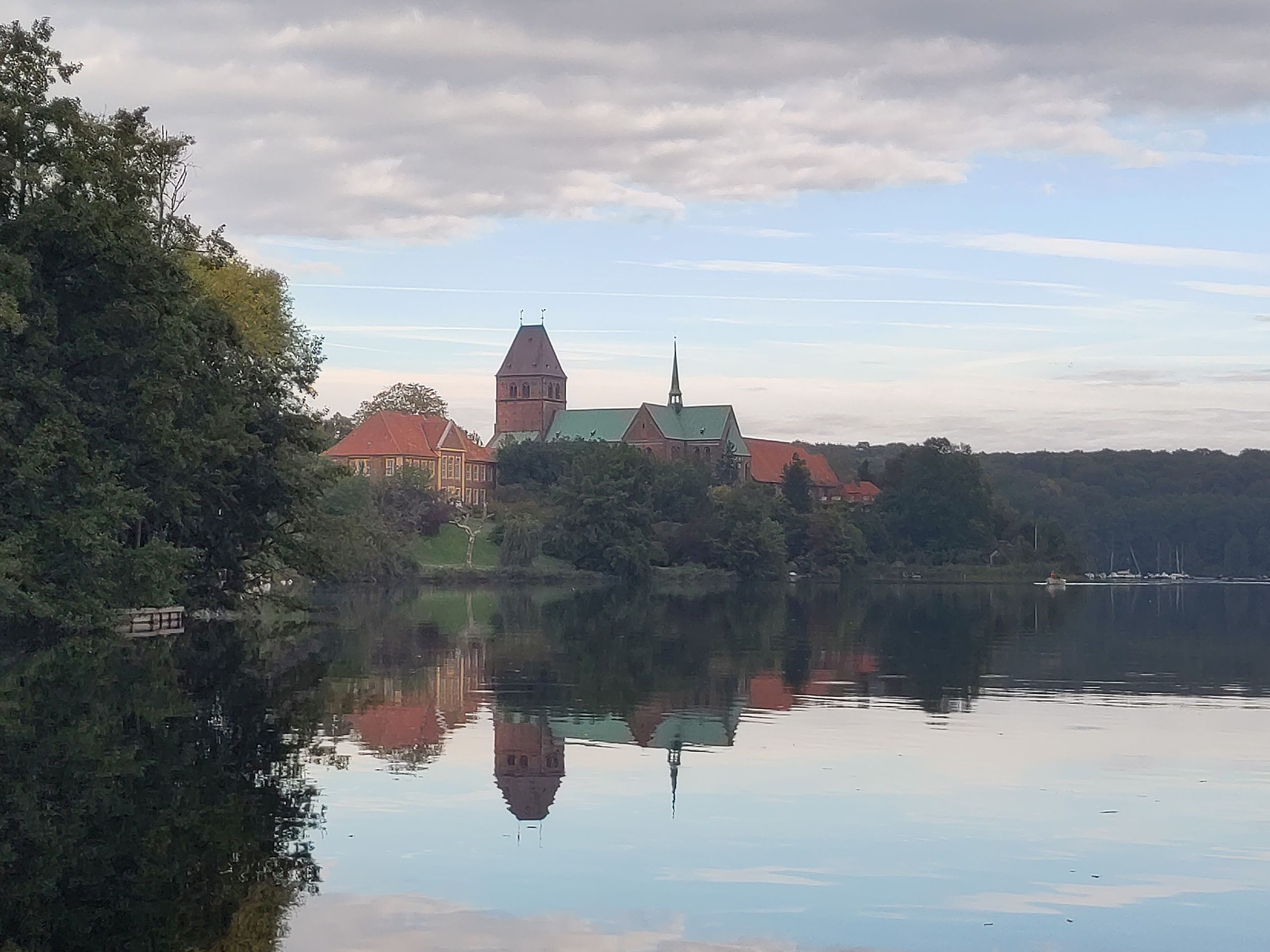
The nature park Lauenburgische Seen 'set amidst the hilly landscape in the south of Schleswig-Holstein and shaped over 12,000 years ago by kilometer-high ice masses' (or through their melting): over 40 lakes, forests, wetlands, flowing waters, and grasslands - yes, hiking is a joy here! More and more yellow birch leaves and entire carpets of beech acorns cover the forest floor. I even take a 3 km extra path for an open farm café to get something hot to drink and warm myself, otherwise, I often feel as though I'm already in Sweden. So many lakes, mostly a bit autumn-dim, dark-overgrown, also rainy; on other days, then almost summery warming sunshine again, e.g., at the large Ratzeburger See, where I take a piece of an excursion boat and look at the shore from the lake instead of the other way around as usual. And I had gotten very wet at night at the Küchensee; there, the 'shelter' on the map turned out to be a type of little sun umbrella made of wood and straw roof. However, the sunset with swans at the lake and the sometimes clear starry sky, the morning mist over the water, and all this magic of 'being in nature' without dividing protective walls or a roof... make up for the damp sleeping bag and soggy luggage. Ratzeburg itself is another of the pretty brickstone towns, this time with a large Romanesque cathedral. On my way to it, I surprisingly come across the museum of the graphic artist A. Paul Weber, and since it is open, I take the opportunity to visit this rich collection. A 'Klönschnack-Bank' invites one for a chat on the market square, but I'm missing a counterpart, so I only greet the funny 'Pocket Man' standing in front of the former savings bank building, who shows everyone his completely empty pockets. He was designed (as was Mölln's Till Eulenspiegel) by Karlheinz Goedtke - the 'Pocket Man' has a cheerful, carefree demeanor, despite (or because of?) his empty pockets. In contrast, a black-and-white photo from spring 1945, 'when tens of thousands arrived with the refugee convoys from eastern Germany and camped here before they were distributed further into the country', shows rows upon rows of vehicles, tarpaulin roofs above them, snow, and unspeakable misery - right here! I look around, the buildings in the old photo are unmistakably those in front of which I stand on this sunny and peaceful autumn day...
From the northern shore of the Great Ratzeburger See to the Trave and Lübeck, the Warkenitz flows, also called the 'Amazon of the North'. Like that one, the banks are so overgrown that unfortunately, it is impossible to follow the watercourse on land; I would need to rent a canoe (I plan to do this at some point) or wait for a day when a boat sails this route - the only private boat I encounter is unfortunately going in the wrong direction ('otherwise, we would have been happy to take you along...') - so I only have to follow the 'Drägerweg', a nice, varied footpath that curves east of Lübeck. This way, I stay 'in the green' and only notice the proximity of the city by indications on bike path signs like 'Center 4.2 km'. 12 minutes before sunset, I find an open shelter, this time fortunately with a sturdy roof, large enough to protect me from the rain that falls steadily and heavily at night and in the morning hours. The ground consists only of dusty dirt, but after I sweep the butts and bottle caps together with a branch, it's okay. I get to sleep in a historical baking house that the owners have prepared for this purpose, where I can spread out my sleeping gear against a donation. A table and chairs, an open fireplace and over a steep ladder a hanging bare wooden floor where hikers can spread their brought sleeping things. I am glad to have found this place and crawl early and wet into the sleeping bag. The rain drums on the roof; whenever I wake up at night, I hear it rustle.
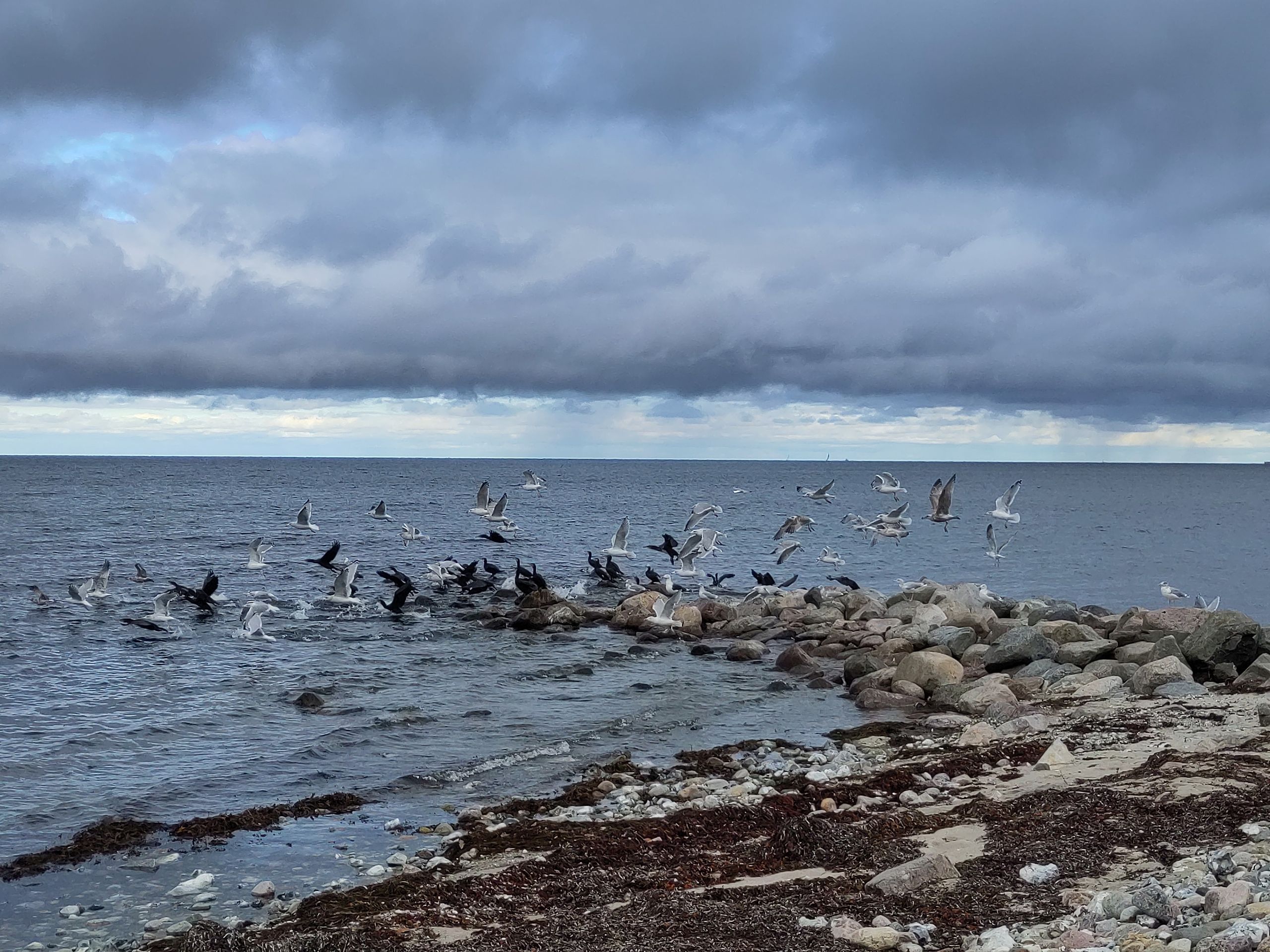
Along with the ducks and wild geese, cormorants and seagulls are now joining - the coast is getting closer. In Neustadt (Holstein), I stand in the rain and cold storm wind for the first time 'actually' at the Baltic Sea: from one side of the bridge, it is called 'inland waters', but the Neustädter Bay has a direct connection to the open sea... Entering Eutin, the road leads over the long 'Bebensundbrücke' between Eutiner See and Fissauer Bucht. Along the Schwentine (which flows into the Kiel Fjord and thus into the Baltic Sea...), I unexpectedly come upon a large sign saying 'You are on the European long-distance hiking trails No.1 and No.6' and next to it, distance indications are given to the left and right, just like the nearby towns: Florence about 2630 km / Flensburg about 70 km (E1) and Rijeka-Adriatic about 2410 km / Copenhagen about 390 km (E6). I love such 'secret signs' that others can't read or are not affected by; this perception of a structure 'behind normal life', belonging to a 'community of those walking from the time'. Even every 'normal' hiking path sign feels like that to me, but so much more when such distances are mentioned, as if it were completely normal to walk hundreds and thousands of kilometers to reach a specific place. I feel unhappy-restless when I encounter such a message, such a sign, without 'being on the way'... ...now it feels good to see it.
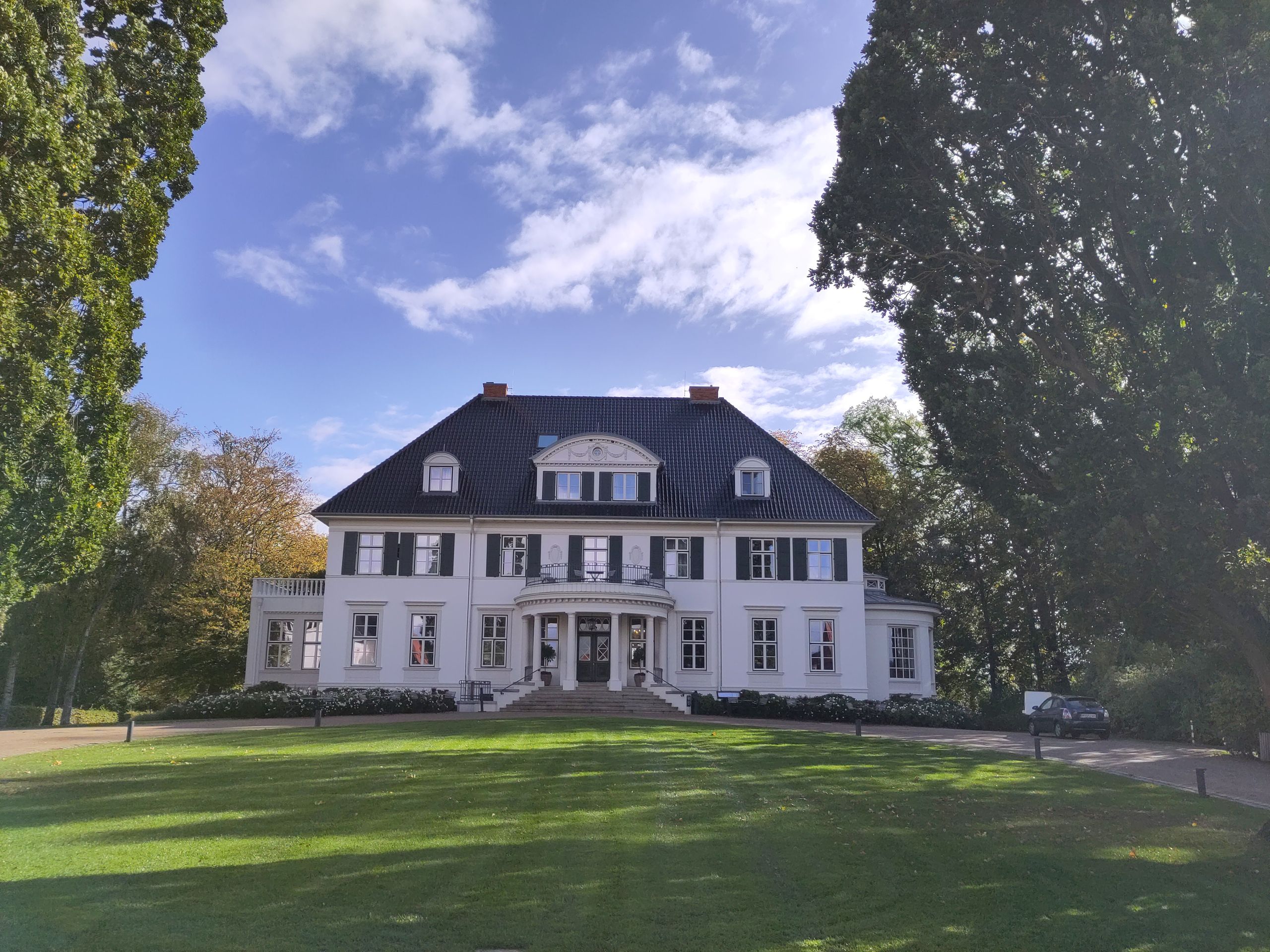
The next surprise awaits me along the way: Gut Immenhof, the large, white mansion at the end of the meadow with its grand staircase, unchanged as if Grandma Jantzen could step out at any moment! A large black-and-white photo of this beloved film grandmother also hangs in the farm shop... The estate is still a pony farm and hotel. Unlike the massive concrete block that disfigures the promenade on the banks of the Dieksee - and it stands empty and decays: 'former Intermar hotel, no longer in operation' it says tersely. That such an ugly building (whether used or unused) is even allowed to stand here, amidst the picturesque landscape of Holstein Switzerland - how much prettier is the completely overgrown old 'Sanatorium'! I cannot help laughing when a donation box offers 'Dog Shit Bags': it is quite sufficient to move around in one's own country from Bavarian to Low German to feel sometimes like one is in another country with a foreign language...
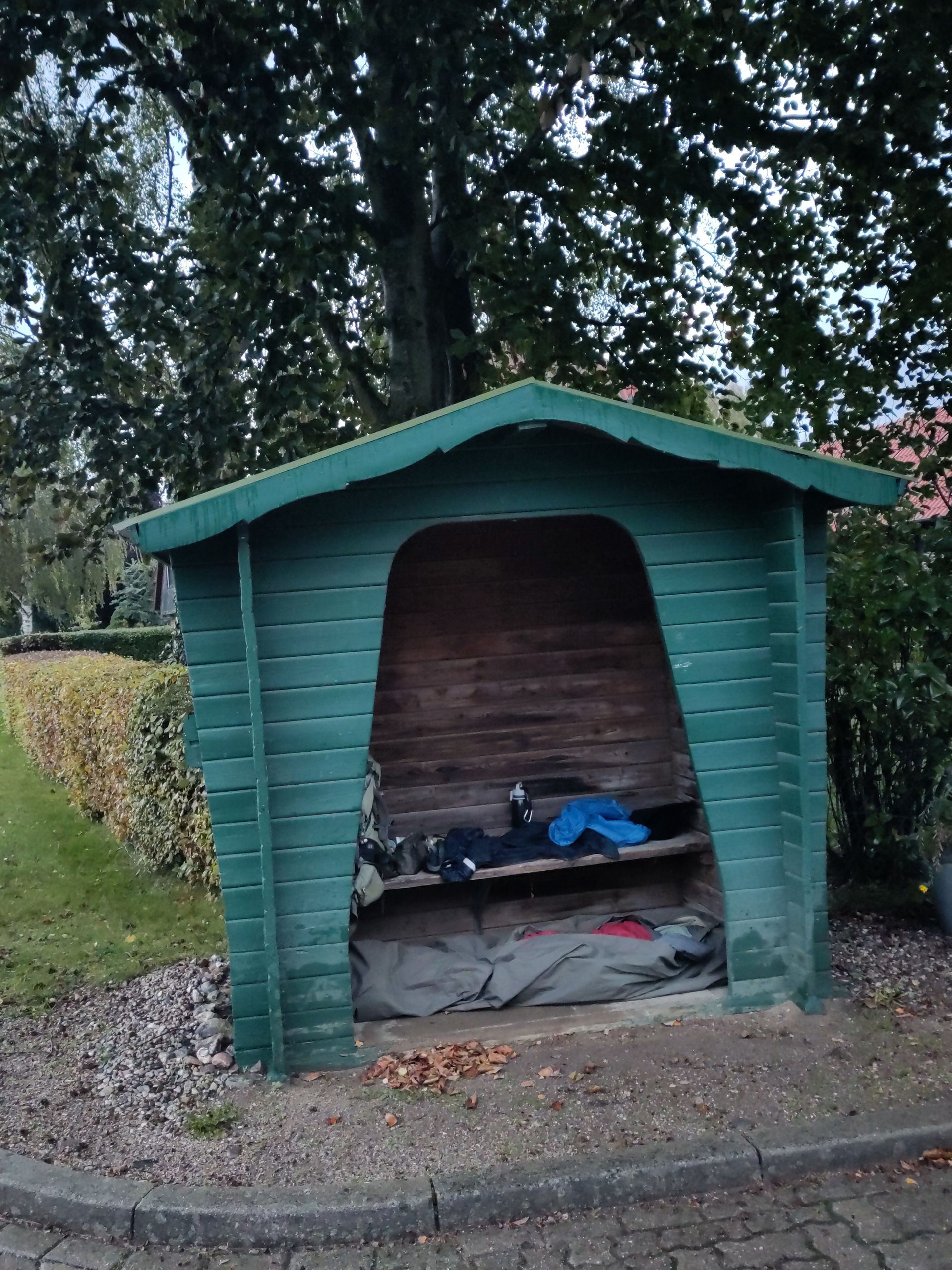
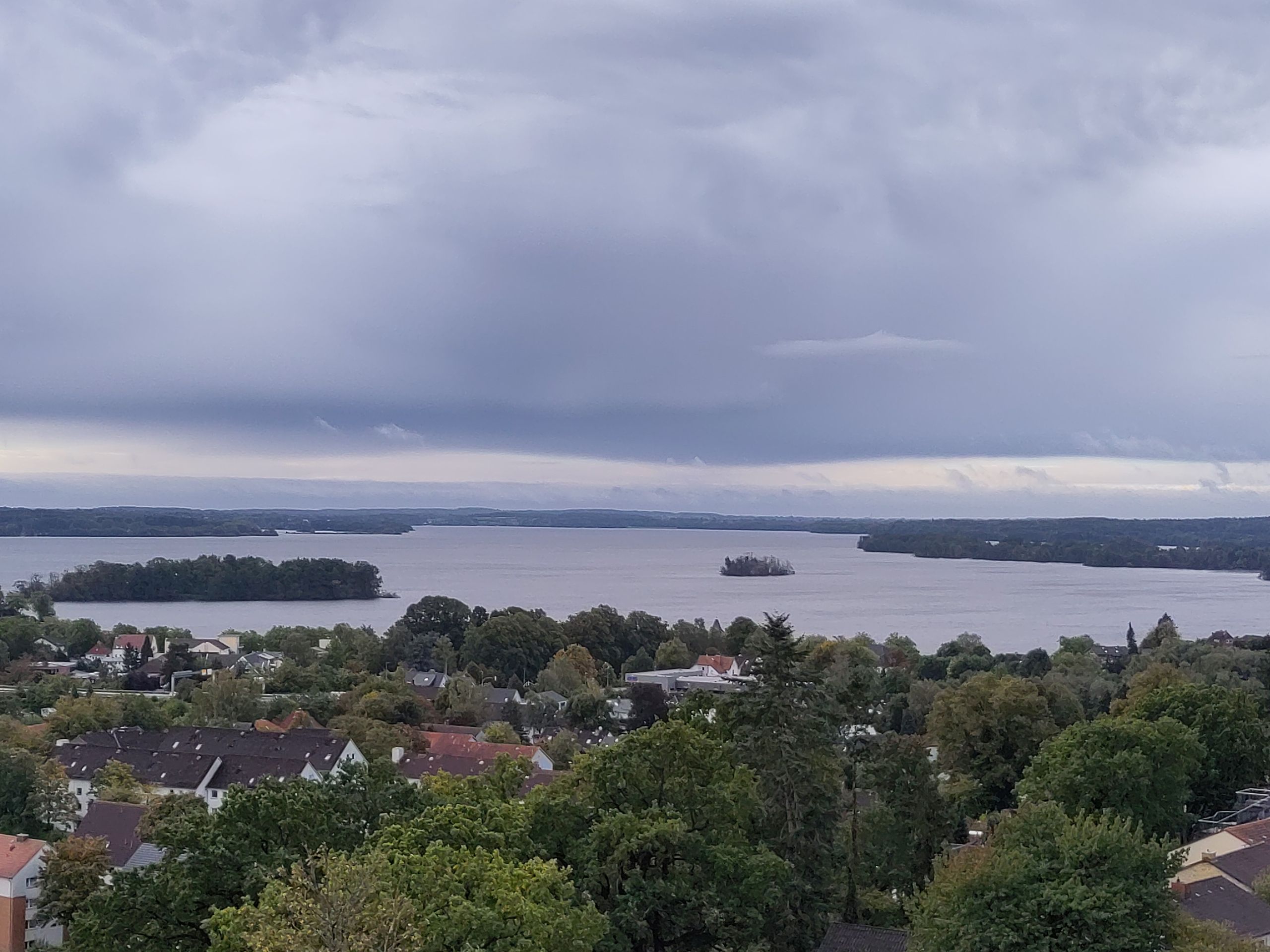
Just before Plön, I enjoy the wonderful view from the 'Parnaßturm' over the lake-rich landscape around. The steel lattice tower with a brick base dates back to the 1880s and rises 20 m on an already elevated hill of 85 m, providing truly a 'summit view'. Later, in Plön, I get thoroughly soaked; it rains so heavily and the wind lashes that eventually, rain pants and jacket let water through, everything hangs damp and heavy on me; finally, there is a very narrow bus stop with green paint. I take shelter in the small dry room, throw my dripping rain gear on the even narrower bench, and arrange my bed half under it and half in front. Fortunately, my children had lent me a bivy sack, which not only warms me additionally but also protects well from the blowing spray rain in this case. In the weak light of the street lamp, a curtain of silver pearl droplets hangs directly next to my 'bed' - I feel warm and cozy in this little spot of dryness and sleep long and well in this unrelenting rustling. Since the bus stop is well visible from the houses on the other side of the street, I am glad that no one seems to be disturbed by my 'nest'; on the other hand, I am also almost a bit surprised that no one comes to offer me something else or at least brings me something warm to drink in the morning... ...I would do that if I looked out the window, and besides, I am obviously spoiled by the kindness of so many people 'along the way'. For example, in the next night, I may stay as a guest in a small B&B. I actually just wanted to drink another tea, but then the owner was so taken with my venture that he invited me to stay for the night: 'just put the key in the mailbox tomorrow'. Grateful for such generosity and trust in a stranger, I lay my sleeping bag this time on the sofa instead of the floor...
Even though I haven't mentioned it so far: In the past nearly two weeks, I have been on the road only with interruptions. This is mainly due to the miracle of the birth of 'my' first completely perfect, tiny grandchild. This weekend, I am now traveling again 'with family', but I will return to the coast at the beginning of next week (if the weather allows) where I last interrupted my way north in Dänisch-Nienhof. At the stormy steep North Sea coast. (Once you start with interruptions... ... - but being on the road with the Germany ticket is also 'adventure travel', though that is not the subject of this blog...)