Swabian Jura North Edge Trail
For the past two weeks, I have been following the HW1, the Swabian Jura North Edge Trail, one of the oldest long-distance hiking trails in Germany: always along the edge, the...

Published: 28.08.2026
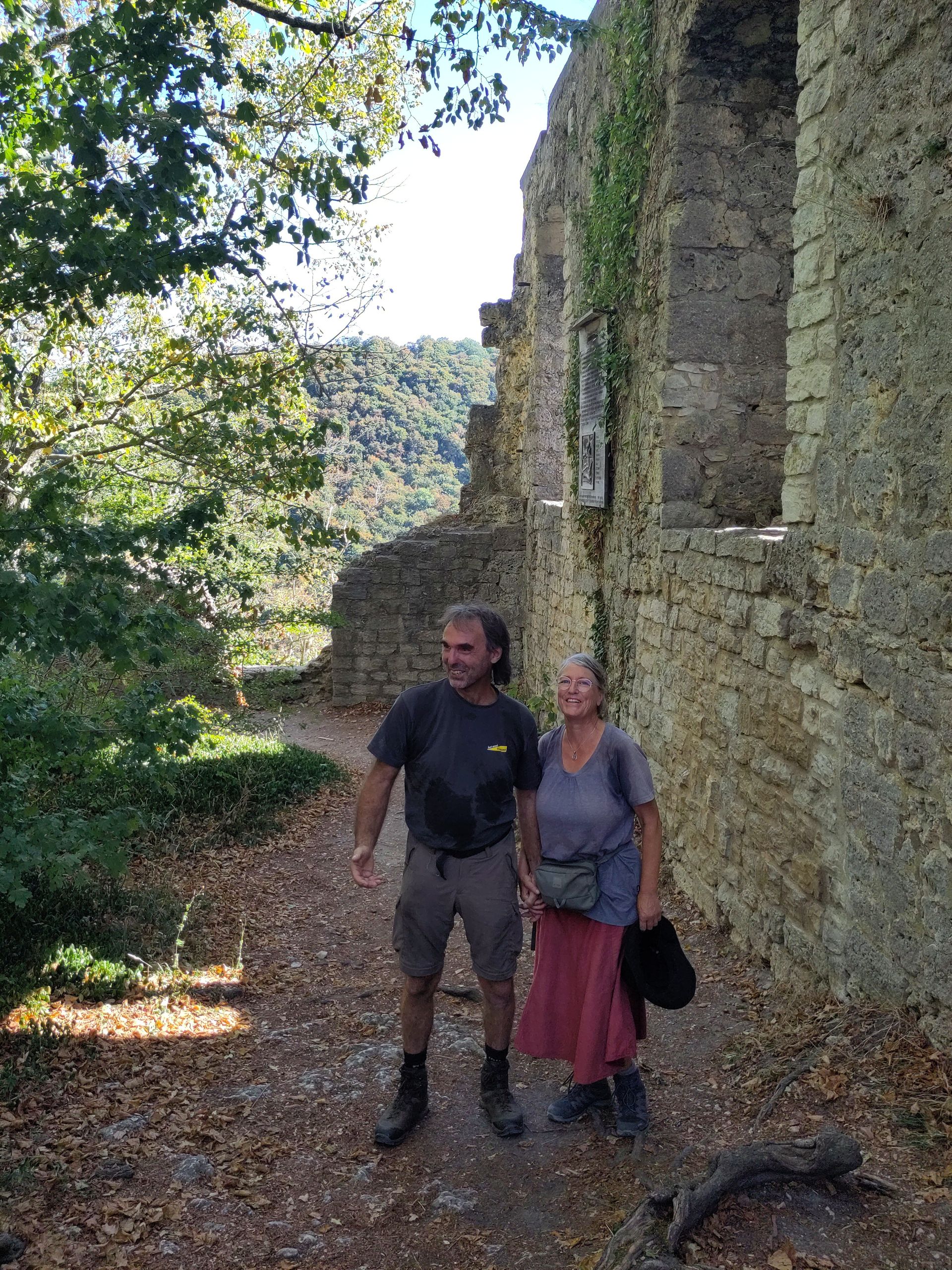
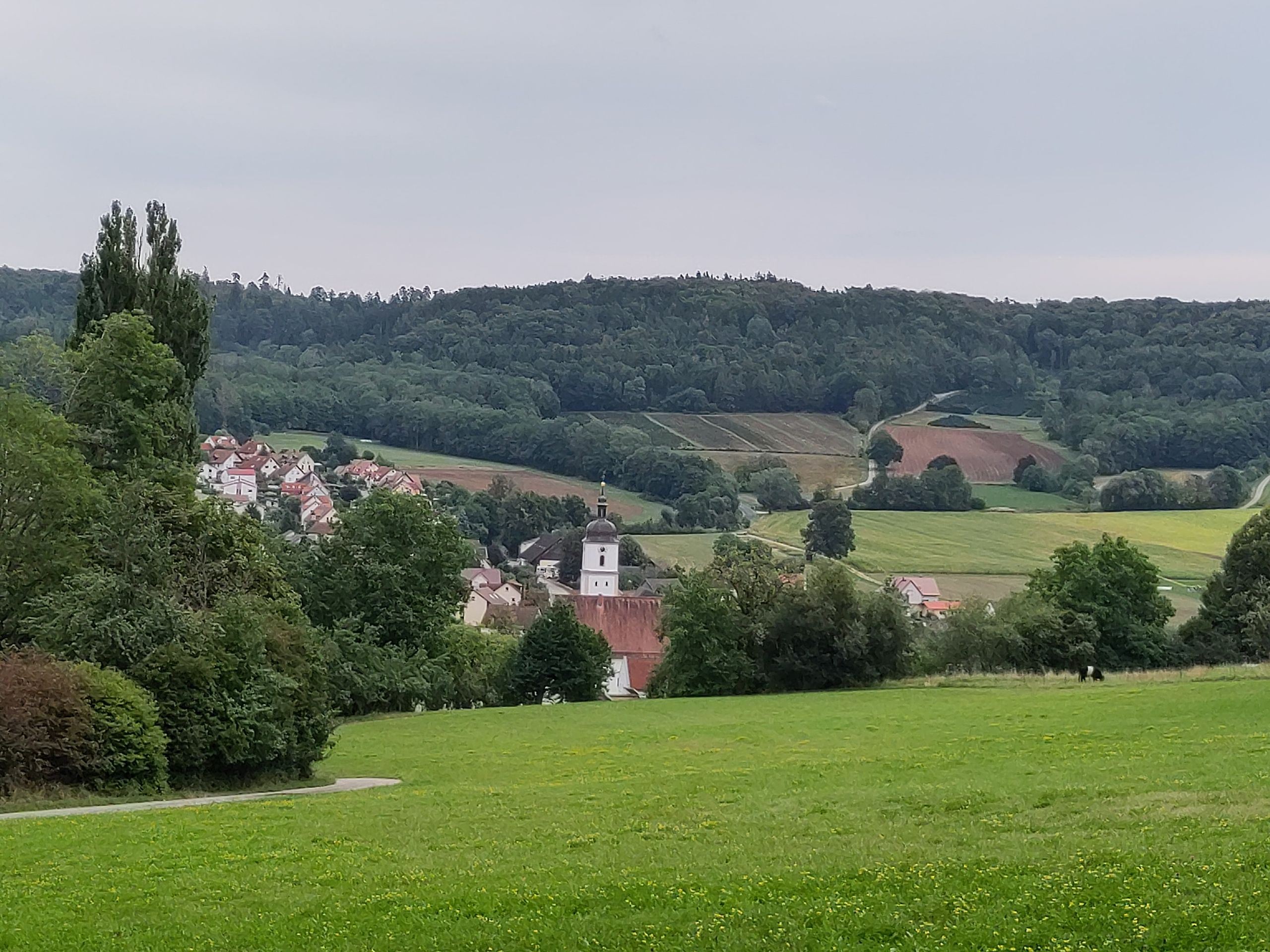
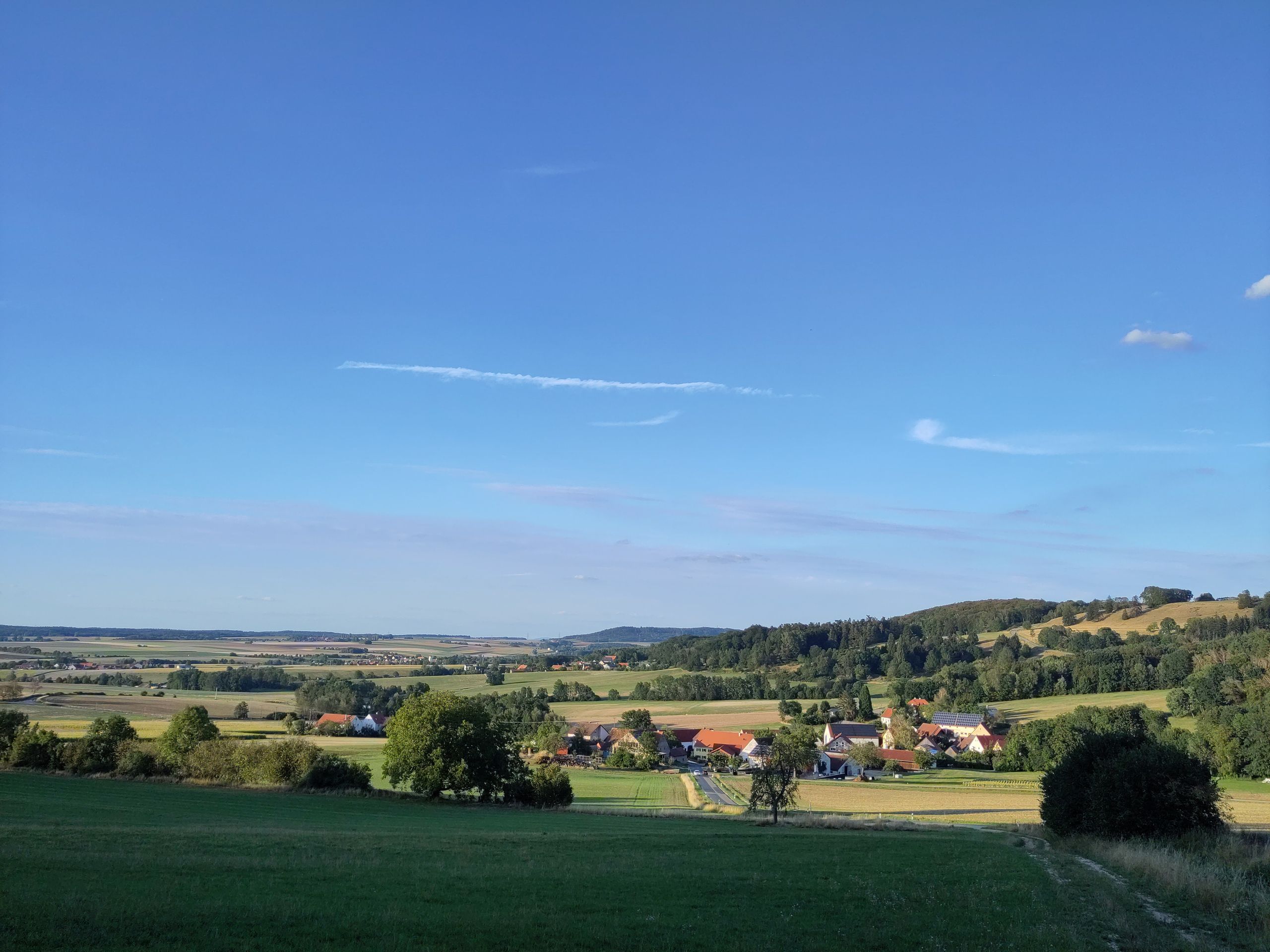
Over the past ten days, the weather has been variable and mostly significantly cooler. Since it was still very hot for hiking on August 15 with over 35°C, and Georg seemed to have a mild sunstroke, we stayed in Bopfingen also for the night on the 16th. It rained heavily and cooled down to 15-20°C 'overnight'. Meanwhile, the atmosphere (especially early in the woods and fields) is already quite autumnal with morning mists, dew-soaked meadows, blue sloes, and red rose hips or hawthorn berries...
In Bopfingen, we reached the Nördlinger Ries, an impressive large plain formed by a meteorite impact nearly 15 million years ago. Some 'witness mountains' rise in this plain, such as the distinctive Ipf near Bopfingen, where powerful prehistoric fortifications date back to the 12th century BC. We hike for days along the edge or on the Alb high ridges above the rim of the Ries. We first see the Ipf up close, then gradually farther away, but always recognizable. In many places along the edge of the Ries at quarries and other steep walls, the dislocations in the original layering of the Jurassic limestone deposits, which resulted from the enormous heat of the meteorite impact, can be seen. Or large rock fragments lie around, according to the information board part of the 'debris cover' that fell in the distance...
First, we continue on the HW1 over ever lower 'summits' (e.g., the 'Ohrengipfel' - without view, as it is completely forested - is still about 650 m high), through woods and fields. The princely house of Oettingen-Wallerstein has extensive lands in the area from Mönchsdeggingen to Harburg (Swabia) - but it is already in Bavaria! - Thus, the path leads us for a very long time through a princely wild boar enclosure: the forest floor is extensively plowed... and although we do not encounter the smallest pig, I am relieved when we can close the massive gate behind us. 'Karlshof' is largely in decay - a pity, as it contains impressive old, stately buildings in a vast forest landscape. A little further back, there was a princely mill and sawmill centuries ago, the former mill stream channel (what an unusually beautiful sound the gurgling of a brook represents!) and fish ponds are still intact, with only an information board reminding of the former mill building. So many traces of former (other) use crisscross our cultural landscapes, some we can still 'read', others are puzzling to us, and others we simply overlook. In 'Christgarten', today also simply 'in the middle of the woods', we can still admire the remains of a once powerful Carthusian monastery. In search of drinking water, we follow the loud rhythms from a rather disturbing facility here in 'Hoppelmühle' and the babble of voices, to meet about 20 'middle-aged' people in 'hippie look' under large sun umbrellas in front of a big scout home, gathered there with plenty of alcohol supplies. We were provided water, but to our curious question about what kind of event this was, we received only the evasive answer that they simply met here for a week to 'chill'. Since many cars with different license plates from all parts of the country from Bavaria to Hamburg are parked around the yard, we wondered for a long time what kind of 'secret, conspiratorial meeting' could this be?
We sleep (view of the picturesque town of Hohenaltheim) before a lovingly covered wooden shelter, head to head, as we no longer fit under the roof side by side - a curious mouse keeps peeking out from under the wood, swallows and later bats (which we see almost every evening) flit by, the sun sets blood red and perfectly round while the waxing moon shows itself again as a slender crescent.
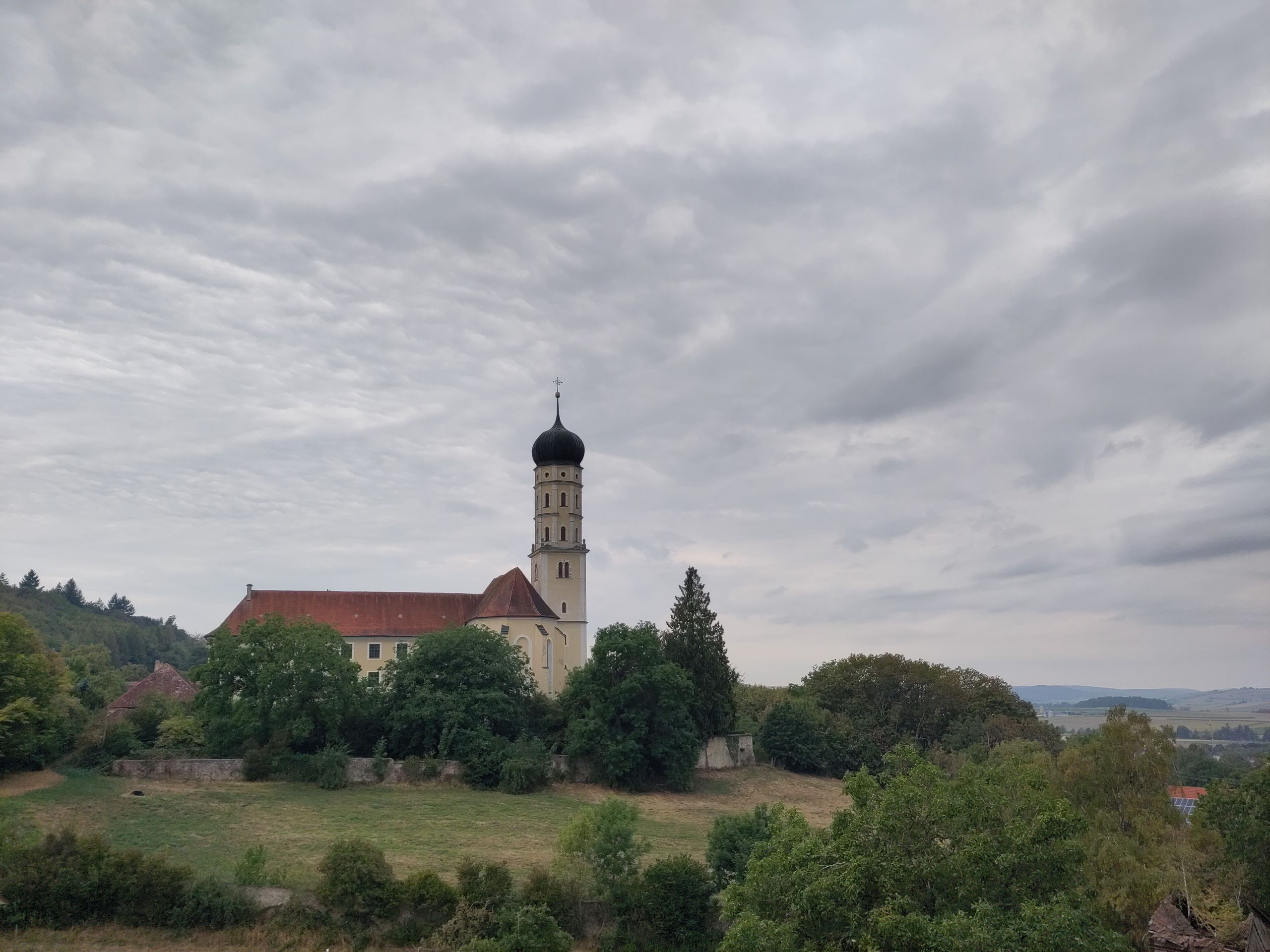
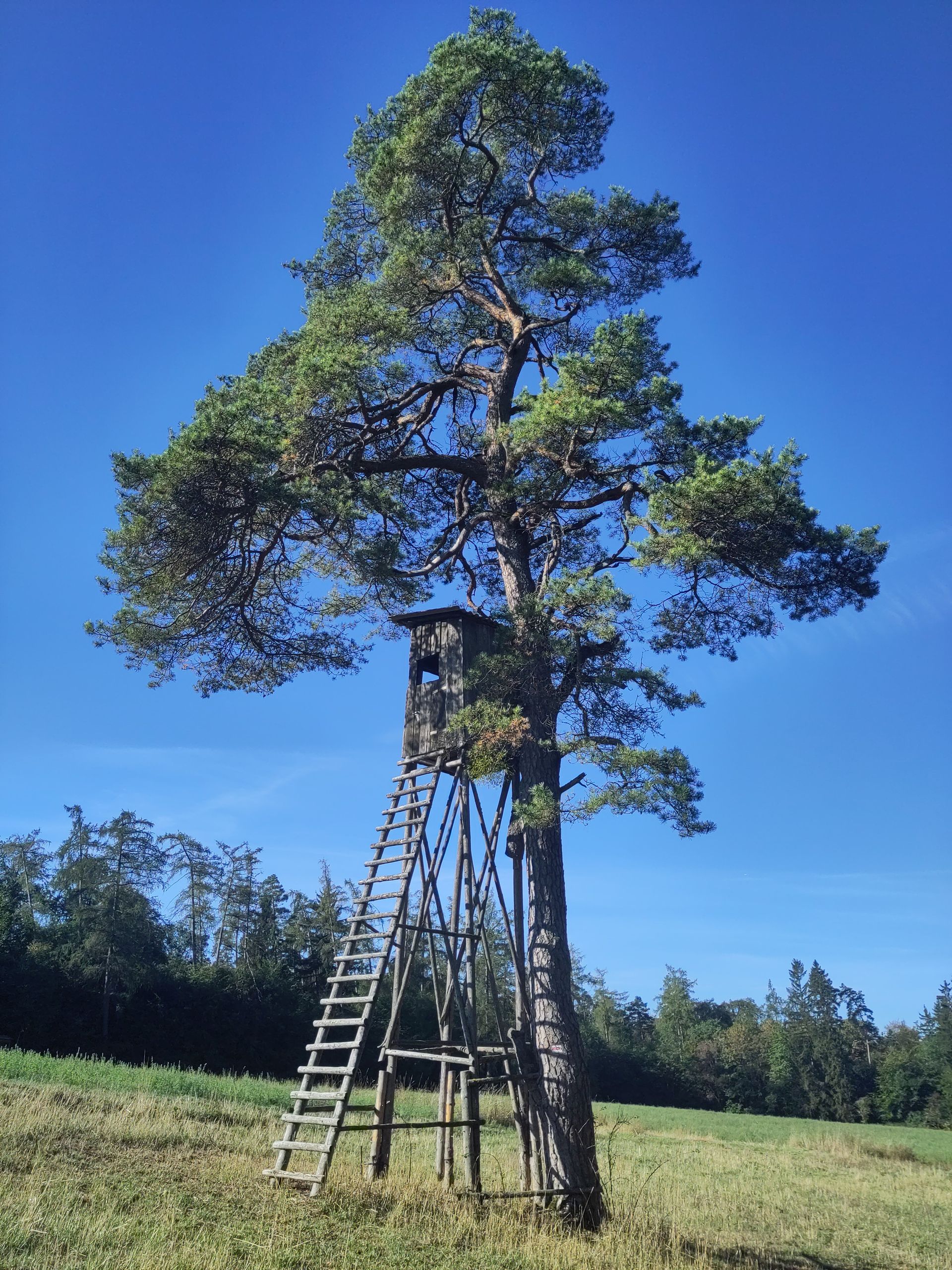
The next two days it rains frequently. In Mönchsdeggingen (large monastery, we take refuge in the baroque church for the duration of a short shower) we chat with the innkeeper of the only guesthouse in the town. She still hosts hikers, but she complains a lot about booking portals like booking.com and similar sites that 'make her life hard'. We spend the rest of the day damp and shivering hours on hunter hideouts, which fortunately are always visible just when it begins to rain again. (Later in Franconia we would have been out of luck, as there are locks on all closed hides for days...) Around us, the nature that has long been dry breathes a sigh of relief, the world 'is coming to an end', and we are glad for the narrow refuge...
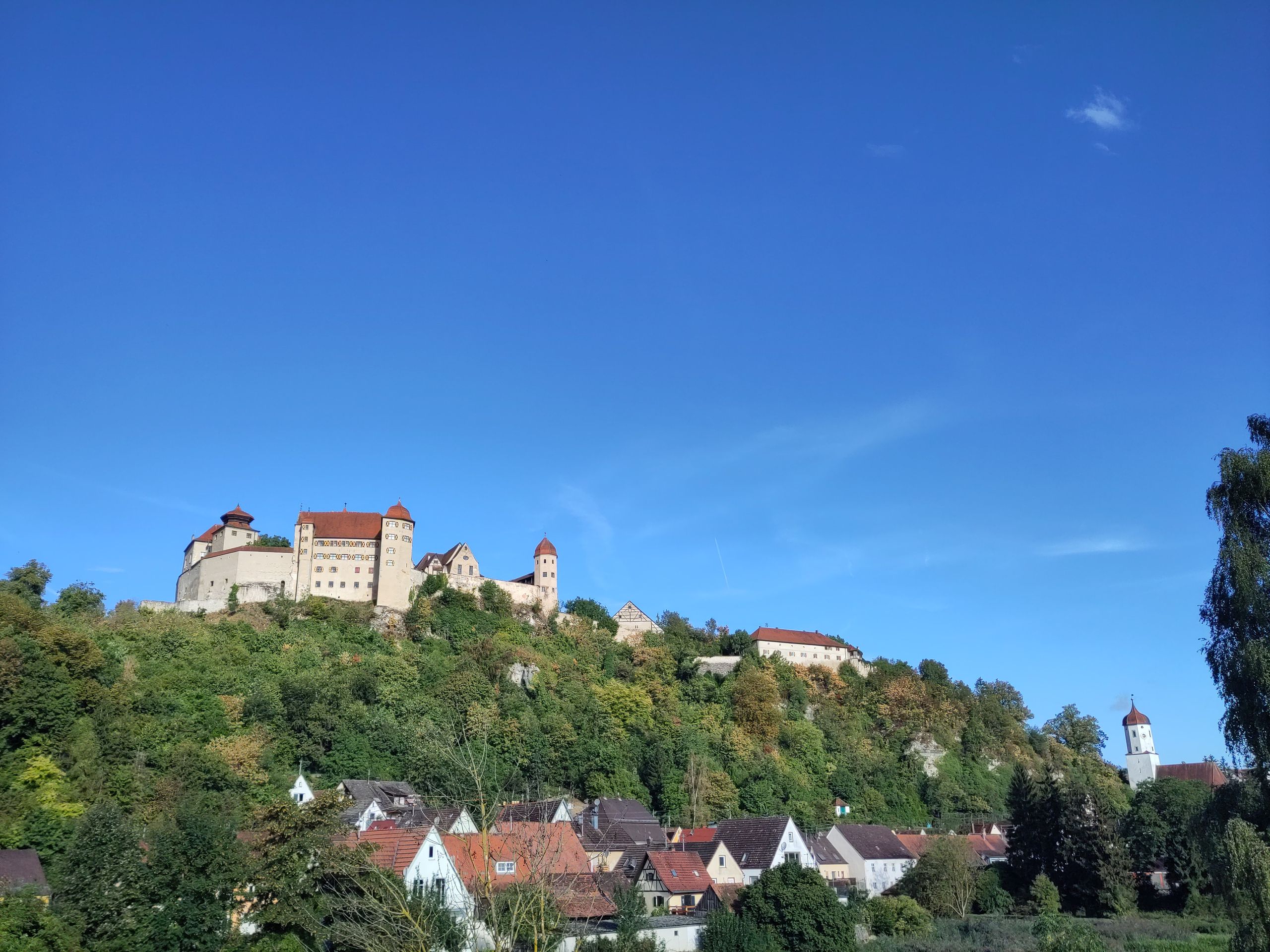
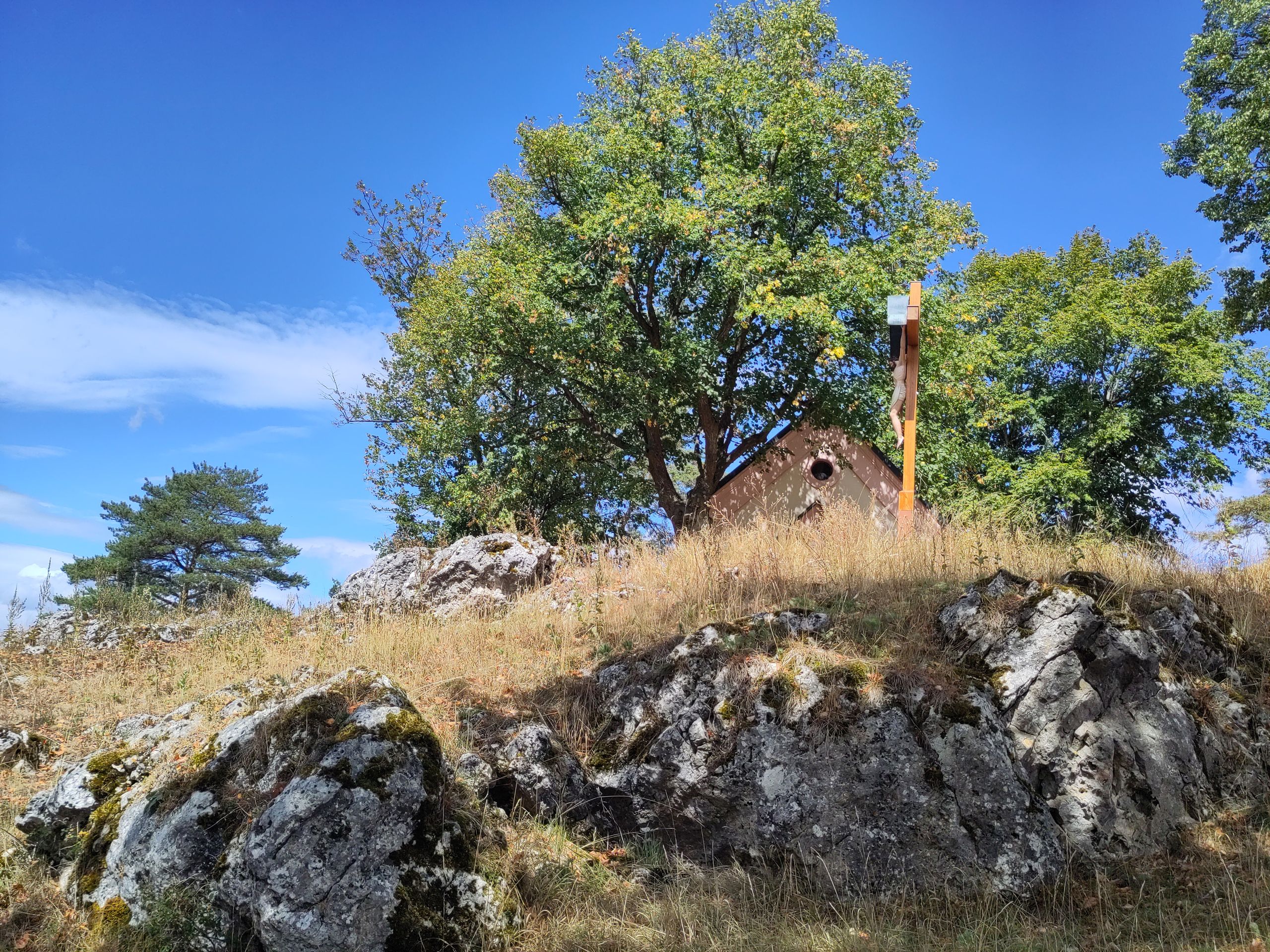
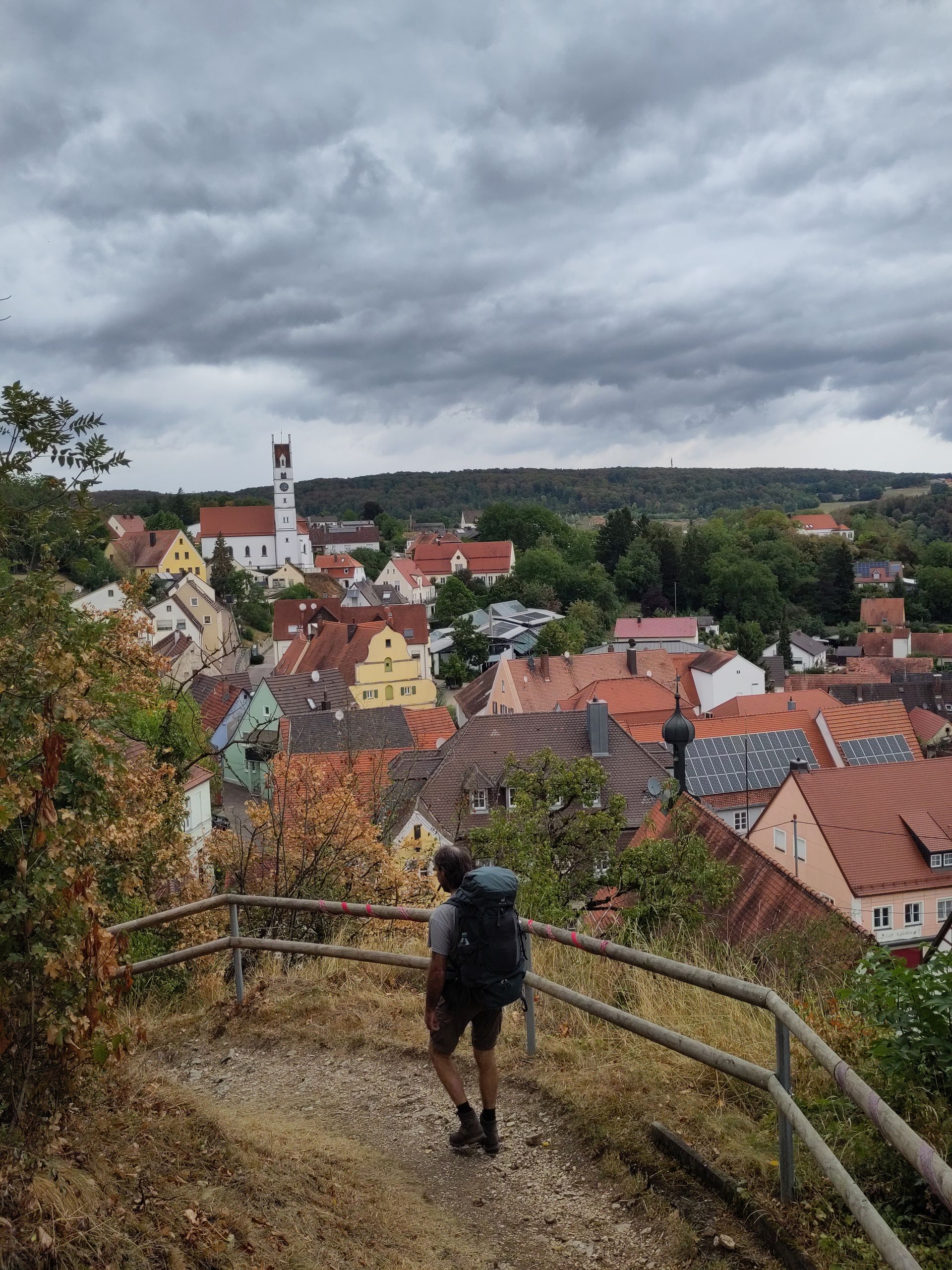
Later we hike through juniper heath, past mighty boulders, across dried meadow heights, and towards the 'Bocksberg' (still about 570 m high), as well as under massive ancient linden trees towards the fairytale castle Harburg. High above the smaller town of the same name by the Wörnitz, this once Staufer 'high castle' towers at the southeastern edge of the Nördlinger Ries (also owned by Oetting-Wallerstein, now a cultural foundation). Very large, very intact, gray walls and red roofs, towers and turrets - as mentioned: a castle like in a fairy tale. Here we part from HW1, which continues to Donauwörth (but really the wrong direction for my plans) and switch to the 'Frankenweg', which is marked with red-white-red markings leading under the castle down to the town. The views of the distinctive rock walls above the valley, the loops of the Wörnitz, the two tall, bright churches and the winding rooftops are so beautiful that we can hardly concentrate on the slippery, wet steep path. It rains again when we arrive in Harburg. Across an old stone bridge, we reach a park where a covered pavilion stands. There we leave the backpacks (and return here to sleep later). During a pause in the rain, we cross the stone bridge again: it spans not only the river but also a kind of island in its middle. There we observe for a long time a weasel, which runs around truly swiftly - it moves so quickly that we can barely follow it! On a house, there are flood marks attached. Already in Jungingen in the Killertal, I had hardly believed my eyes at the sight of the small, gently flowing river that its floods must once have been at least 5 meters higher. Likewise, it exceeds my imagination here - what must it have looked like when the river flooded so high over its banks!! The frequent floods probably bring a lot of sand, and thus this sand was previously manually retrieved for construction purposes from the Wörnitz using long, narrow wooden barges. In a beer garden, we still sit down for a salad and warming tea under the awning, where it patters loudly above us, looking at the water, where ducks, herons, and a tiny wagtail can withstand the rain. Right behind our sleeping pavilion runs the railway line; fortunately, there is no train between 10 PM and 6 AM. Georg thinks in the morning that it had rained most of the night; I slept through it...
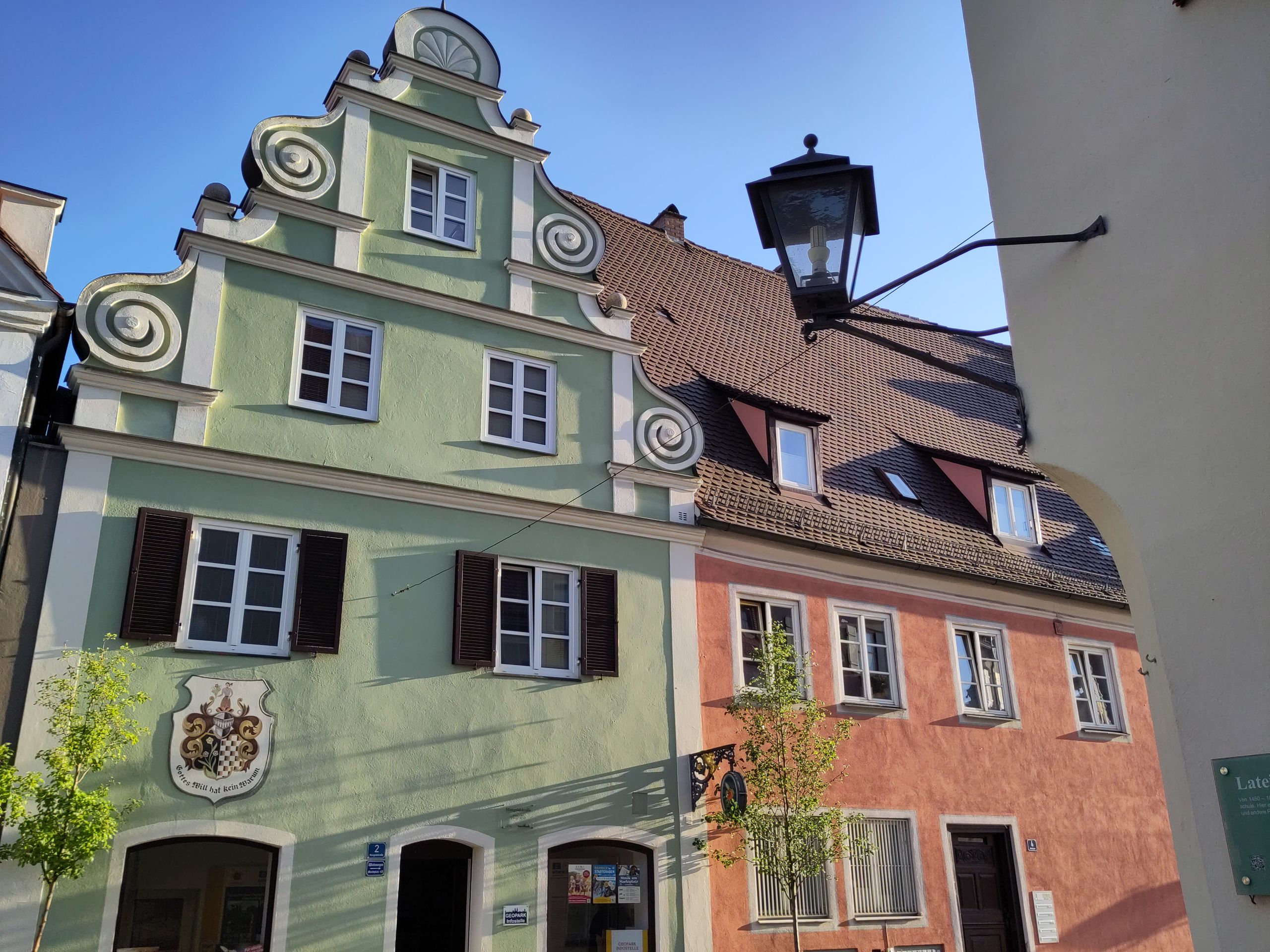
We reach the charming town of Wemding in the evening light of the next day (after being accompanied all day by the sound of large corn choppers). The baroque gable fronts of the old town houses are colorful and playfully curved, and around them, there is still an intact double city wall, with beautiful foot and cycle paths between them. Under avenue trees and along small 'behind-the-gardens paths', we walk about 2 km to the very large pilgrimage church 'Maria Brünnlein zum Trost', which we have seen as a distinctive, standalone basilica from afar (since Bopfingen). Even today, about '150,000 pilgrims and visitors come to this place of grace every year'! Around 1680, a citizen of Wemding brought back a richly adorned Madonna from a trip to Rome and 'honored it in his house'. The town pastor forbade this, not allowing 'private sanctuaries', and thus the image moved to a small chapel that was built above a spring, a 'Brünnlein', at the site where another citizen of Wemding had made a vow to build a chapel. However, in 1735 and 1746, 'two miraculous events' concerning the figure of Mary were observed - after which 'thousands of pilgrims flocked here' and the church had to be enlarged. The current church was built in the mid-18th century. In front of the altar stands 'the image of grace': the rather small figure of Mary with the child in her arms, both dressed in richly decorated garments, in a golden glass shrine. Around and behind this, the spring bubbles (in a church, an unusual sound!) in seashells: clear, cold water - I wash my face and hands with it and drink some. In a side altar, I can also admire the bones of some saint through a stained glass window: I look in mild horror for a long time at the skeleton, whose skull is adorned with gemstones, its bony fingers decorated with rings, a gown edged with lace from silk and brocade that ends at the gem-studded knees. Thin, naked bones protrude very slenderly from the fringed trouser legs and then, strangely grotesquely! in normally sized shoes adorned with sparkling stones. The noble skeleton raises a chalice with one hand, while the other holds a long, gilded scepter... ...At eight o'clock, a man in a safety vest with a big key arrives and locks the church for the night. So we walk (past the hotel and the beer garden 'to pilgrimage') and a completely overcrowded wild enclosure at sunset for a short distance to an even, mown meadow path - behind us the tower of the basilica, beside it the narrow crescent moon, in front of us, for a long time, violent lightning on the horizon. At night it is very clear: the Milky Way is easily recognizable, and I see several shooting stars; Cassiopeia and the Big Dipper guard my sleep...
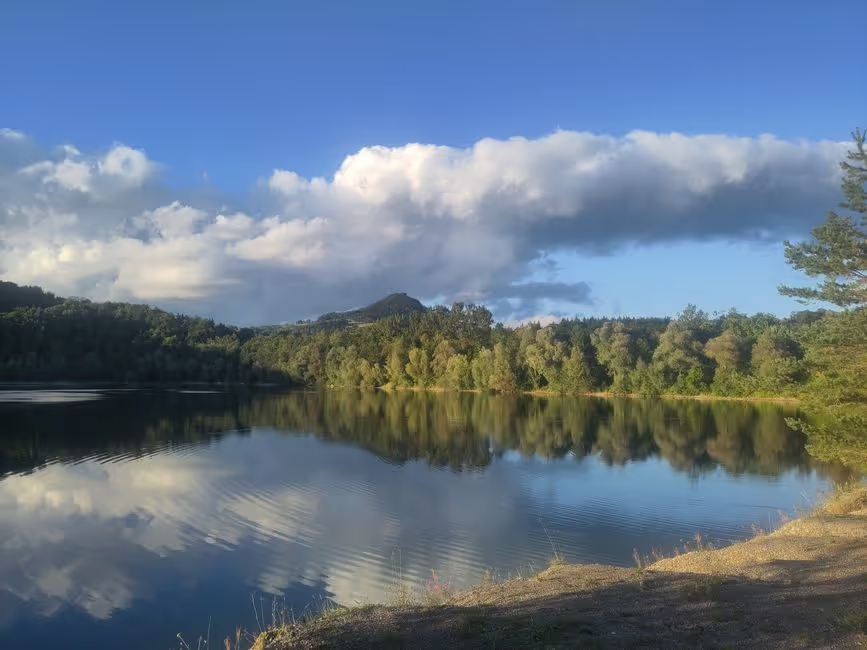
On the ridge 'Hahnenkamm', we reach the beautiful lake of the same name on the 20th at noon - a reservoir of the Rohrach. Wonderful to swim out into the cold, clear water! Well-kept shore facilities - we wonder how little traffic there is (August, holiday season) and enjoy the peace at the lake. Despite the limited number of guests, even the kiosk is open so we can watch the dark black thunderclouds over the water while enjoying coffee and cake, a strong wind comes up for a short time, it thunders and lightning flashes, but really it only rains elsewhere. The nice places we pass through are mostly deserted - we often ask the only person we see over the fence for water. Almost always there are nice conversations, once we even receive two freshly harvested cucumbers handed over, and now and then we have to quickly walk on, as the questions about where we come from and where we are going and remarks about world politics and the situation in Germany (especially Bavaria) ... do not seem to come to an end. Very different churches and church towers, places that do not spill into the landscape with loud new housing areas, 'nice villages' that we walk through alone, or those 'below us' - Gosheim, Ursheim, Polsingen, Hechlingen am See, just to name a few, or Hohentrüdingen - there we find a massive shelter in the middle of orchards (much to Georg's dismay, apples and plums along the way are still a bit unripe, but here we find delicious clear apples). Under a generous roof, we watch calmly as the stormy, sulfur yellow sky unfolds, as well as some rabbits in the grass and later the flitting shadows of bats; under the roof, there are probably dormice stirring.
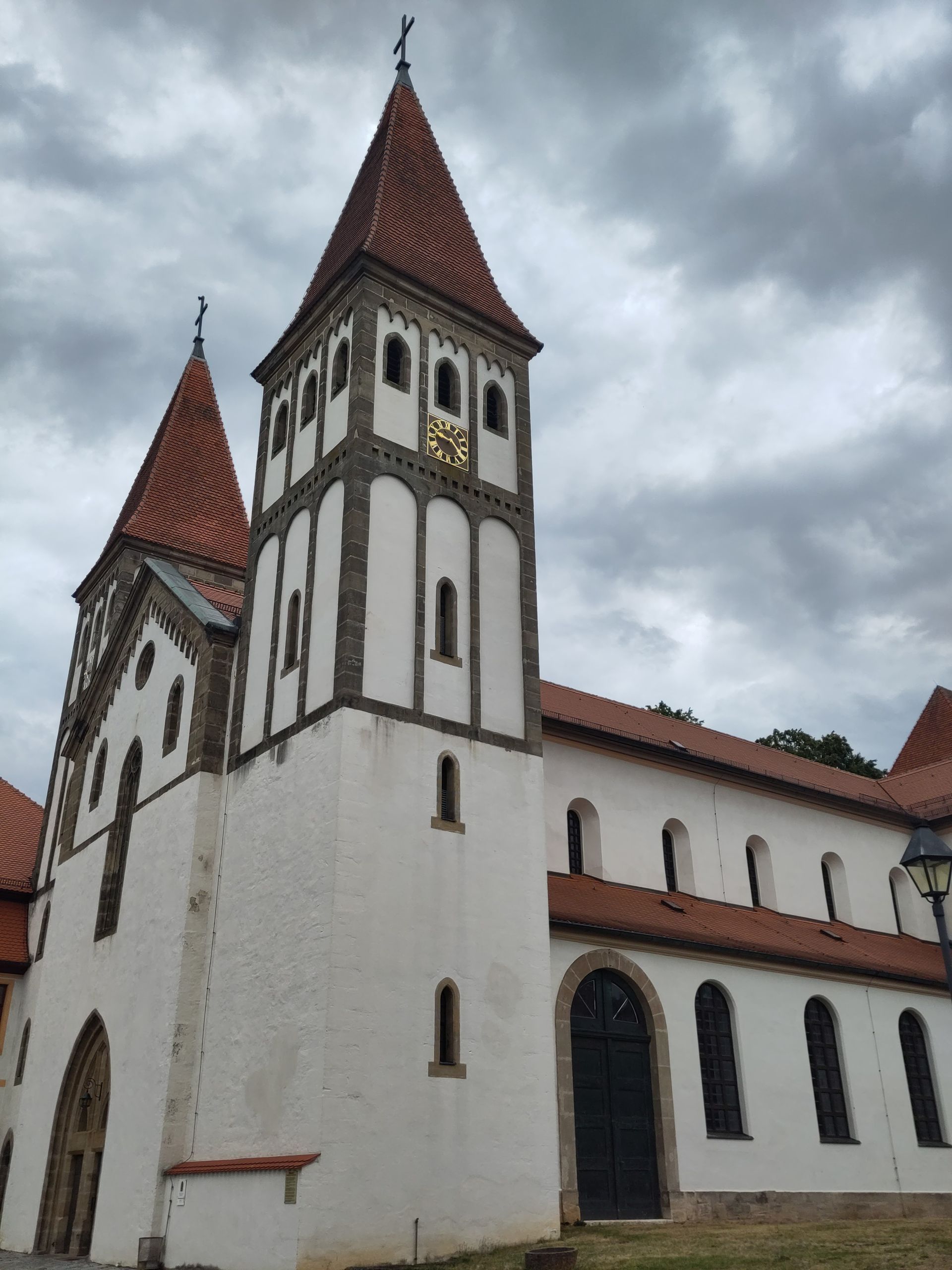
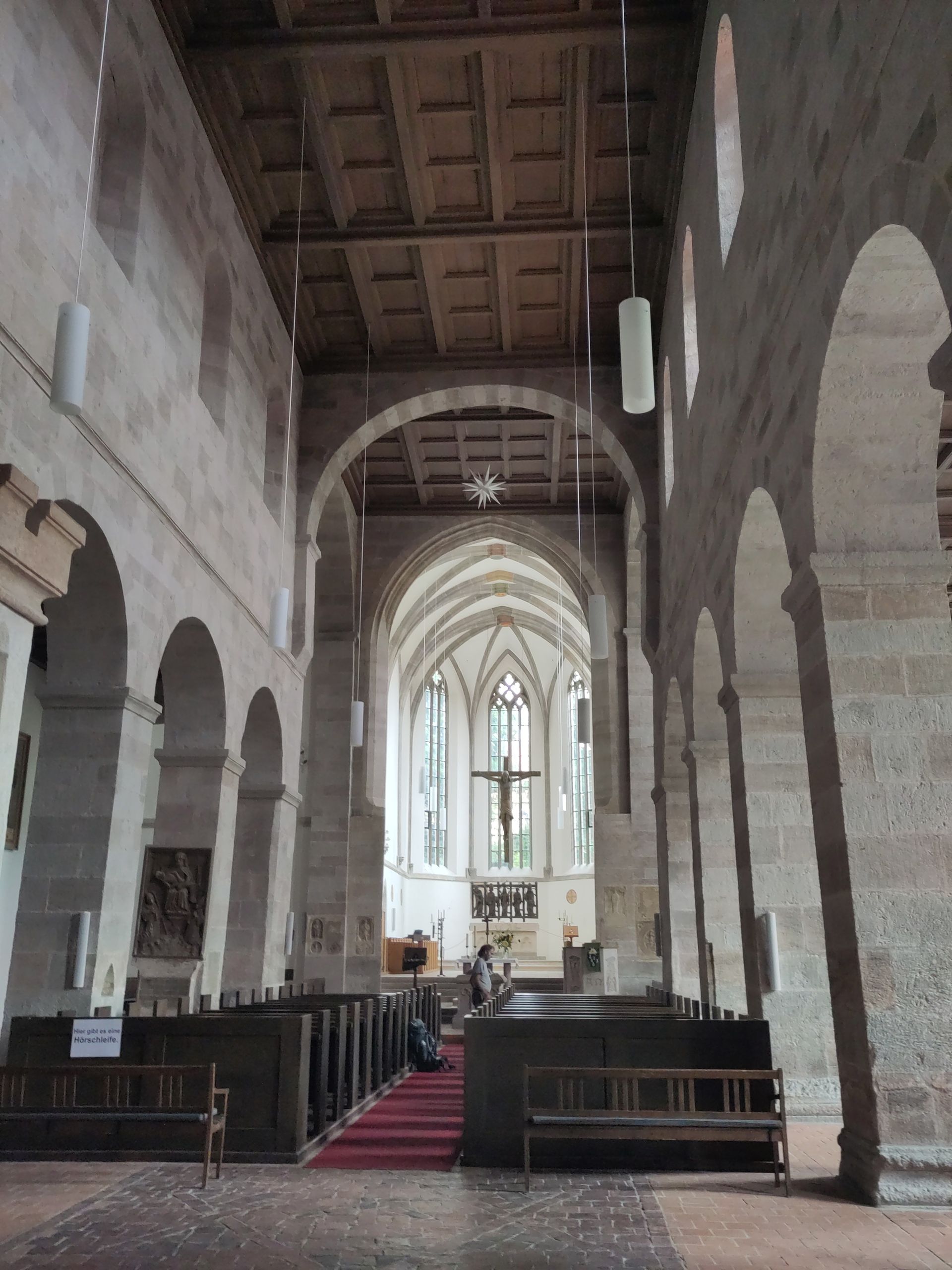
On Friday, we walk only a short time through dew-soaked meadows and cloud-dark woods. Arriving at a small road, I quickly hold my thumb out, following the motto 'either we will be picked up soon, and we drive into Markt Heidenheim (where there is, for example, a bakery and coffee...), or not, then it should not be so and we continue following the hiking trail, which bypasses Heidenheim in a wide arc through the forest. Since I am a person with a very poor sense of direction, I initially find myself on the wrong side of the road, so the stopping driver is very surprised when I say where we want to go... After switching to the right side, a small bus picks us up. The friendly driver tells us he actually shouldn’t take us, as there’s no bus stop here, but he always says 'being human is more important than rules'; the only passenger, a very old lady, obviously enjoys our boarding. Again without a bus stop, the driver lets us off in the town square just in front of the bakery. Since it is about to rain and according to the weather report it will not stop until the next morning, we rent a 'pilgrim's room' in the town (there is an ecumenical pilgrimage route through Heidenheim), which is already a bit dated, yet still at a proud price - but we have it warm and above all dry and a hot shower (rarely enjoyed) evokes the purest bliss... In the rain, we later visit the monastery. In the 8th century, monks from England crossed the canal, and St. Wunibald founded a monastery here. However, he soon died young, so his sister Walburga took over his position. Under her direction, it became a double monastery: monks and nuns lived under one roof for 30 years under a woman's leadership! (Before Rome took strict measures, such things were still possible under early Christian influence from Irish-Scottish culture...) In the large Romanesque church (two tall pointed towers), the stone grave sites of both Wunibald and Walburga (a special chapel was erected within the church for her sarcophagus) are present, the cloister is Gothic, in the monastery garden, there is still a Gothic well house and a huge beech whose root system stretches over the stone steps of the gate. In the monastery courtyard and in front of the church portal stands a narrow statue of Walburga, this unusual woman.
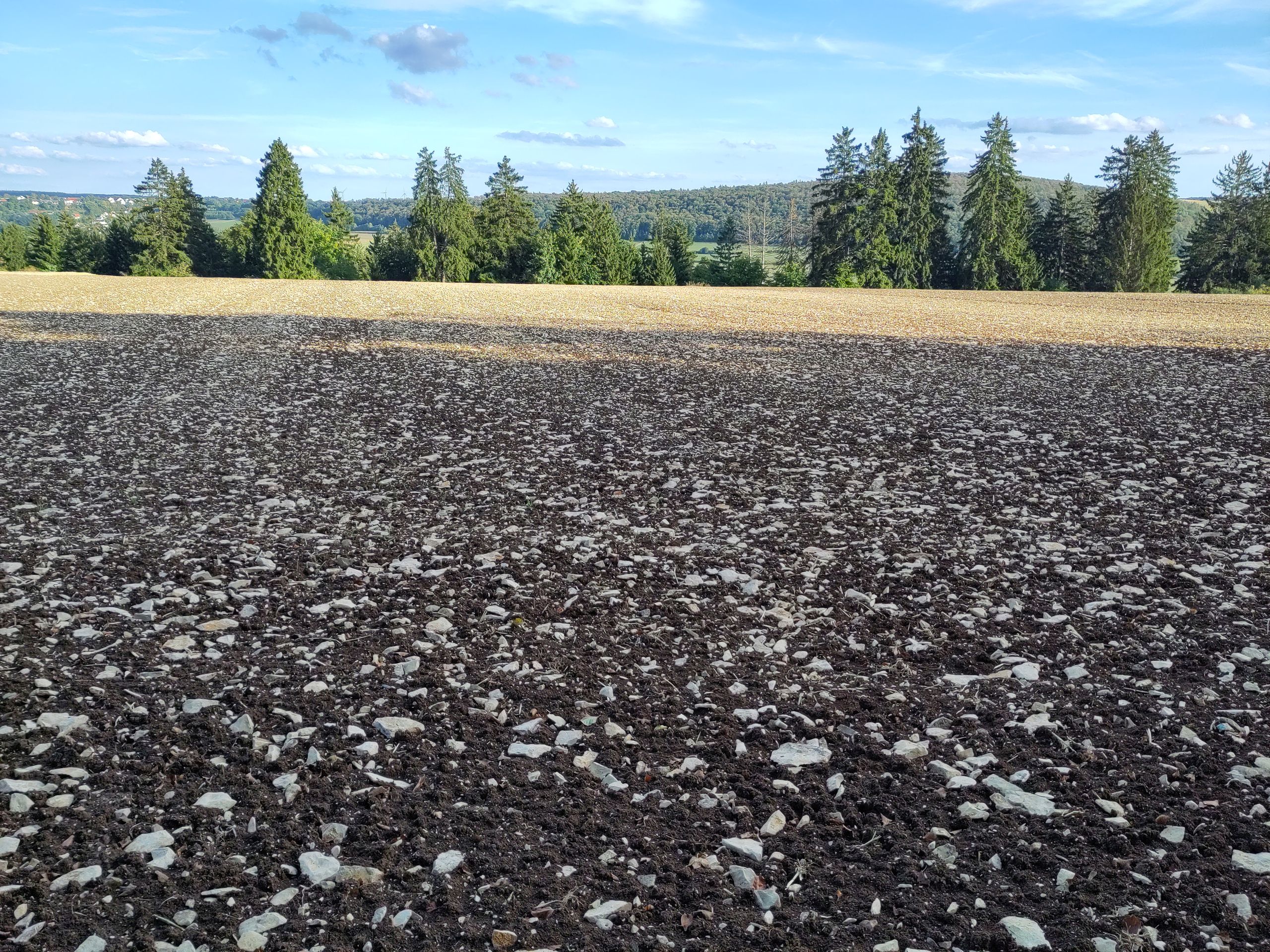
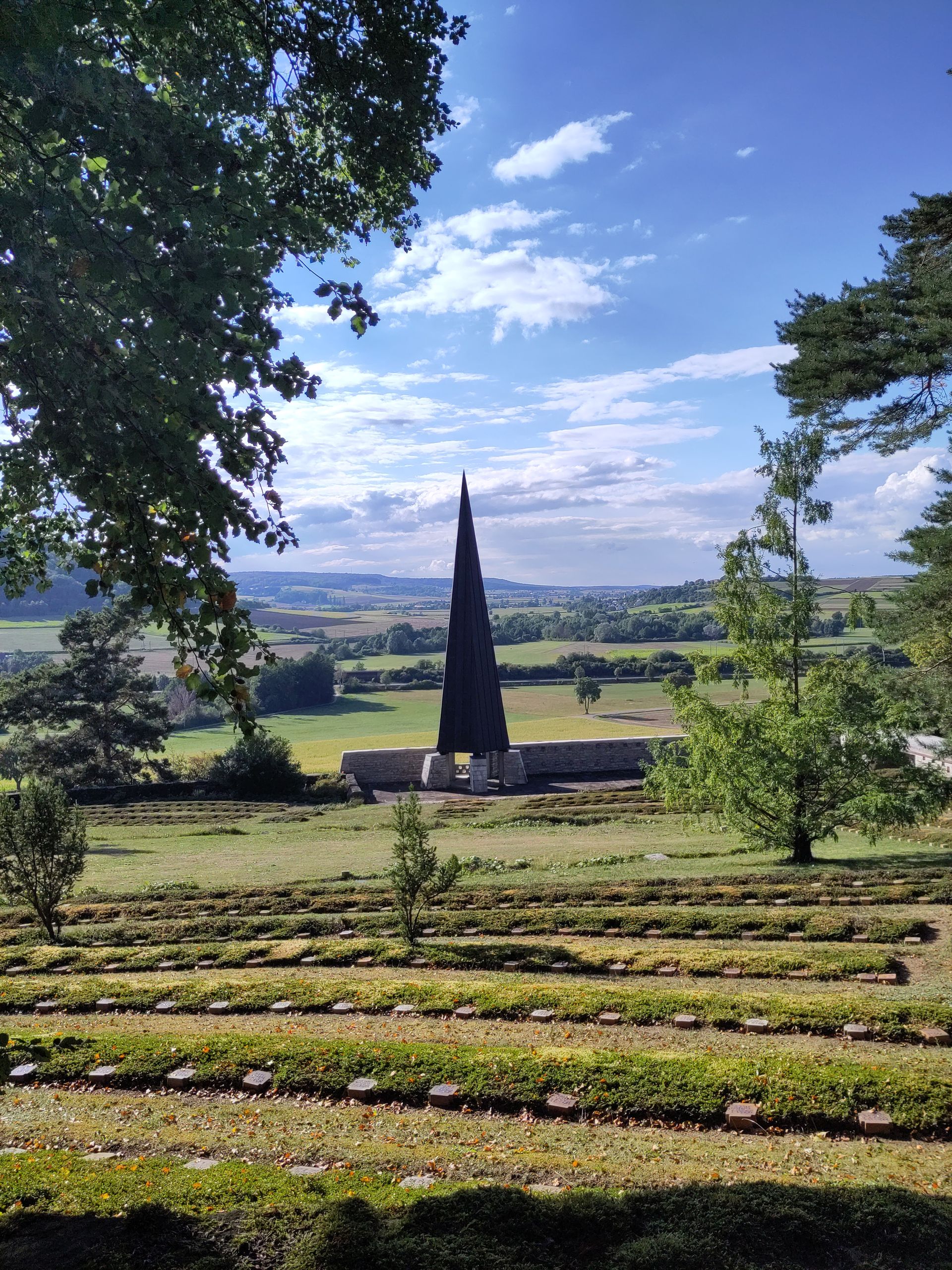
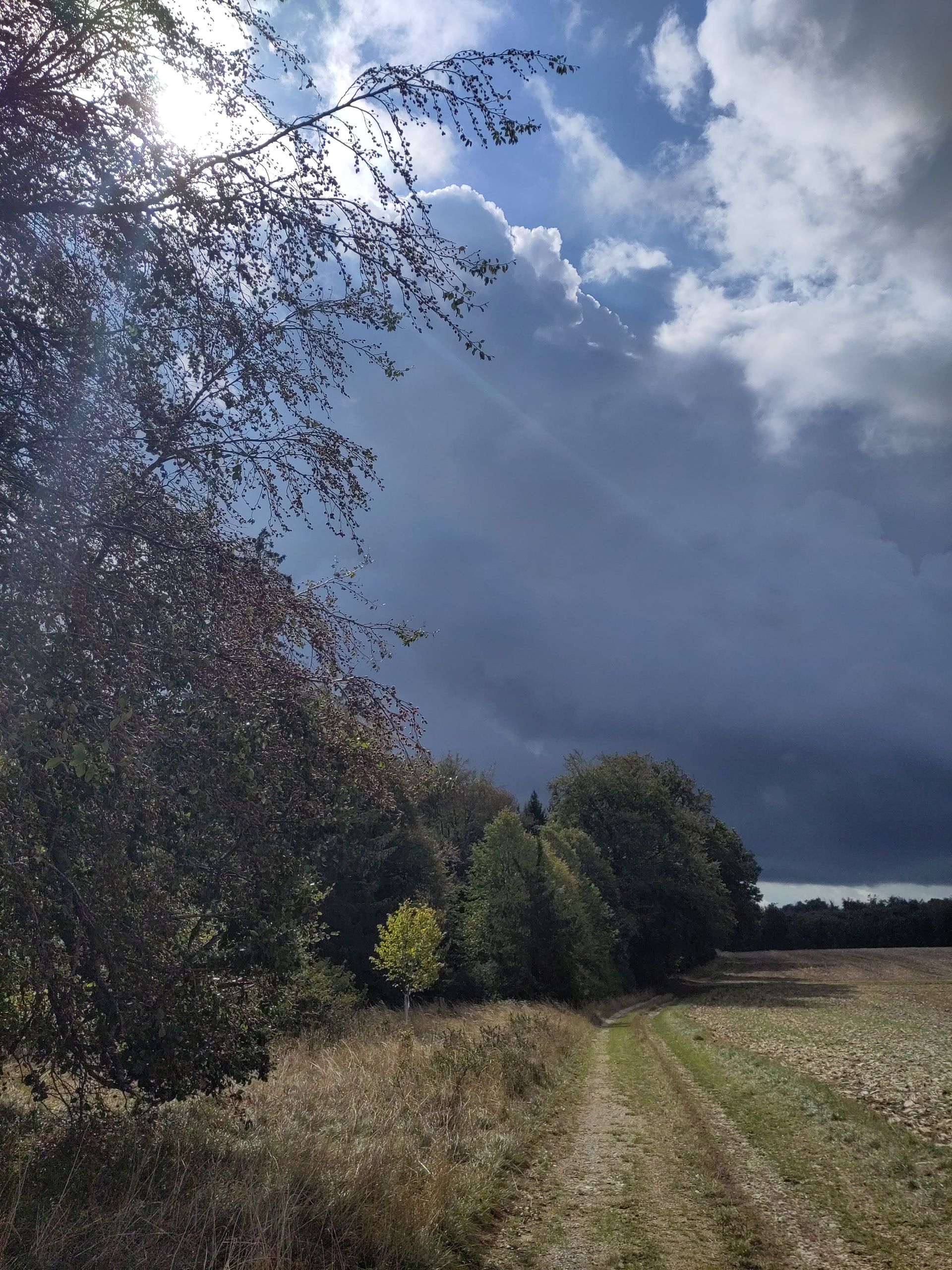
After the thunderstorms and rainfalls, many branches and twigs lie once again on the paths, clear erosion marks adorn the (steep) paths, autumn crocus dare to emerge, only the bright, intense blue of the chicory still shines continuously along many path edges, otherwise flower colors have largely disappeared from the landscape. Dried corn plants are bent. A farmer extended his field right up to the edge of the forest, so we must now walk over freshly sown field (on the marked path!). Someone has dug up the survey boundary stones, marked them in red, and also placed wooden stakes with red tips in the ground... In Windischhausen, we are surprised by a heavy rain; we flee from our snack spot to warm up in the village tavern: run by the 'grandfather' of the guest room in its sixth generation besides farming, as he cozily explains to us, 'there is no modern frippery' on the menu, 'only old favorites' like schnitzel and fries, onion roast beef, and sausage salad... - but we can get a hot chamomile tea, that suffices for us, and a socket for my phone - I slowly warm up again. The Rohrach winds through a wet 'storybook landscape' with shimmering water, reeds, herons, and large trees standing green in the water, before flowing into the Altmühl in Treuchtlingen. Just like the many long freight trains using the tracks through Altmühltal, we cross this 'medium-sized' river on a rusty metal bridge and ascend the Nagelberg (542 m). Along the way up, roughly carved crosses made of light Jurassic limestone accompany us (behind Treuchtlingen, a huge quarry shapes the landscape: here 'Treuchtlangen marble' is mined, not crystalline, but looking polished, interspersed with white 'flames', the tiny marine creatures of the former Jurassic Sea). At the end of this 'Way of the Cross' lies a large war cemetery on the forest's edge. Well-maintained and dignified, this place holds the graves of '2553 soldiers, women, children...' - many of the soldiers are between 16 and 18 years old, still half children. Under a pointed tower roof rests a young bronze soldier, around which the inscription reads 'Let our sacrifice be enough, renounce violence, and save the human in humanity'. A plaque at the entrance tells exemplarily some of the stories behind or under the graves. We linger for a long time at this place, and I sing here before we continue...
In the evening light along the Nagelberg (very beautiful woodland edge with large beeches, oaks, and ashes), we pass the ruins of a Roman villa ('for self-sufficiency and to supply the soldiers at the Limes' - which runs very close by here), we make our way off the designated path to a 'witch dance place' (today only goats dance here, but we wonder what they find to eat on the dry upland, let alone consider dancing...) The grill hut, where we intended to sleep under its awning, is already occupied by three young people who are in the process of lighting a fire. We ask them how long they will stay and if they plan to listen to loud music? 'We don't have a music box with us,' is the answer. 'Then you leave the car door open and take the radio?' asks Georg. 'We're here to have peace, not to make noise!' they deny, 'We are still normal, even though we are young' says one almost defiantly... We find a spot on the meadow between the young people and the goats, knowing that the shelter is in reach should it rain at night. It doesn't rain, yet our things are very dew-soaked in the morning; we pack them with damp, cold fingers and hike shivering through tall wet grass and blackberry brambles. At noon in the sun, we dry our sleeping gear over the fence of a parking lot while we snack. Since poor Georg froze miserably at night (at most 9°C), he quickly asks the innkeeper of the castle tavern at Wülzburg if she happens to have an old sleeping bag. His insight into human nature proved correct: happy and warm, he has been sleeping since then in an ugly, camouflage-patterned but warm sleeping bag that had been waiting to be discarded for 14 years in the attic of the old guesthouse. Its package dimensions are, however, less backpack-friendly, so we then pack a bundle with the summer sleeping bag and some other now unnecessary items like sunglasses and sunscreen... to make some space for the monster.
The Wülzburg impresses with its sheer size: a Renaissance fortress (from 1588), 'built on one of the highest elevations of the southern Frankish Alb' (630 m), where before stood a Benedictine monastery. Cisterns with up to 30,000 liters capacity and a 143 m deep well secured the water supply up here. In 1918, Charles de Gaulle was imprisoned here for some time, and after World War II, 10,000 Eastern refugees were housed here. A hiking path runs for over a kilometer around the star-shaped massive walls (and in front a deep moat), offering views wide into the country and down to Weißenburg located 200 meters below.
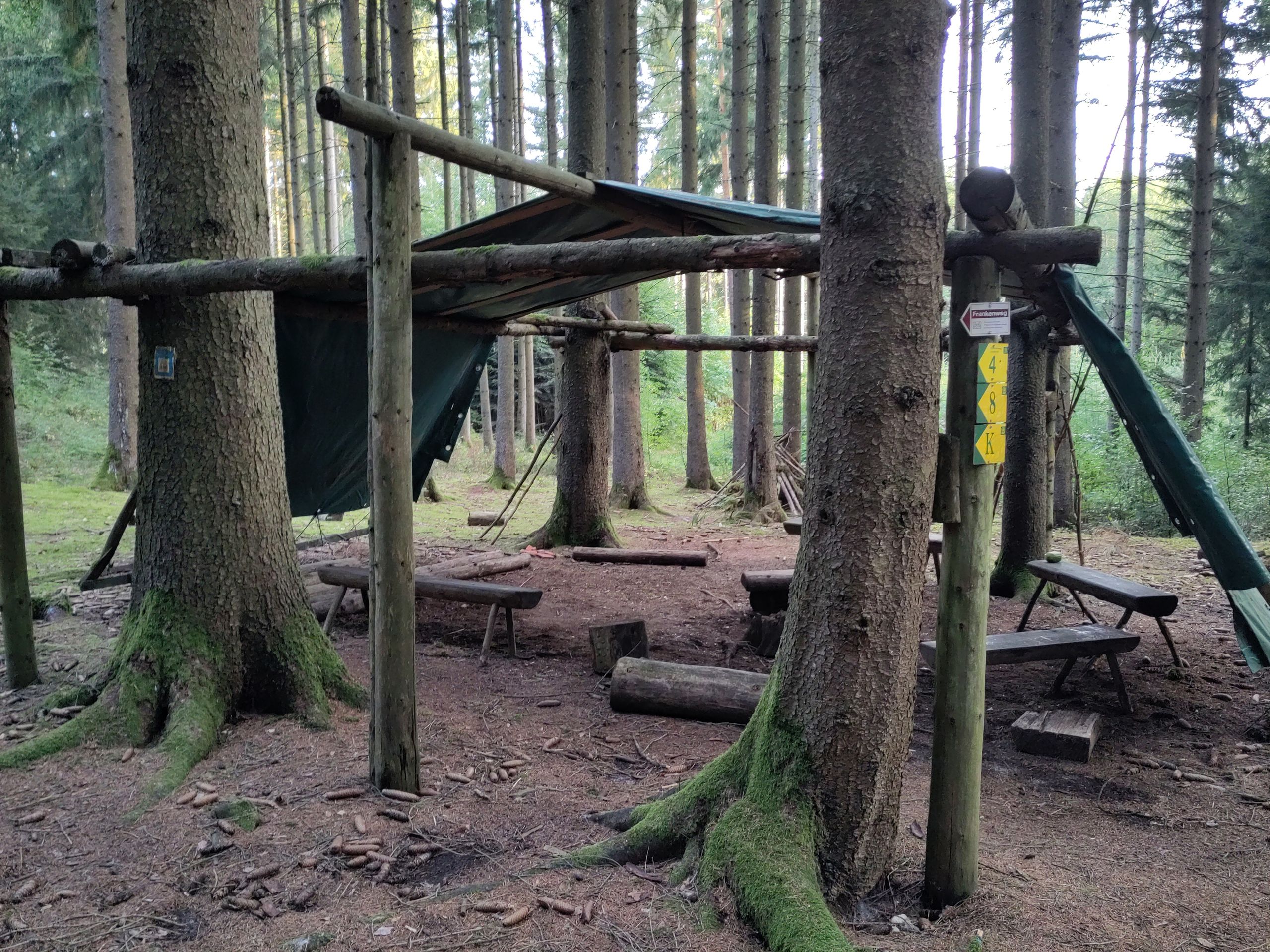
Above Thalmässing, we sleep under the tarp of a forest kindergarten in the middle of the spruce forest, and at night there are heavy thunderstorms around our not quite waterproof roof. The day before yesterday, we considered in each town whether we should dare to go further or wait for the likely impending rain near some shelter. We crossed the A9, which echoes over the landscape, and stood for a long time on the bridge, somewhat puzzled as we watch the endless stream of trucks and cars rush beneath us: when walking, the reality of an expressway seems somehow foreign... In Obermässing, two inns and an ice cream parlor are marked on the map, but nothing of that exists anymore in reality, 'everything is dead here', as a (very talkative) local explains to us. However, after we had a snack in the drizzle on a bench and cooled down a bit, I discover that the butcher (which still exists!) serves coffee - grateful, we enjoy this hot delicacy before moving on.
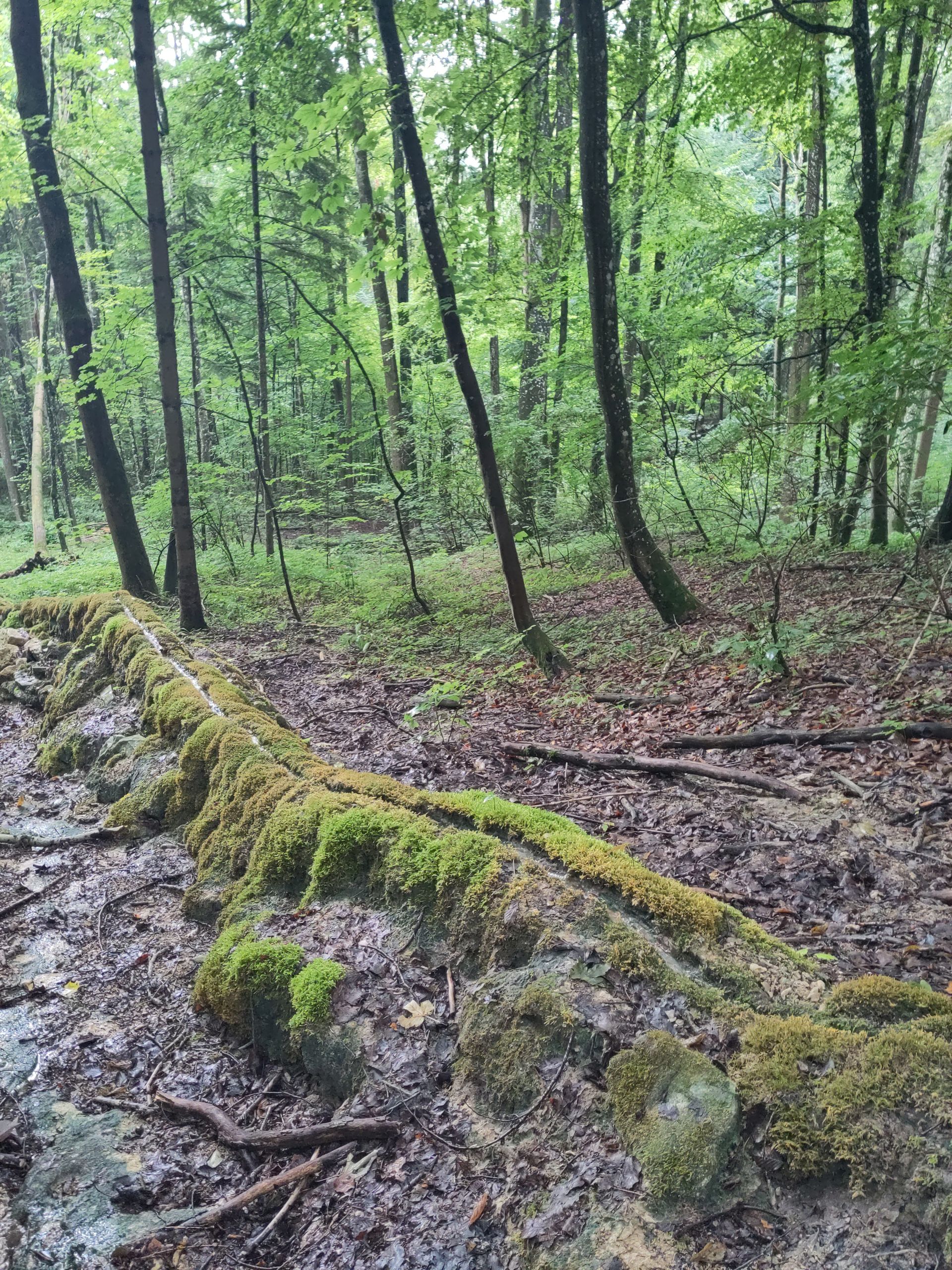
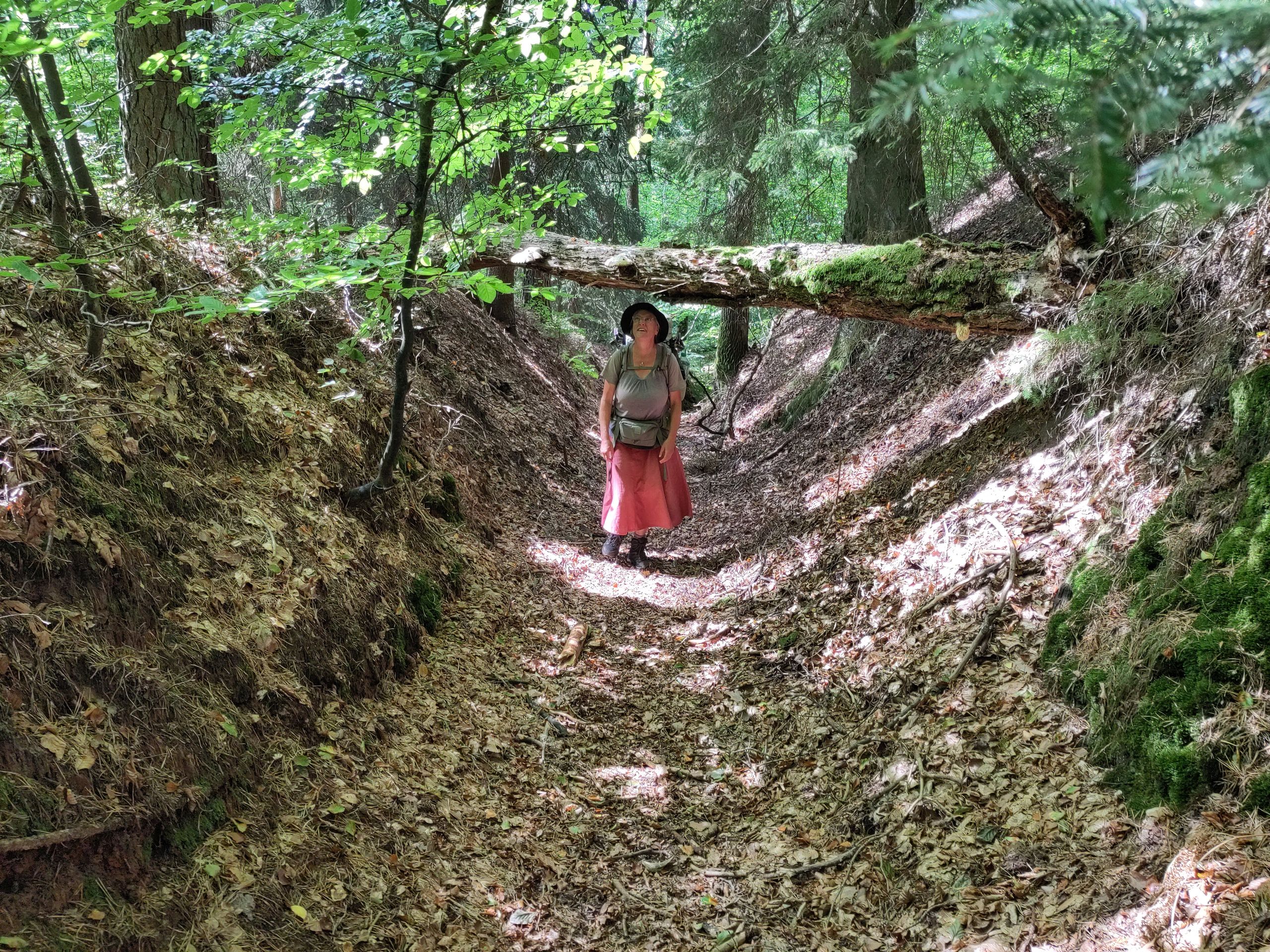
The Frankenweg ('from the Rennsteig to the Swabian Alb', marked continuously since 2004) zigzags not very linearly through the landscape. We still go steeply up and down again, often through woods, but also a lot over field paths. As we are still in karst area, many dolines are found in the forest, holes and cracks, trenches, and mounds (often from Celtic times). Here iron oxide is often present and colors the earth, the sand (stone) in various shades of red. Twice we come across a 'stoned run': absolute wonders of nature! About 80 m long and 1 m high, under certain conditions, a moss-covered narrow channel builds up from deposited tuff. This sensitive structure grows 1-2 cm per year! The walking paths are even less traveled than those in Swabia: for days we do not encounter another person (except for a farmer with a tractor or the one we ask for water over the garden fence)! Again and again, we encounter ticks, once in a while there are a lot of ants where we want to sit or lie, from time to time jays curse our arrival in less melodious but loud ways when we enter the forest, otherwise, we see more deer and hares than humans. I wonder why I don’t see any squirrels in the woods - maybe it was too hot for them to scurry around? The marking of the Frankenweg is less 'professional' than that on the HW1, and also partially 'aged' - mainly a type of sticker was used, which is often faded or badly weathered and illegible. However, often already with or next to that, there are new (hard plastic) signs; more often than not, we don’t find the way right away and then have to go back a bit or differently. For instance, we find ourselves in the little village of 'Dixenhausen', through which our route had actually not run... and we meet three 10-12-year-old boys who are happily and merrily carting dried corn plants into the village. We ask them what they are doing. They explain very seriously that they grew this corn themselves, and now they will chop it up - they precisely describe their machine - and then 'spread it on our fields', when we ask, they say each has a small own field or garden. We are pleased that there are still kids in the countryside who voluntarily and obviously with joy and pride lead such lives in their school holidays. Together with the young people at the 'witch dance place', who described themselves as 'still normal, even though we are young', and the couple of high school students we met in Harburg, who asked with great interest and enthusiasm about our hiking and sleeping outdoors, expressively stating that their peers have 'only mud in their brains'... these three encounters make us thoughtful: happy and sad at the same time. In both the first cases, the young people expressed that while they feel 'normal', they feel 'not quite belonging' among their peers, 'since we do other things than just hanging around with technology', for example. By the way, the young people at the campfire up on the Nagelberg were indeed very quiet, we slept well and were not disturbed by them, even though they claimed to return home 'not before 2 AM'.
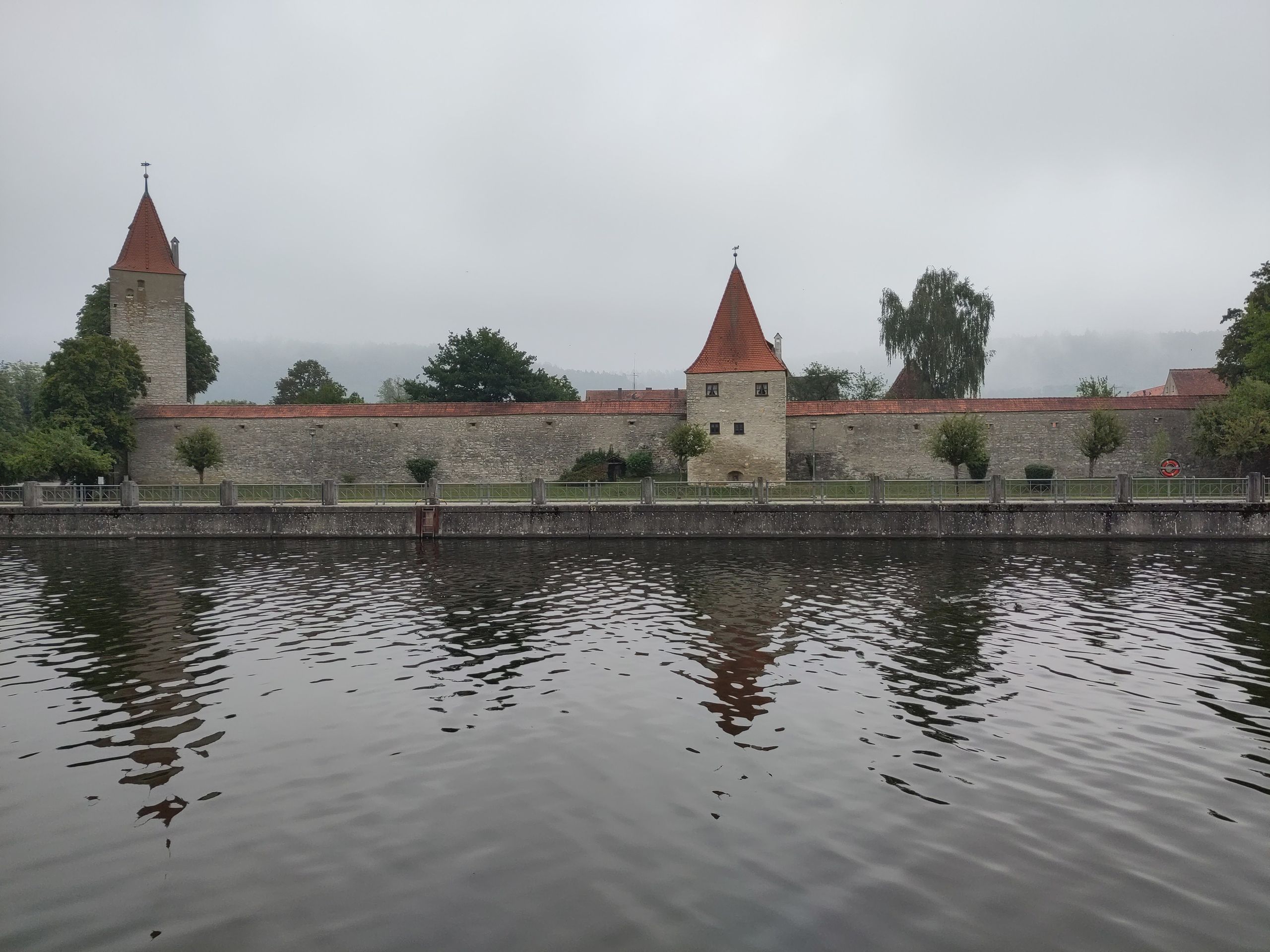
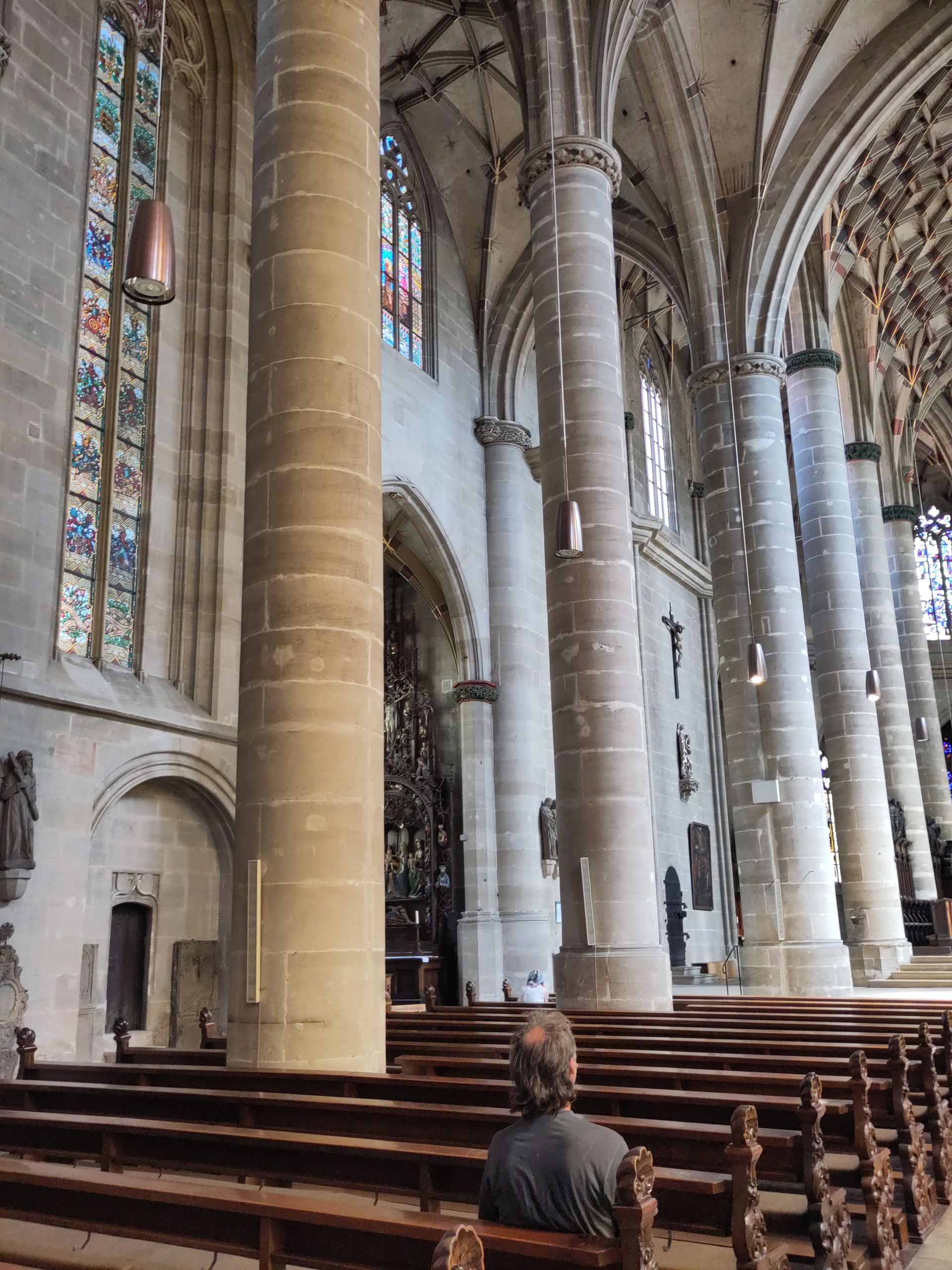
The day before yesterday, we arrived in Berching at the broad Main-Danube Canal. Berching has an intact city wall with many towers and gates. It is humid and cloudy as we stroll through, but we really like it. Later, the path leads for a long time through a forest that is unusual here: very sandy floor, heather, and (brown-dry) blueberry bush under exclusively reddish shining pines, between them moss and sometimes an oak sprout. While we rest on (moist) moss cushions in this special forest, we are surprised by rain, so we seek a partially emptied firewood covering to wait out the further rain - and soon the sun shines again. After the rain, paths and fields are covered with tender green: tiny seedlings, previously dry seeds that are now sprouting. By the wayside, deep black-glossy deadly nightshade lures on its stately shrubs. Many wind turbines (often largely standing still) shape the landscape. At some sleeping spot or during many kilometers of hiking, we hear the sound of their turning blades. Yesterday we passed by a newly constructed, even taller wind turbine, beside which a simply unrealistically tall crane and the three rotor blades still lying on the ground: how enormous they are!! Now and then, the view falls on a landscape that is actually rural-dreamy, where high forest trees and high church towers are regularly overshadowed by 'wind power plants'... ...and then again we enter a forest where light spots dance on the path, where silence prevails, the leaves rustle and whisper softly when a wind moves them, the thick gray (mainly) beech trunks rise massively - when I enter a Gothic church, like in Schwäbisch Gmünd, the high columns often resemble beech trunks in the woods.
'To start walking again to learn it, to clear the head, goes better in the distance! To walk calmly and dare to trust, to experience goodness and pass it on!' - I find this quote (unfortunately without an author's indication) in the 'guestbook' of a church: they speak directly from my heart! Even if the past night in the protection of a bus station roof in Neumarkt in der Oberpfalz was not very refreshing: the bell of the nearby church rang loudly and fully every quarter hour...