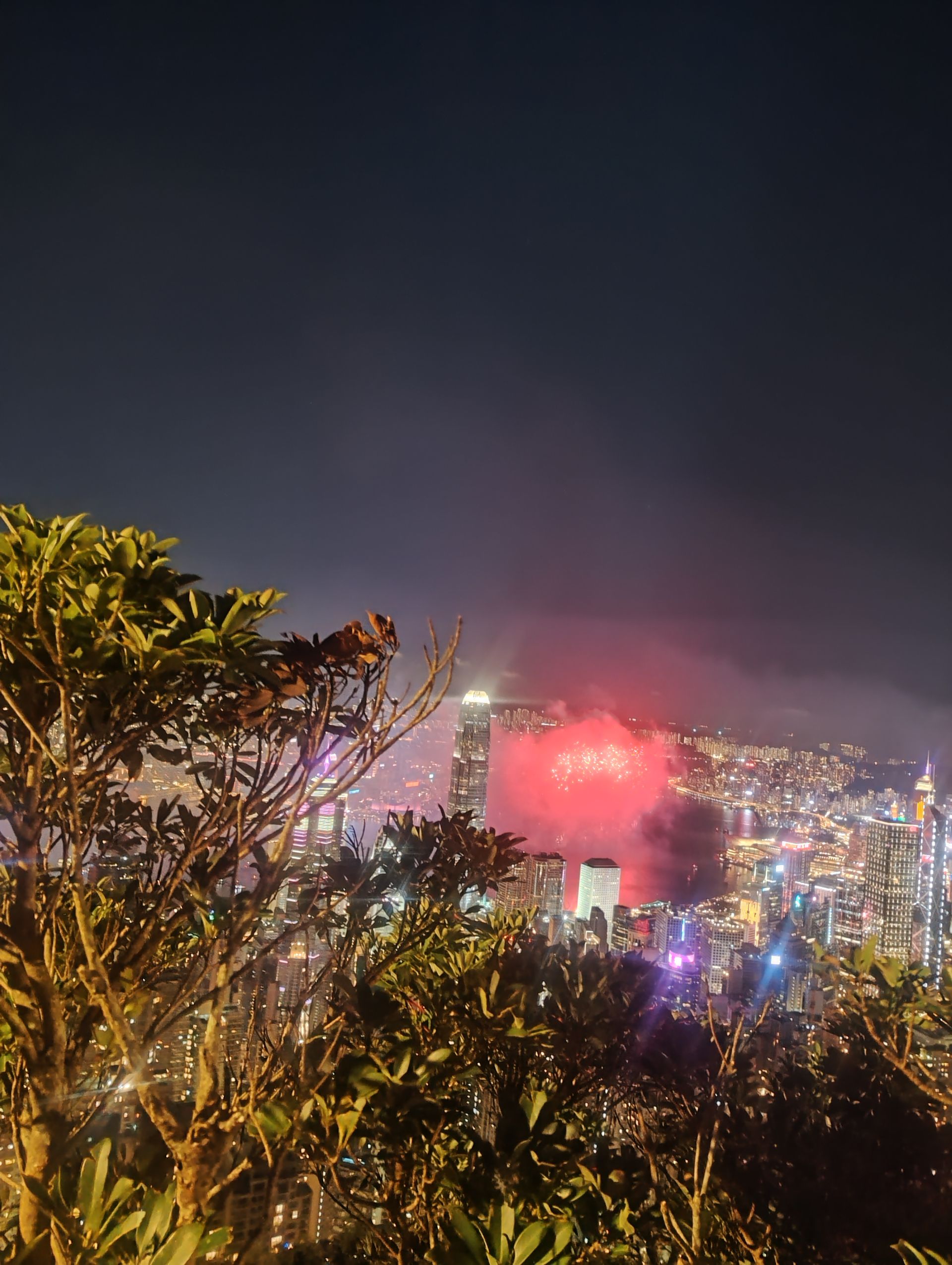
Chinese rockets explode over the sky of Hong Kong. Two rows of ships face each other in the strait between the city’s peninsula and island. In the middle, there are flashes and lights. Delayed from the detonations, the thundering sounds reach me from a safe distance. It is not the beginning of World War III, but merely a display of power from China. The ships are not aircraft carriers, but simply tourist boats. Like every year on October 1, the government has organized a fireworks display for Independence Day. I hadn’t actually planned to visit Hong Kong, but Darryn and Leo raved about it so much that it piqued my curiosity. Additionally, Hong Kong is a great place for hiking. There is a law that mandates a certain percentage of the city-state remain natural. Every felled or downed tree must be replaced. Therefore, about 50% is undeveloped.
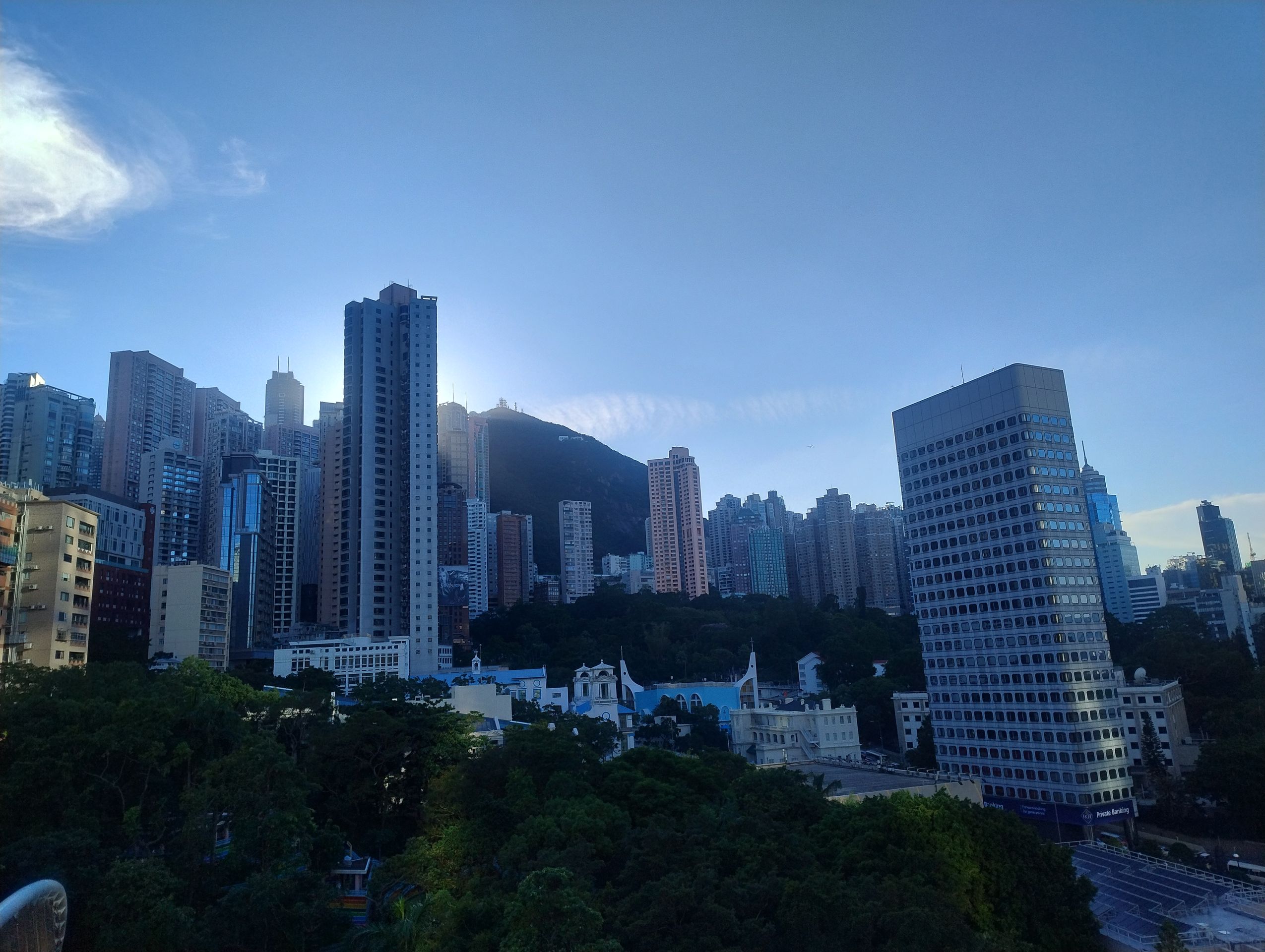
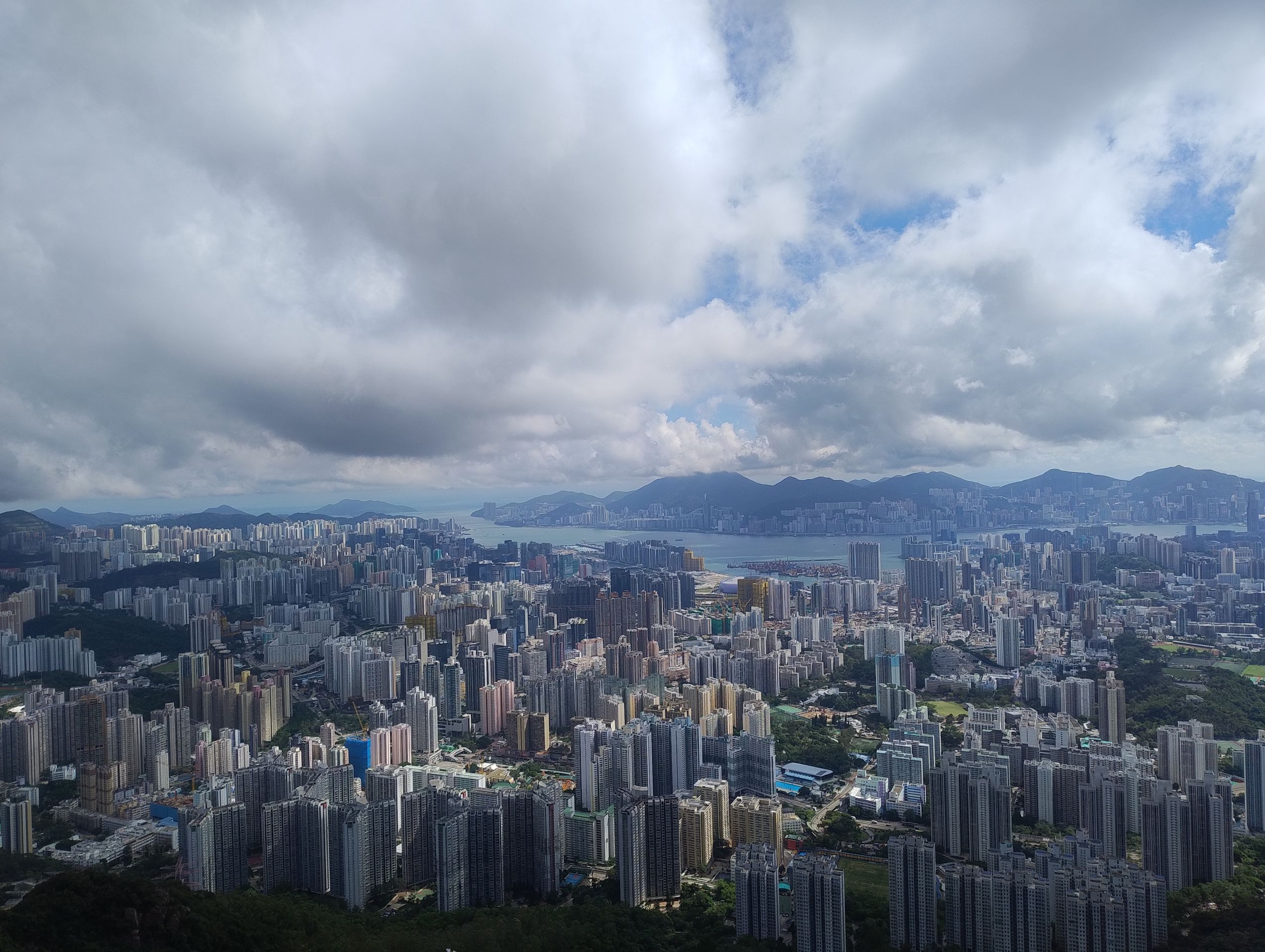
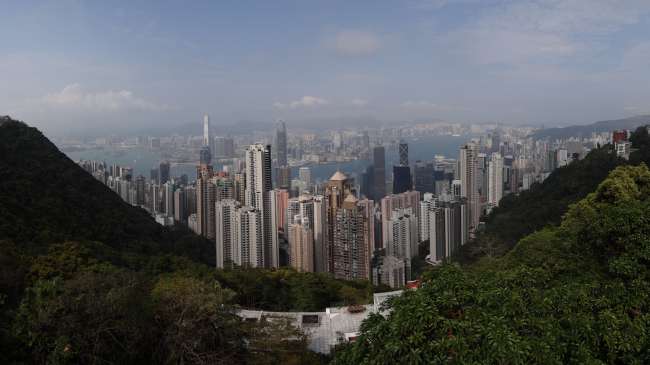
Now in the evening twilight at Victoria Peak, looking over to the mainland, I see the results of this policy. The multi-story apartment blocks and skyscrapers are surrounded by green mountains.
Before the fireworks begin, I strike up a conversation with an Italian woman who lives in Hong Kong. I guess correctly: She is a banker. Among the crowds of people standing by the fence of the mountain path, police patrol. A noise from the slope startles them, and they call something in Cantonese in the direction where they suspect a person is off the path looking for a better view. 'That's not a noise of an animal,' I say skeptically to the Italian woman, and she agrees. It sounds more like the noise of an animal rustling through the bushes. There are no monkeys on this side of the island, but she suspects it could well be a wild boar. They have even been sighted in the city sometimes. I look down and instead see the silhouette of a hedgehog, which is hardly interested in the fireworks.
A London that works. This is how Hong Kong is benevolently described, and it fits. The left-hand traffic rolls smoothly, the double-decker buses are on time. The crowds during the holiday week are guided by the police. When the traffic island gets too crowded, the crossing at the traffic lights is cordoned off with a tape.
As is customary in Great Britain, museums and public toilets are free of charge. The signal yellow of the road markings, the parks, exterior and interior designs, the door locks - everything embodies playful UK aesthetics.
The people of Hong Kong speak perfect English. But whenever I encounter people in restaurants or stores who do not, I suspect they are mainland Chinese, whom the party has increasingly settled in the city in recent years to break the resistance. Apparently with success - since Corona, the demonstrations seem to have been smothered in their infancy. In a park, the flags of Hong Kong and China hang side by side. The Chinese flagpole is raised by a few centimeters, but clearly visible.
In a bar, I observe a woman setting up a tarot deck. She offers to read my future. 'Thank you, but I really don't believe in that,' I try to sound polite. But since I have nothing better to do, I join her at the counter and ask her about her work and life in Hong Kong. Tarot card reading is a 'tradition' from the West, but she has already been doing it for three generations. Her grandmother taught her. As she describes it, it sounds a bit like her superstitious customers are just booking a therapy session with her.
But she is primarily a teacher. Every morning she goes to her home to prepare food for her grandmother before she then gives private tutoring at a confessional school. Interestingly, there are differences in learning there. Mainland Chinese are generally good at math, but more abstract text problems are better solved by their classmates from Hong Kong families. Perhaps a talent fostered by liberalism, less so by a one-party dictatorship.
I have nothing to lose, and a first tarot round costs just five euros. So come on, what does my future have in store? Some of her analysis about me is predictably vague, but some surprisingly precise. The actual talent of fortune-tellers is, after all, their understanding of people. In two to five years, at any rate, I would have a family of my own, which is nice. I don’t ask for a money-back guarantee. It was entertaining at least, and I have sunk five euros into dumber things.
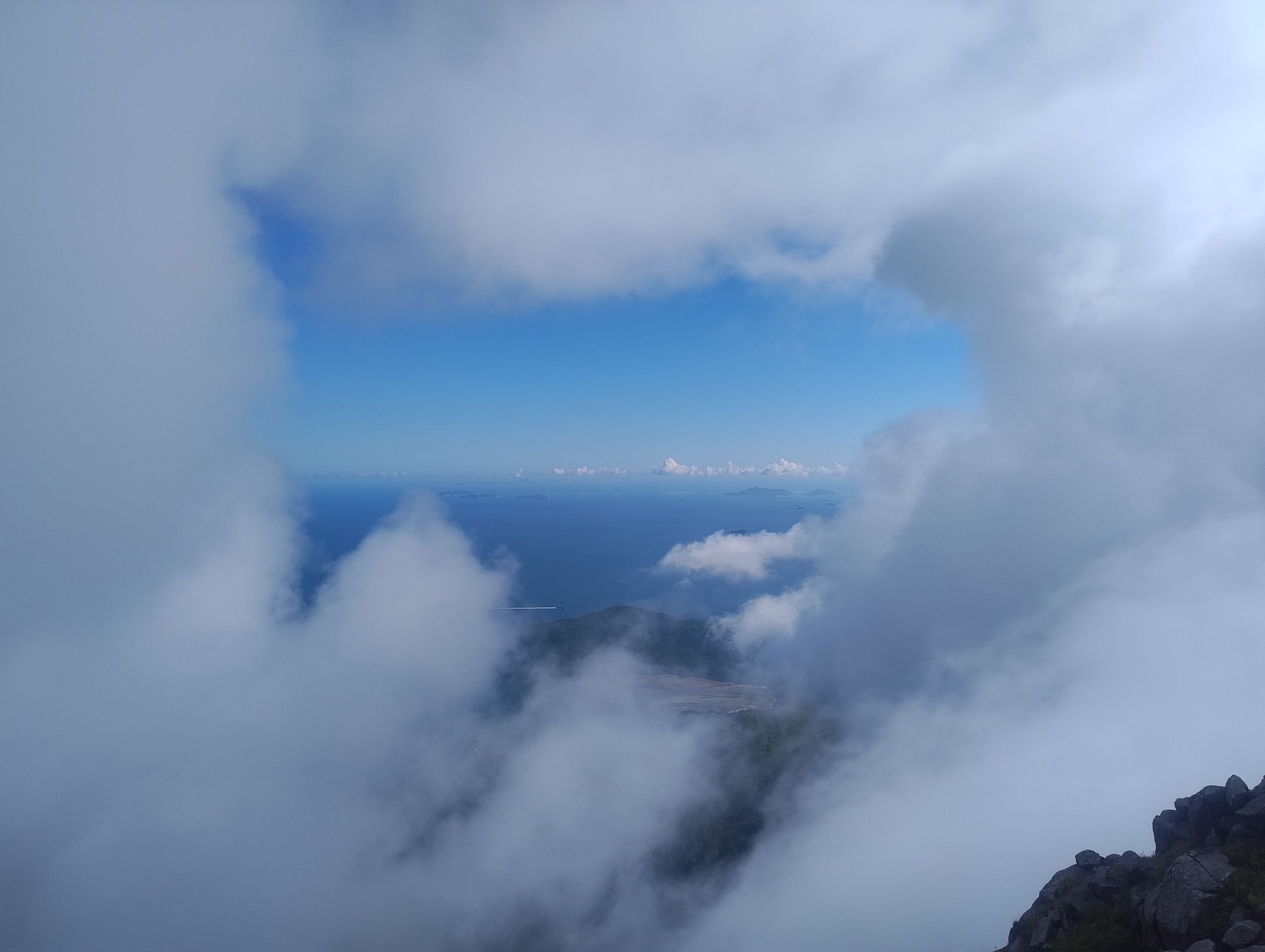
On my first hike, I once again overestimate myself. After a month of rainy season in Vietnam, I am no longer used to the heat and have to descend again at 300 meters elevation. I actually wanted to climb Lantau Mountain, the highest point of the island of the same name. But I am sweating from every pore, my academy running shirt is drenched and my water bottle is empty. Down by the shore, a café container looks inviting. A nice older gentleman makes me an iced coffee and brings me lunch with a free soup on the side. It is said that the people of Hong Kong are unfriendly. I cannot confirm that. At least no more or less than what one would expect in a big city. Berliners have no equal when it comes to rudeness. Instead of walking the entire way, I take the cable car, to then hike up from the tourist spot Ngong Ping to the peak. From the gondola, I see towards Macau a multi-kilometer traffic bridge that seemingly disappears into the sea on both sides. It is a tunnel designed to allow larger ships to pass through, a Hongkonger explains to me. For the mega project, that is, bridge and tunnel, it took less than 10 years.
I do not want to go to the Asian casino of Macau. Instead, a short trip to the Chinese border city of Shenzhen is appealing. I can visit the administrative zone visa-free for 36 hours. The express train from Hong Kong takes twenty minutes.
In meticulous preparation, I downloaded the three most important apps needed to survive in China. The Chinese Google Maps 'A-Maps', the taxi app 'Didi', and 'Alipay', which is used for payment. What I didn’t consider is that my current SIM card for Hong Kong does not work on the mainland. Without the internet, all my apps are useless. Cash is almost abolished in China, and I can just forget about paying with my debit and MasterCard as well. Without a functioning phone, a 21st-century traveler is disoriented, but in China, they are utterly lost.
I sit resignedly in front of the train station, which, in addition to my dilemma, is not the one I thought would be my arrival station. Shenzhen Central is twenty minutes away from my hotel. Shenzhen North, where I currently am, is about twenty kilometers further. A young Chinese man sits down next to me. I ask him if he speaks English, and he nods. However, he truly cannot understand me. My translation app does not work offline, and I cannot manage his. At least he can use this to ask me if he should provide a Wi-Fi hotspot. 'Yes, please,' I ask him. With that, I can at least order a taxi via 'Didi' and pay for it with Alipay. I thank him and walk to the pickup point, but I see no road where a taxi could drive on the square. Again without the internet, I am just as lost as before. A family man walking to the station with his wife and children sees my despair and offers his help in flawless English. Just at that moment, I receive a call, which obviously comes from the taxi driver. So calling works, just not the internet. The helpful Chinese man takes the call, but the driver probably says he can’t make the trip. I still thank him for his help.
I wander around the area and for a moment find a guest Wi-Fi access. With that, I search for a metro connection using 'A-Maps'. At the counter, I again ask the ticket seller about a hotspot for the internet and can pay via 'Alipay'. Annoying, but it works, and I finally reach the hotel two hours after my arrival.
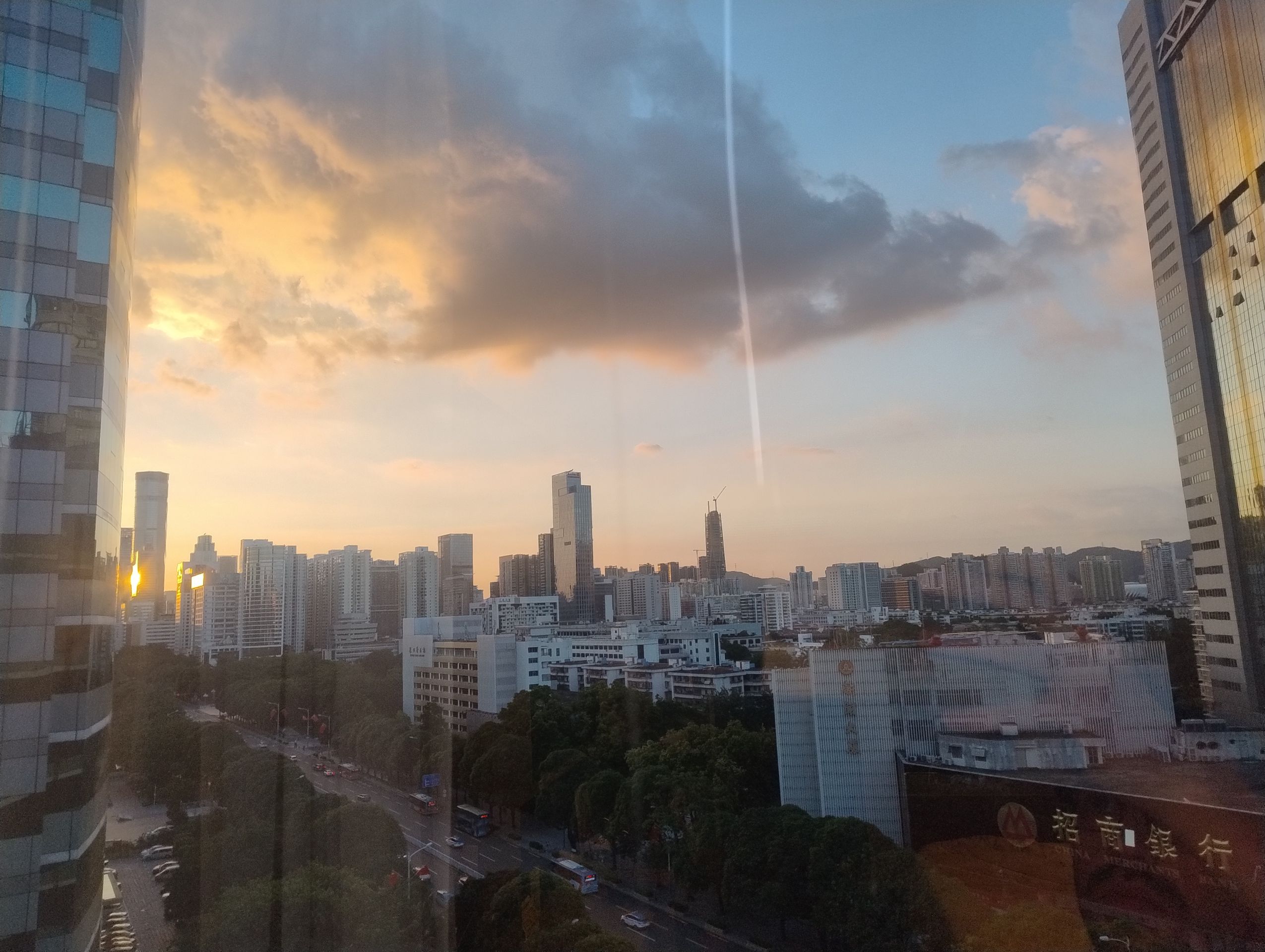
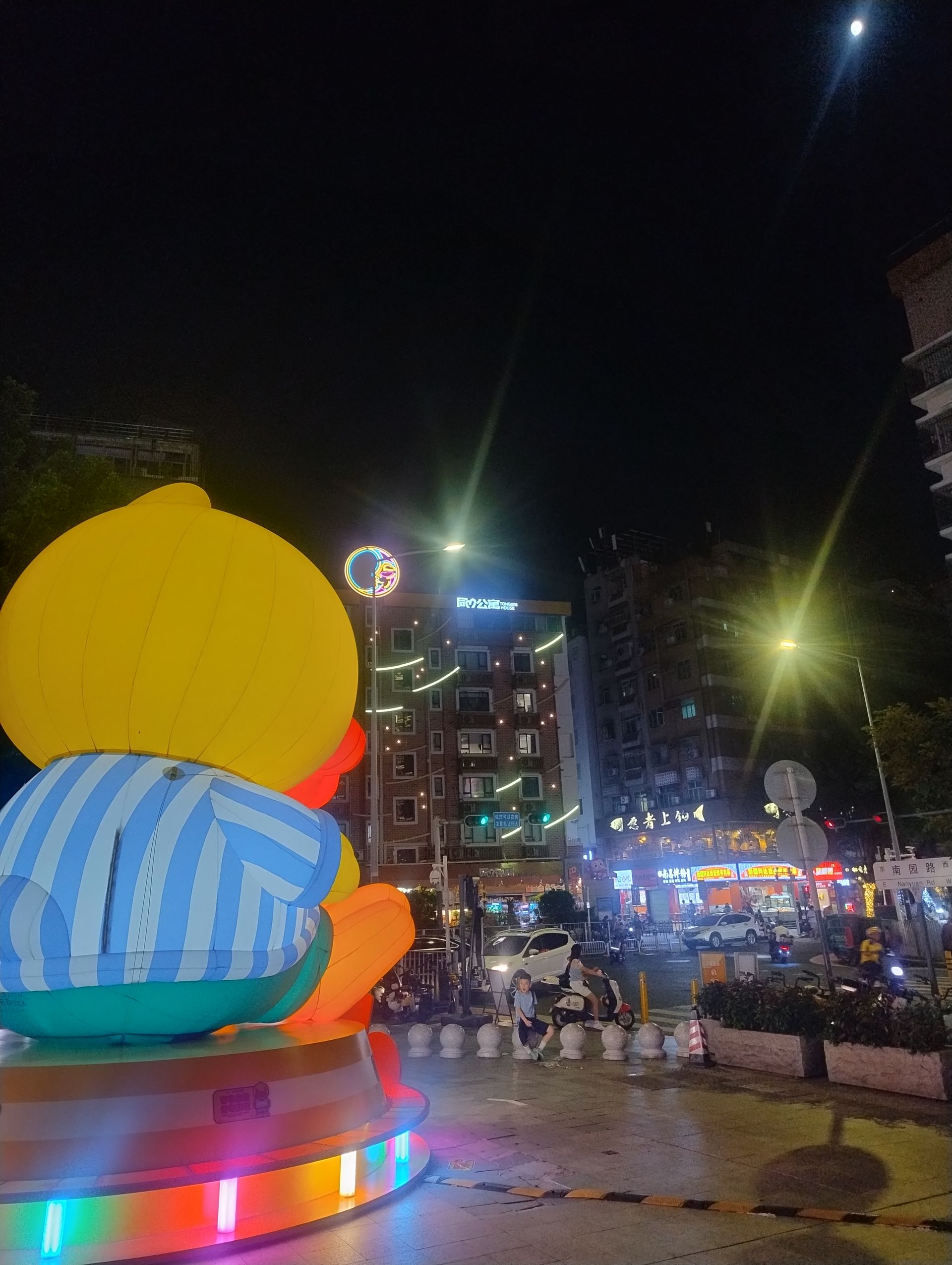
With the same method, I settle all further expenses: Ask for Wi-Fi and pay with Alipay. In the restaurant, the waiter asks me if I would like my food spicy. I mime my usual 'No, I’d rather not' face that I always make with this question. He types something into his translation app: 'A touch of spiciness?' That works, I can indeed handle a hint of spiciness, especially due to the nicely phrased translation. Walking through the streets, I first notice the many e-scooters with seats. The Chinese ride them at breakneck speeds on the sidewalks, and one constantly has to be careful not to get run over. More than in Hong Kong, I expected that people in mainland China would follow rules. But not so fast. Despite the many cameras, people constantly cross streets on red. Men openly urinate against a power box on the side of the road.
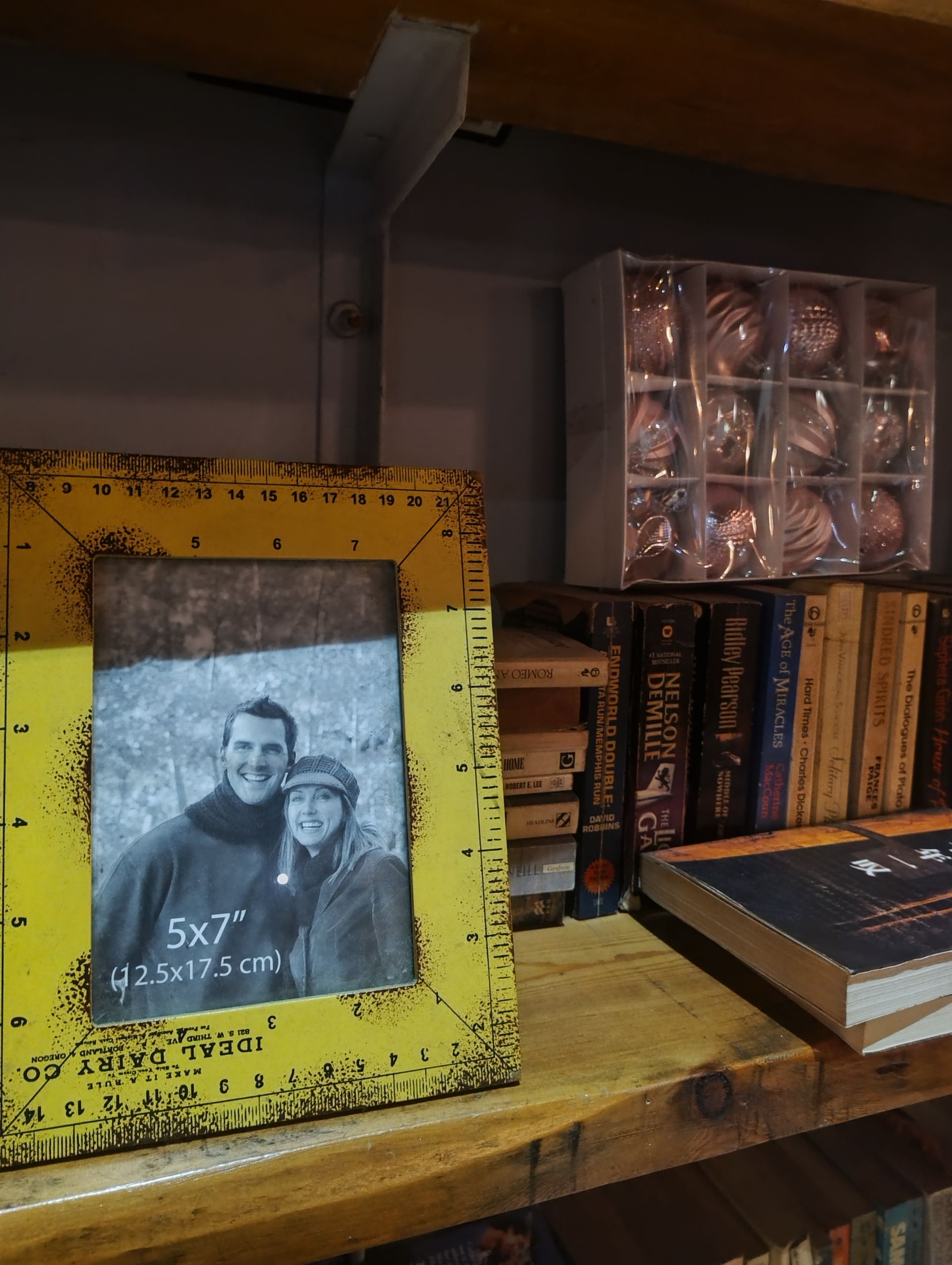
In a café, I wind down for the day. 'Europe - Style - Simplicity - Nature' is the motto of the place. At least that’s what it says on the well-worn menu. The cover depicts the skyline of Istanbul. Europe, after all. If the Chinese are good at one thing, it is imitation. The imitation of a generic European café seems almost satirical, but it is sincere: Year-round Christmas decorations, plastic flowers, Ikea interiors, and wall tattoos with clichéd calendar phrases. In a picture frame still hangs a print of the white patterned couple. They didn't even have to replace it, after all, they look western enough. On one wall hang portraits of Hollywood actors. Across from it, a black-and-white photo of a street scene in London. However, it is reversed. But to be fair - if an image of Beijing rotated in the opposite direction were hanging there with all the characters, I probably wouldn't have noticed either.
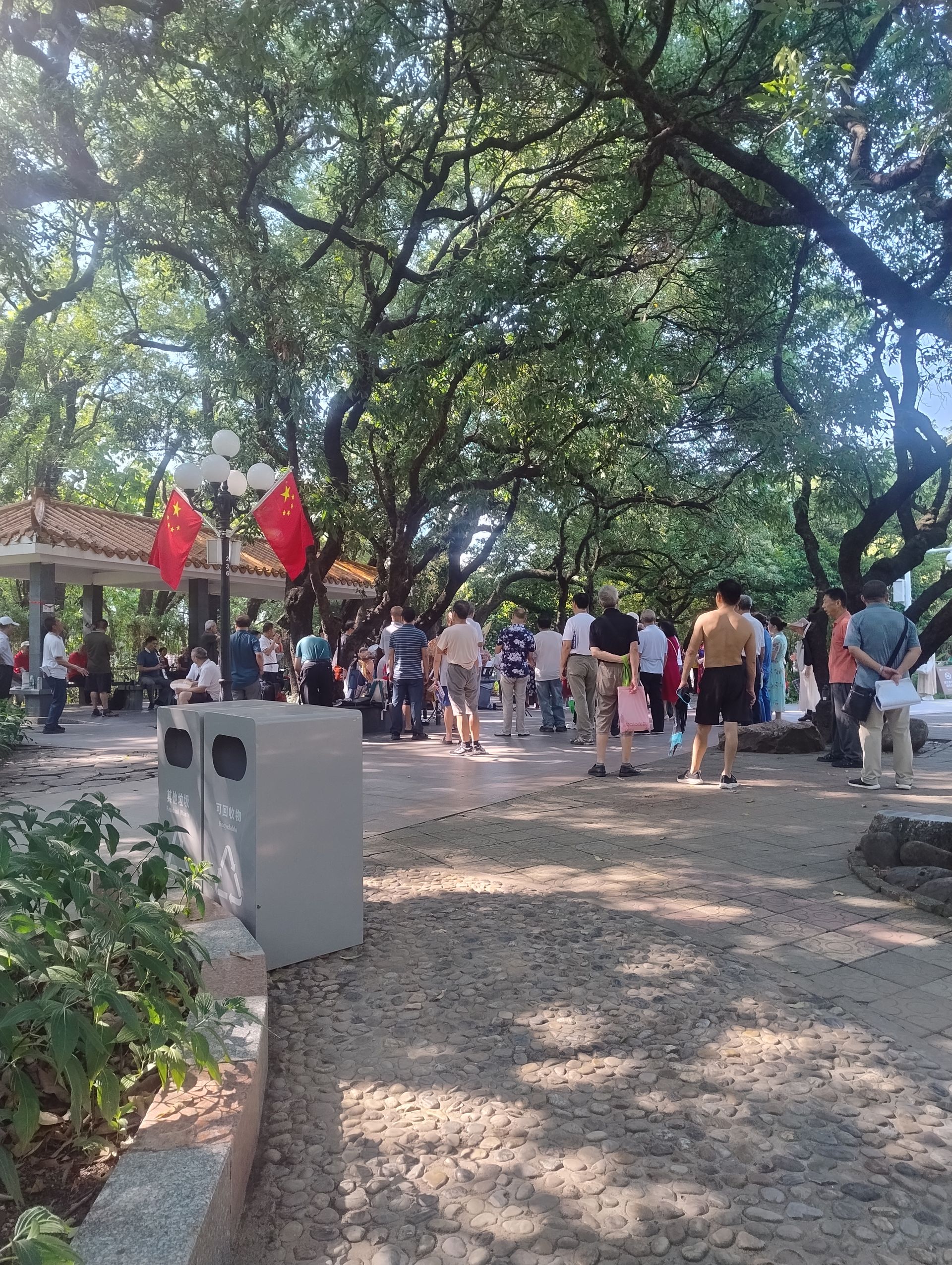
Looking for a place to have breakfast the next day, I stroll near the hotel through a park. At the entrance, the old party leader Deng Xiaoping smiles down from an oversized propaganda image at the park's visitors. It's Saturday, and the whole neighborhood is up and about. People practice Tai Chi, do gym exercises, stretch, and pound their fists on their hearts and veins. Music drifts in from all directions. Either alone, in duet, or in chorus, the Chinese are playing their traditional violins and singing their folk songs, sometimes just twenty meters apart. A fantastic cacophony. I stop enthusiastically at a group of a few musicians with string and wind instruments and twenty to thirty bystanders singing along, and I sit down on a bench. The crowd sings with all their might. Some sway to the rhythm while others perform their boxing and stretching exercises. An old man holds a stick and demonstrates a combat technique to two young women. Groups are cheerfully conversing. Mothers with their strollers and retirees sing along as they pass by. These are evidently old songs that all generations know by heart. The whole scene moves me. The park radiates such harmony and liveliness that I suddenly begin to question my previous image of China. I realize that it has been far too dominated by politics and news until now. But in doing so, I have too much overlooked that people do not automatically represent the regime. China makes me scared, China makes me curious. Both feelings coexist in parallel. Ying and Yang.
While I am thus absorbed in thought, an old woman around 90 takes a seat next to me with her walker. She hums softly along and glances in my direction. Whether the gaze is directed towards me or the music, I cannot tell, but I feel as the only foreigner being ignored yet a part of the whole.
The old lady reaches into her walker, and I awkwardly hold the lid up. She retrieves a mandarin, peels it, and hands me half. 'Do zei nei,' I thank her. She waves it off, but her look is kind. With a few sentences in German, English, and Chinese to bid farewell, we converse in our foreign languages without comprehension. Still, it’s lovely that we exchanged a few words and friendly looks, I think, as I walk back to the hotel. With my half mandarin, I have found my modest breakfast in good company.
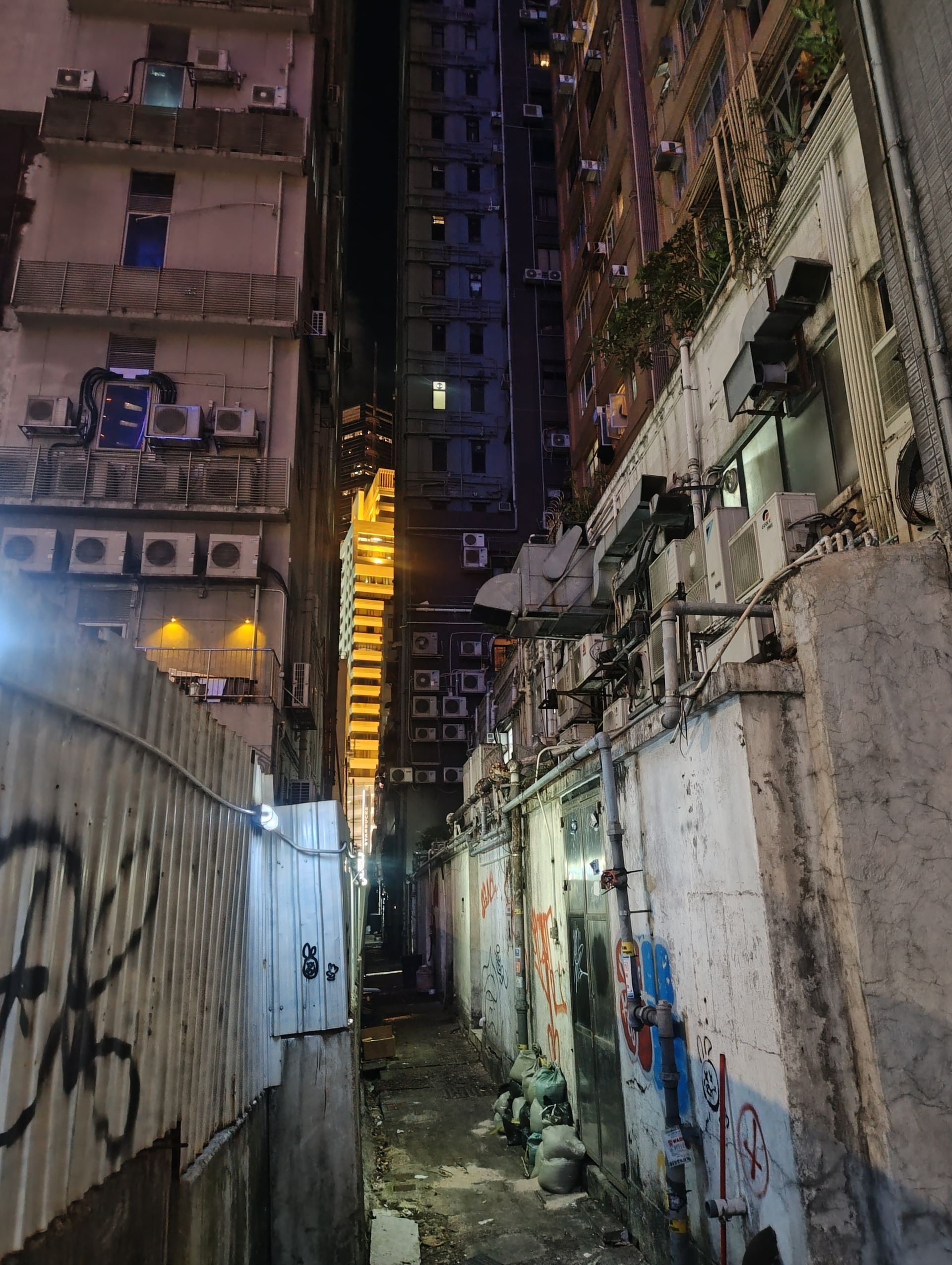
The Chungking Mansion is a famously notorious residential complex in the heart of Hong Kong. Downstairs, shops and inexpensive restaurants from various countries are located. Above, a murky labyrinth of corridors, elevators, and stairwells extends over about twenty floors. Within it lie countless hotels and hostels, attracting backpackers from all over the world thanks to their low prices and possibly their shady reputation. I only booked there because prices are too high due to the holidays. A bed in a hostel starts at 50 euros. For the same price, I can also afford a windowless room in the Chungking Mansion, which at least has a central location. Still, I have to forego the disadvantages of a window: The ventilation shaft acts like a tin can phone, and I hear traffic humming, cars honking, and engines revving.
To reach my cell, I have to stand in line for the elevator, as only two elevators go up to my hotel in the entire building. The system is completely confusing. The elevators only go to selected floors. Therefore, one must first figure out via a list of apartment names such as F3 or A2-4 which of the similarly named hostels and hotels like 'Holiday Hotel', 'Holiday Guesthouses', or 'German Hostel' and 'Hotel Russia' the respective elevator goes to. Asterix and Obelix and the pass permit A38 come to my mind.
I ask three times if and where there is a staircase, for the Nepalese hotel operator cannot believe it is possible that I’d rather walk six floors through one of the stinking stairwells than wait ten minutes for the elevator. I can navigate through the maze of corridors and staircases by the stench and characteristic dirt stains. Each time I pass the 'Boris Johnson is a wanker' graffiti, I know I only have to walk up two more floors.
Kowloon Walled City is now an idyllic park. However, in the 90s, it was the most densely populated place in the world. A residential complex compared to which the Chungking Mansion resembles a luxury resort. Since the Chinese legally claimed the area of Kowloon Walled City, there was no jurisdiction for the British here. Hence, the Triads operated their dealings in the area. Drug trafficking, prostitution, and 'illegal' dentists who did not obtain a license anywhere else in Hong Kong made the partly 14-story residential complex a frequently visited mini-neighborhood. Since the British wanted to hand over their beloved Hong Kong broom clean to China, things ended in 1993, and the wild collection of buildings was demolished.
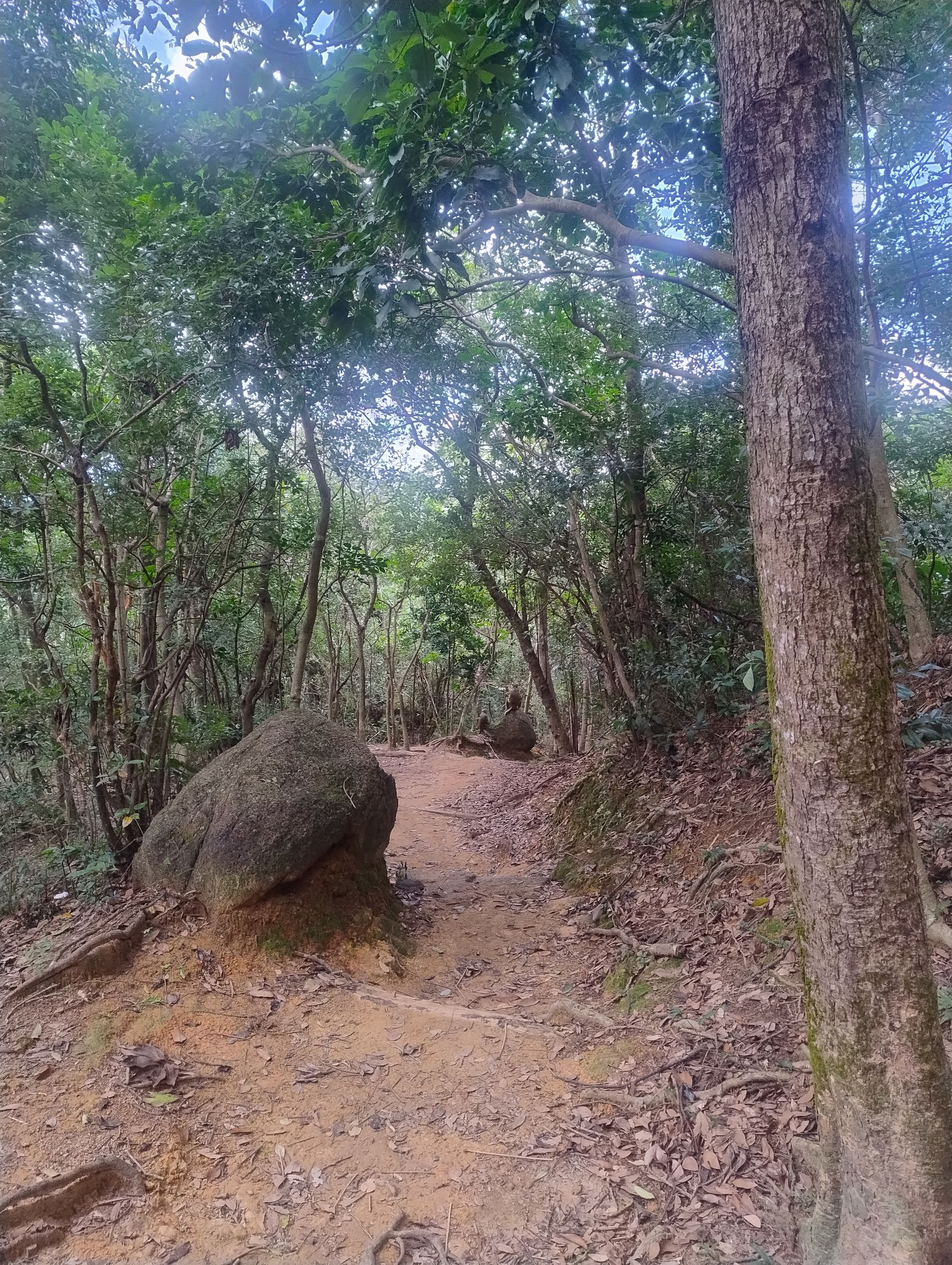
A hiking trail leads up to the mountains from Kowloon Walled City. The midday sun burns too strongly once again, and as I finally cross the ridge after many pauses in the shade and turn onto a path downhill, I hear familiar sounds coming from the trees. Unlike on Cham Island, this time it is Rhesus monkeys swinging from the branches around me and flopping down in front of me on the path. I immediately recognize that they have no fear of me and must take a detour. Warning signs later teach me that I have done everything right since improperly approaching the macaques can provoke them and they can go wild. On the detour down, I feel uneasy at the thought that my secret enemies, snakes, are anything but rare on the peninsula. In addition to pythons, small green poisonous snakes often wander into residential areas and bite people. A reptile even took the metro last month without validating its Octopus Card.
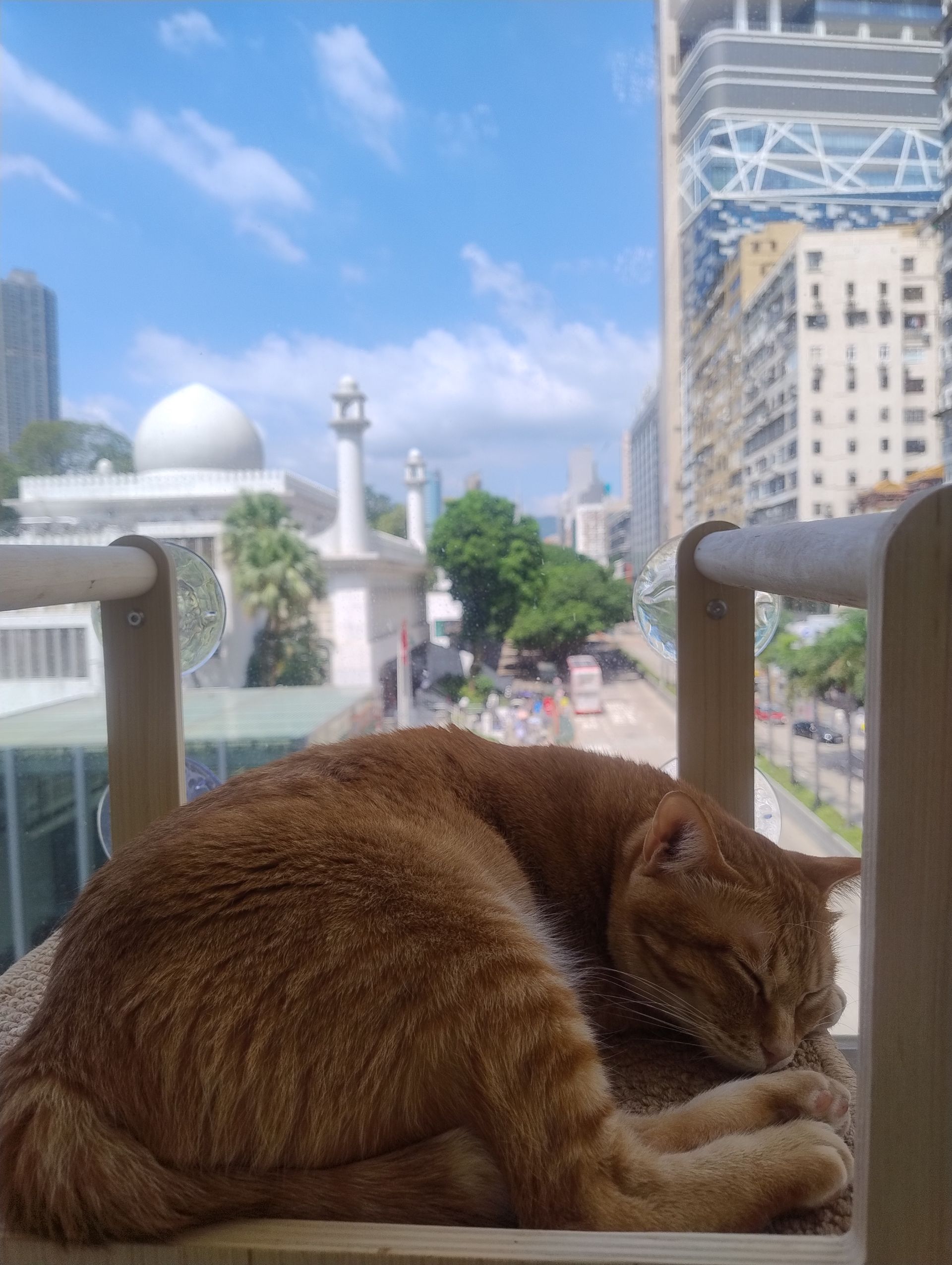
I'd much rather have my cats. The morning before my departure to Taiwan, I sit down in a cat café and reflect on the past week. My situation is similar to that of the policeman in the episodic film 'Chungking Express,' a reference to the building complex. The Hong Kong cop laments a past love that ended too soon. Ah Hong Kong, what could have become of us two...