Quietly, but audible to the few rows in front and behind us, the woman next to me in the airplane seat starts to sing. It's a gospel song. She begins to sing a second song. 'Thank you,' I glance at her as she finishes singing. 'Do you like it when I sing?', she asks. 'Yes, it's quite soothing,' her singing indeed lifts the mood amidst the monotonous noise of the engines.
Wati is a Methodist and as a pastor, she visited a friendly congregation in Australia. But now she is glad to return to Fiji. Around her neck hangs one of those chains you see in movies and documentaries about Hawaii. Hers is Christmas green, with a few chocolate candies attached. She suggests singing another gospel song in English so I can understand the lyrics: 'This is the day, this is the day that the lord has made, that the lord has made. We will rejoice and be glad indeed, and be glad indeed.'
The 65-year-old explains to me that she is from an island in the eastern part of the country. She shows me a video of a small ferry dropping off a jeep onto a raft in the sea to then transport it to the beach of her island. There are no roads or cars where she lives. Just to help at a construction site, they painstakingly unloaded the truck at the shore for the duration of the construction. She describes a wonderful village community that supports each other and where there are no locks on the doors, while she offers me one chocolate after another.
She would never travel with a lot of money, but always with her Bible. Her blessings on the road and in life in general come only from God, who hears her constant prayers. That's how she met a nice young woman from Fiji before the flight, who has now paid for her food during the flight. And that's how God placed me next to her so we can now spend the flight time chatting. 'See!' she comments after the landing announcement, looking at her Rolex, how quickly the time has passed. We already have a slightly different understanding of God and the world. But I don't say this out loud. Instead, I nod obediently. Her determination and kindness are disarming. Perhaps this supports the effect of her prayers to maintain the small miracles of everyday life. I received mine without prayer. Wati teaches me words in Fijian: Bula - Hello and Vinaka / Vinaka baka lebu - Thank you / Many thanks.
'Bula!', after the two ukulele players behind the border control have played their welcome song, they shout a loud 'Hello' to us passengers. If Wati hadn't taught it to me already, I would have quickly learned it intuitively. It echoes everywhere. On the streets of Nadi, every passerby greets me, so I soon take my headphones out. Fiji is not a country where one can stroll through the streets listening to podcasts undisturbed like in Japan.
A grandfather sits in front of a tree with his three grandchildren. 'Bula,' I greet him. 'Bula, have a good day.' - 'You too.' - 'God bless you!'
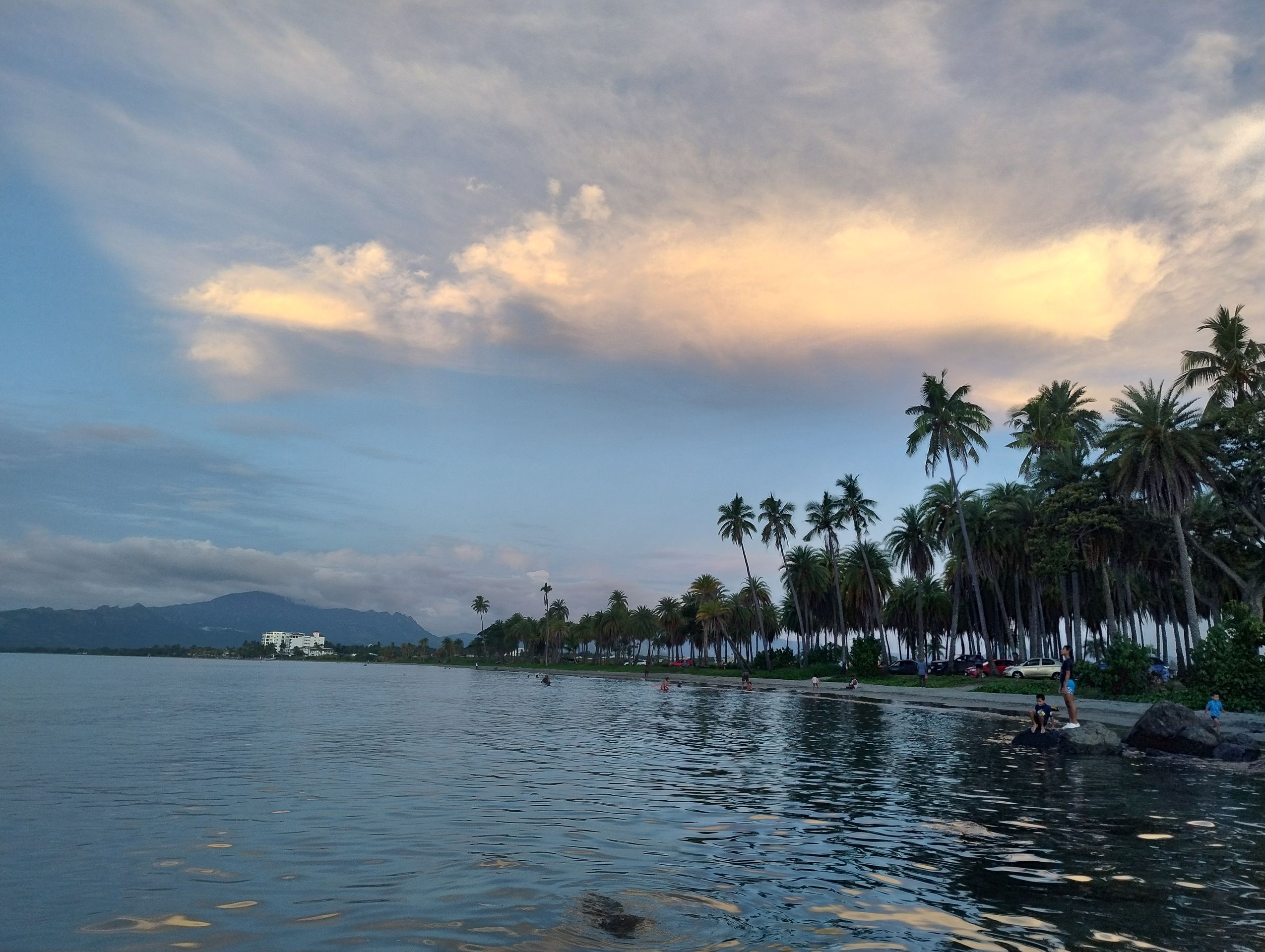
With my swift pace, I approach a man from behind, who turns uncertainly. 'Bula!', I call out. 'Bula!' - 'I'm just trying to catch the sunset,' I explain quickly as I pass by. 'Ah, better hurry then.' I arrive just in time at the beach to watch the sun set. Families sit on blankets, children swim in the water. 'Bula bula.' - 'Bula,' I greet and am greeted back as I walk along the warm sand.
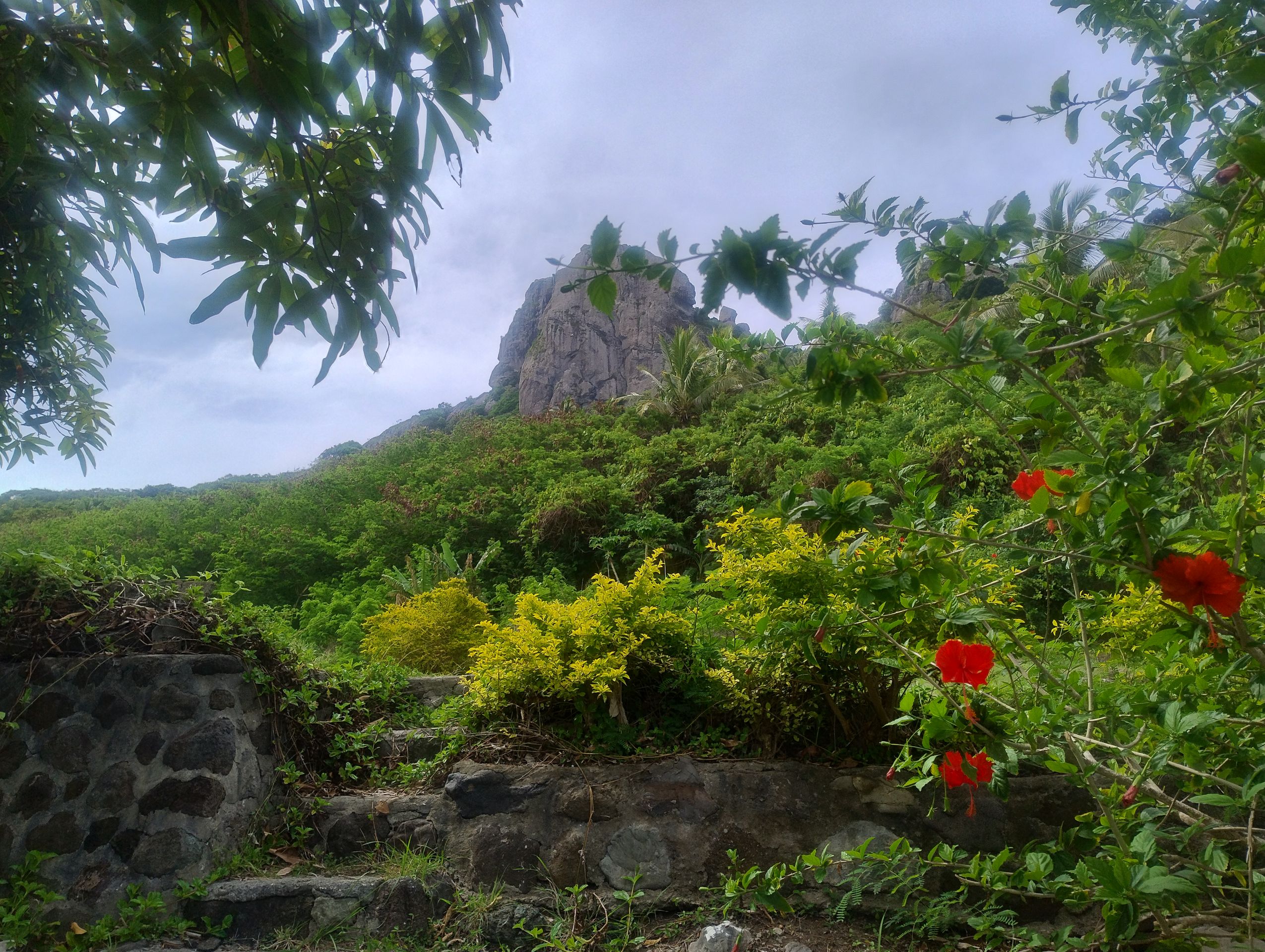
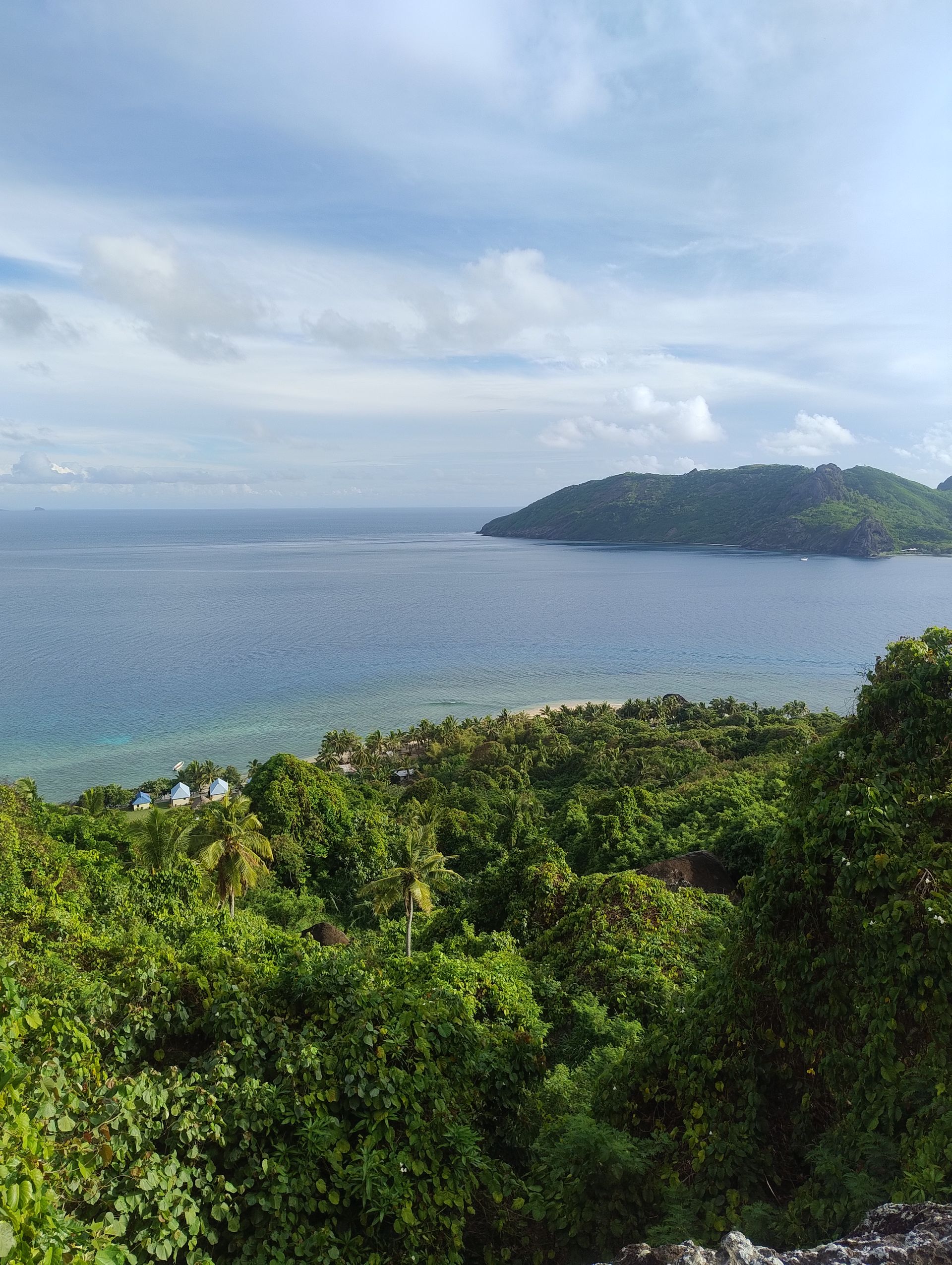
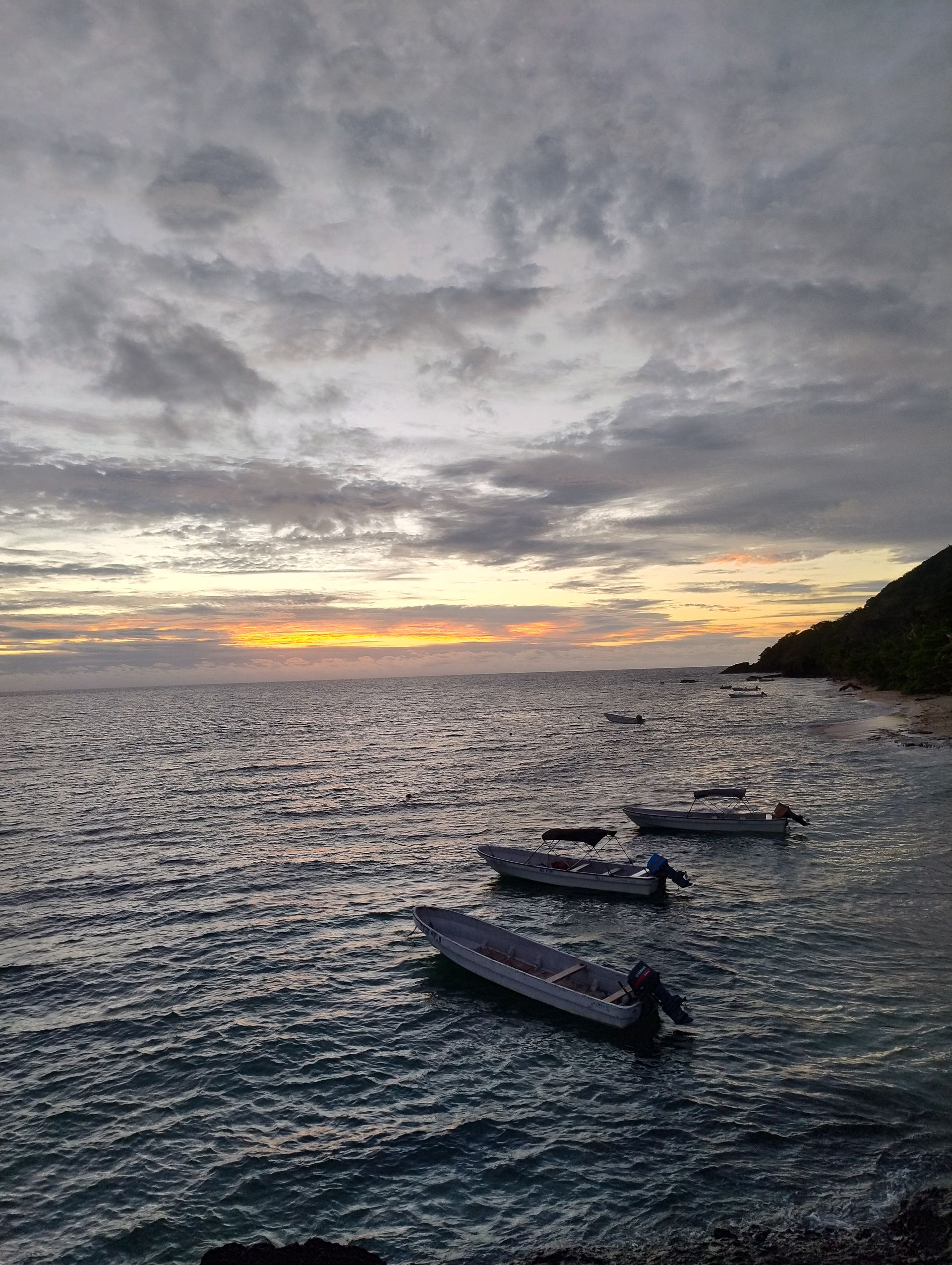
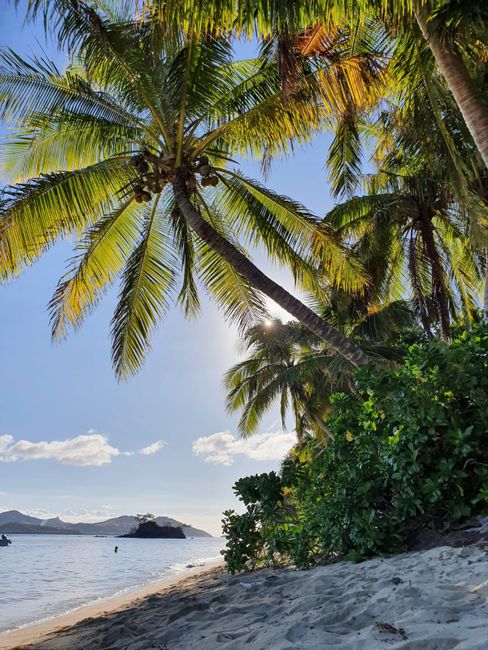
The ferry stops between two islands. One looks like it's out of a catalog: small, with sun loungers under palm trees, and a few bungalows in the background. The other looks no less idyllic, is larger, and rows of houses behind the beach form a small village. Above it rises a gigantic rock in the green jungle. I spend my next few days on the second of the two southernmost Wayasewa islands. From the ferry, I get into a small motorboat with three others and sit on the wooden planks. As the boat departs, Kyle and Scarlett, a British couple I met during the crossing, wave to me. Both have been on their open-ended sabbatical in
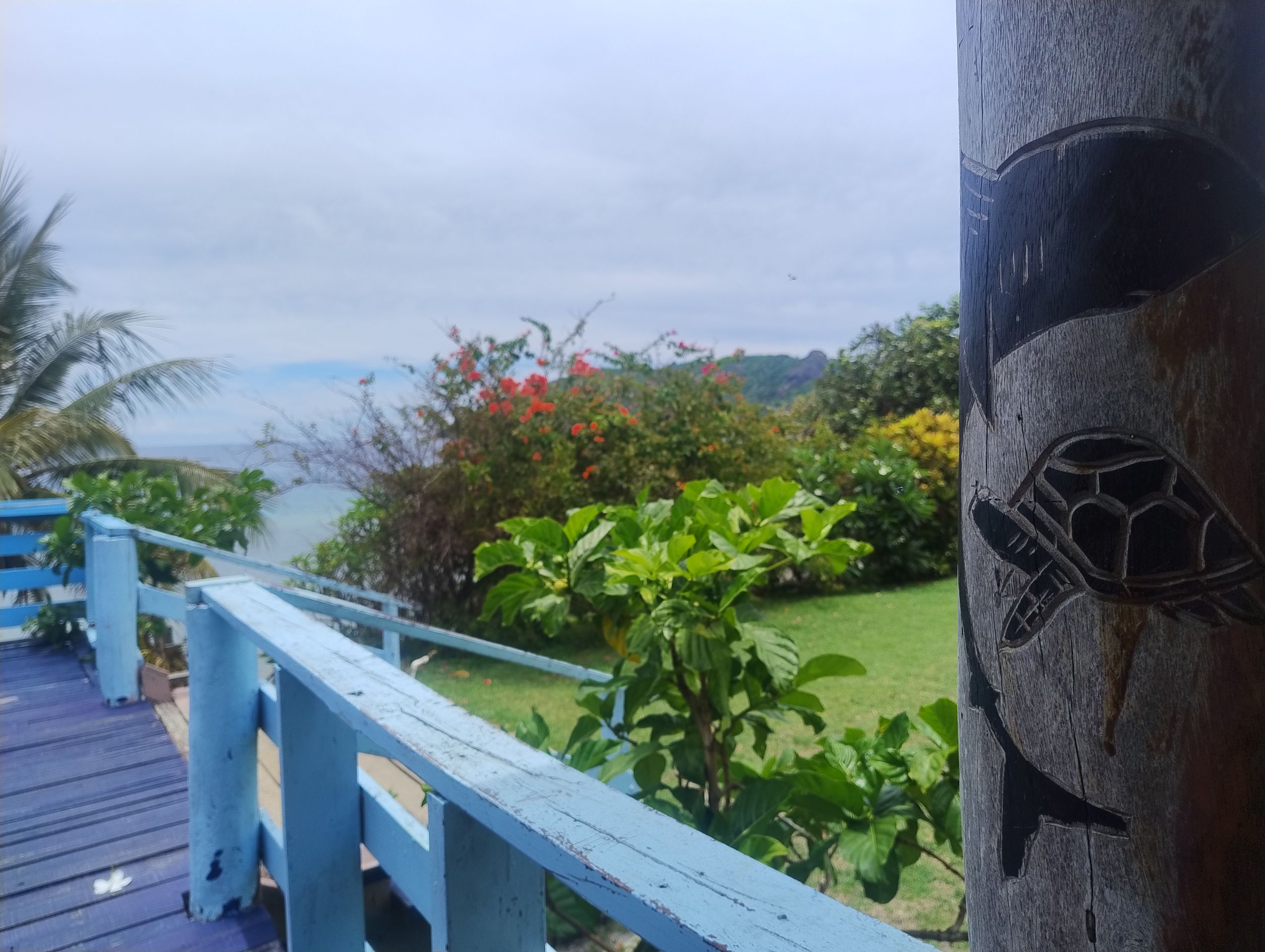
New Zealand and Australia. Two Dutch are dropped off at the beach near the homestays in the village. Michael is originally from Manchester and now works as a mountain guide in northern Italy. He and I are the last to be dropped off at the beach by the 'Wayalailai' resort. We receive a welcoming committee, three Fijians with guitars sing our welcome song in their native language and loudly shout 'Bula!' at the end. 'Bula!' we shout back as we disembark and 'Vinaka baka lebu!' Our bags are taken, and we are escorted to the main building. Tailo, an older lady with a serious expression welcomes us and explains a few things. There is a vague time for mandatory meals: 'When they hit the drums.' We are supposed to take our shoes inside. Recently, one pair was shredded by a guest's dogs. Otherwise, there are no dangerous animals on the island. 'Only dogs are dangerous…,' she pauses and looks us in the eyes over her reading glasses: '…cause they will eat your shoes.'
The drums sound, it's lunch time. We meet Marianna and Tonia from
Norway and Nicolas from France. In the off-season, they don’t have many guests, Tailo explains to us. Fortunately, I was upgraded from a dorm bed to a private room in the elongated bungalow. There's a board listing the weekly activities we can sign up for. Michael goes fishing. I’ve signed up for today's sunset hike.
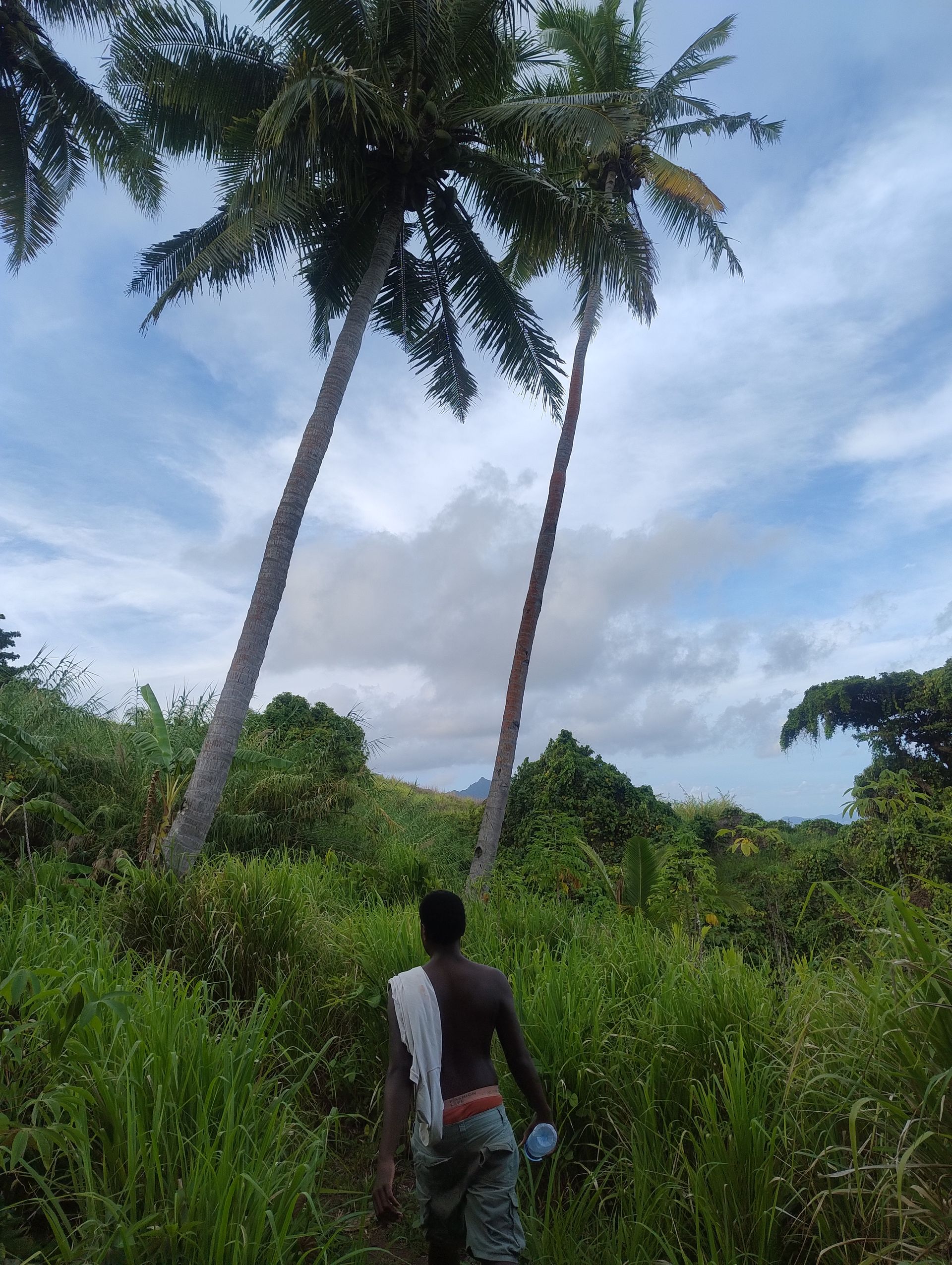
'You look fast. Are you fast?', asks John, my guide for the sunset hike, after I mention my preferred pace. It's hard to answer anything else but: 'Sure, let's go fast.' And fast the 19-year-old is. The trek consists of five levels, and he pauses briefly at each one. Without being out of breath, he looks at me challengingly: 'Should we take a break?' ‘Let's go!’, I say, as sweat beads down my forehead like last time in the tropical heat of Hong Kong on my way to the peak. From level 3 it gets cooler and less steep. We circle the rock in a spiral formation. Along the way, he shows me the 'Wabbling Stone', a several-ton heavy round boulder resting precariously on another rock. John tells me to move it. I push, but as expected, nothing happens. He holds his index finger and female hand in the air and places them at a notch that reads 'Push' in graffiti above. He can actually wiggle the rock a few millimeters.
Just before the summit, we meet Nicolas. Like eagles, large bats circle their cave near the highest rock.
At a cliff, John suddenly jumps down steeply only a few inches from the edge in flip-flops. A clear death-defying move that has its effect. I feel like a worried mother. Young man, what are you doing?! He stands there a few inches above the edge, where it drops at least a hundred meters straight down. 'Keep going?' 'Yes, please!', I try to hide my tension. His look tells me he does this every day. That’s exactly my fear.
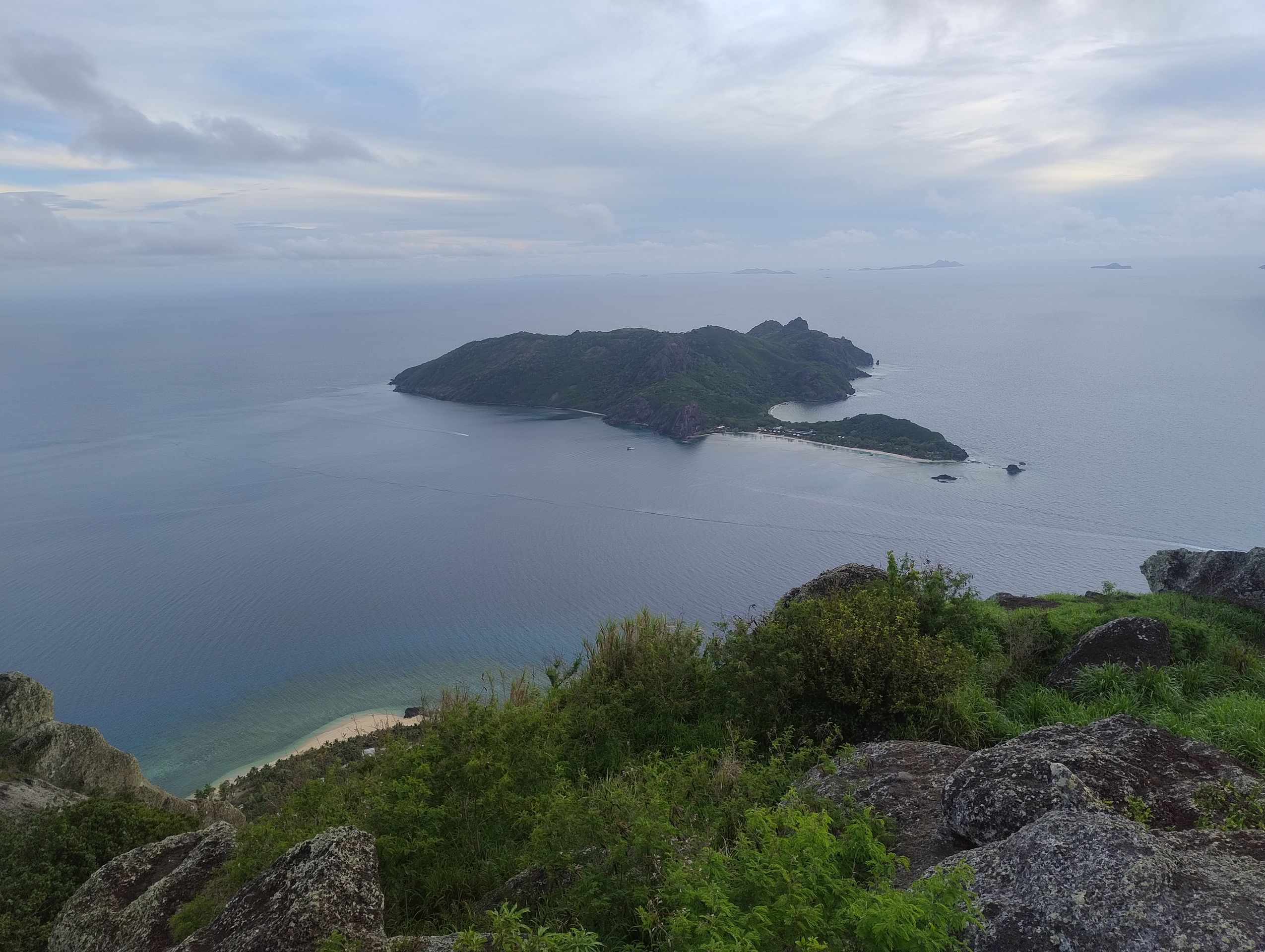
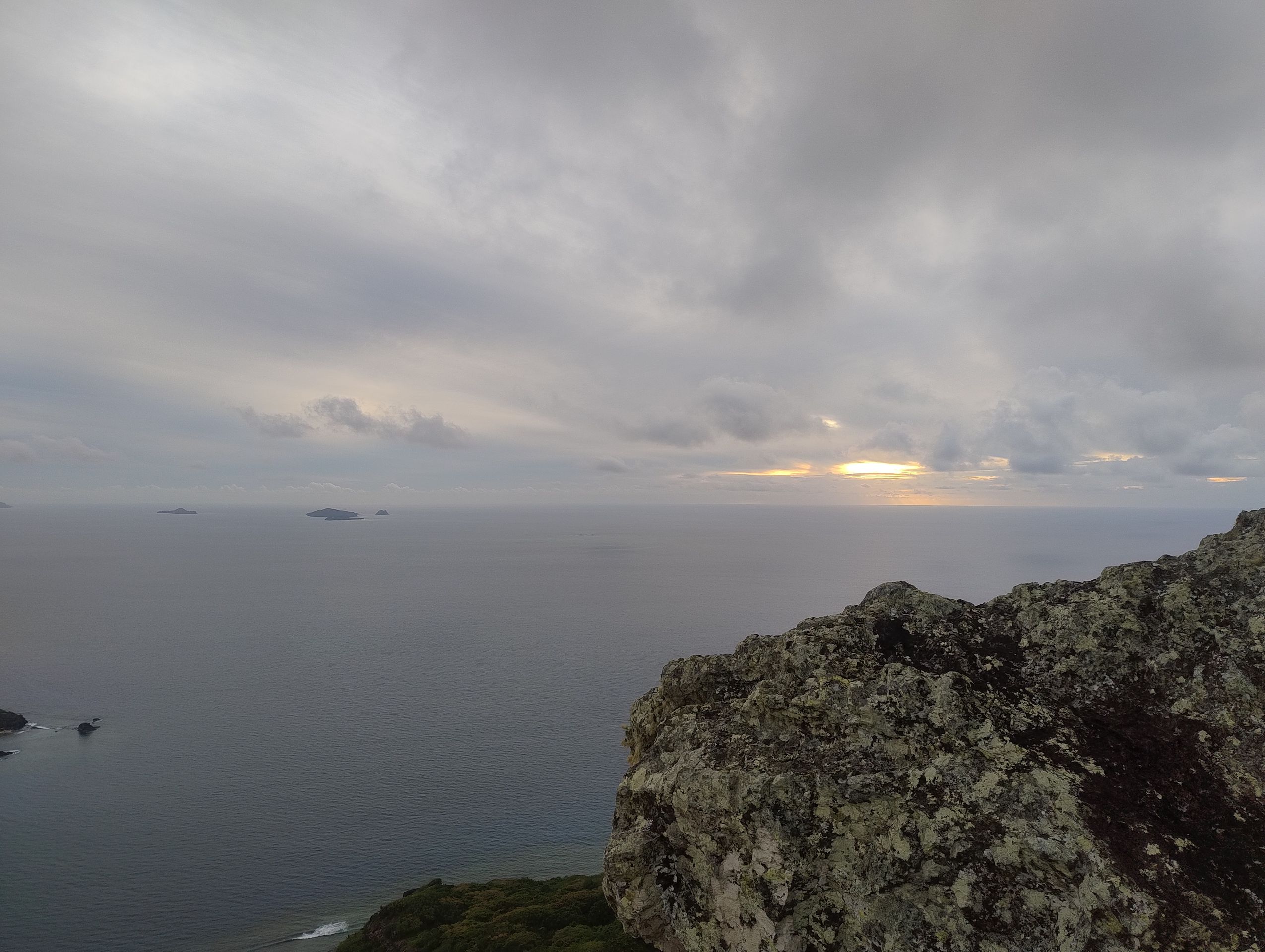
Upon reaching the top, John briefly explains the myth of his ancestors to me. A white rock a little further down symbolizes a woman; the larger black one, on which we are currently sitting, represents the man. The ancestors of the islanders were giants, John tells me. They put down or threw those rocks into the water, including the Wabbling Stone and the one that juts out white into the sea over there. He says all this with deep conviction. Myth and history blend into one narrative. In the past, before faith illuminated them, they waged wars with the other islands. Kings demanded tribute, and cannibalism was not uncommon. Back then, they lived deep in the island; on the beach, they would have been an easy target. From above, we have a 360-degree view. We can see the other smaller island with the resort to the south, the other Wayasewa islands to the north, and the main island to the east. We should slowly head down again, and behind the thick clouds the sunset can only be guessed at anyway. Soon after the onset of darkness, the dogs would come out. Not the peaceful ones in the village that only eat shoes, but the wild ones. They’ve known him since he was seven and took his first steps into the island's interior. But they would react sharply to tourists.
A German couple that has just hiked up after us is now following us down in the twilight, taking their time, and John is pushing the pace. He strikes an empty plastic bottle with a stick. That would scare off the dogs. The flying foxes, on the other hand, are harmless. One bat hangs just a few meters from us in the branches and observes us upside down. At another point, John picks something off the ground that at first glance looks like a huge spider. The German girl lets out a high-pitched scream. It’s just a giant crab, which John holds out to her. He tosses it back into the bushes.
Throughout the week, I speak with a few villagers about the view from the rock and the supposedly dangerous dogs. They wave it off. John would tell all sorts of lies that one should not believe. There are no dangerous dogs in the island interior, and John is not 19 but 17. A little fibbing must be allowed. After all, John isn’t much different from his tour guide colleagues in
Vietnam or Thailand. I still find it fascinating how I can remain so gullible after five months and take everything at face value that is served to me.
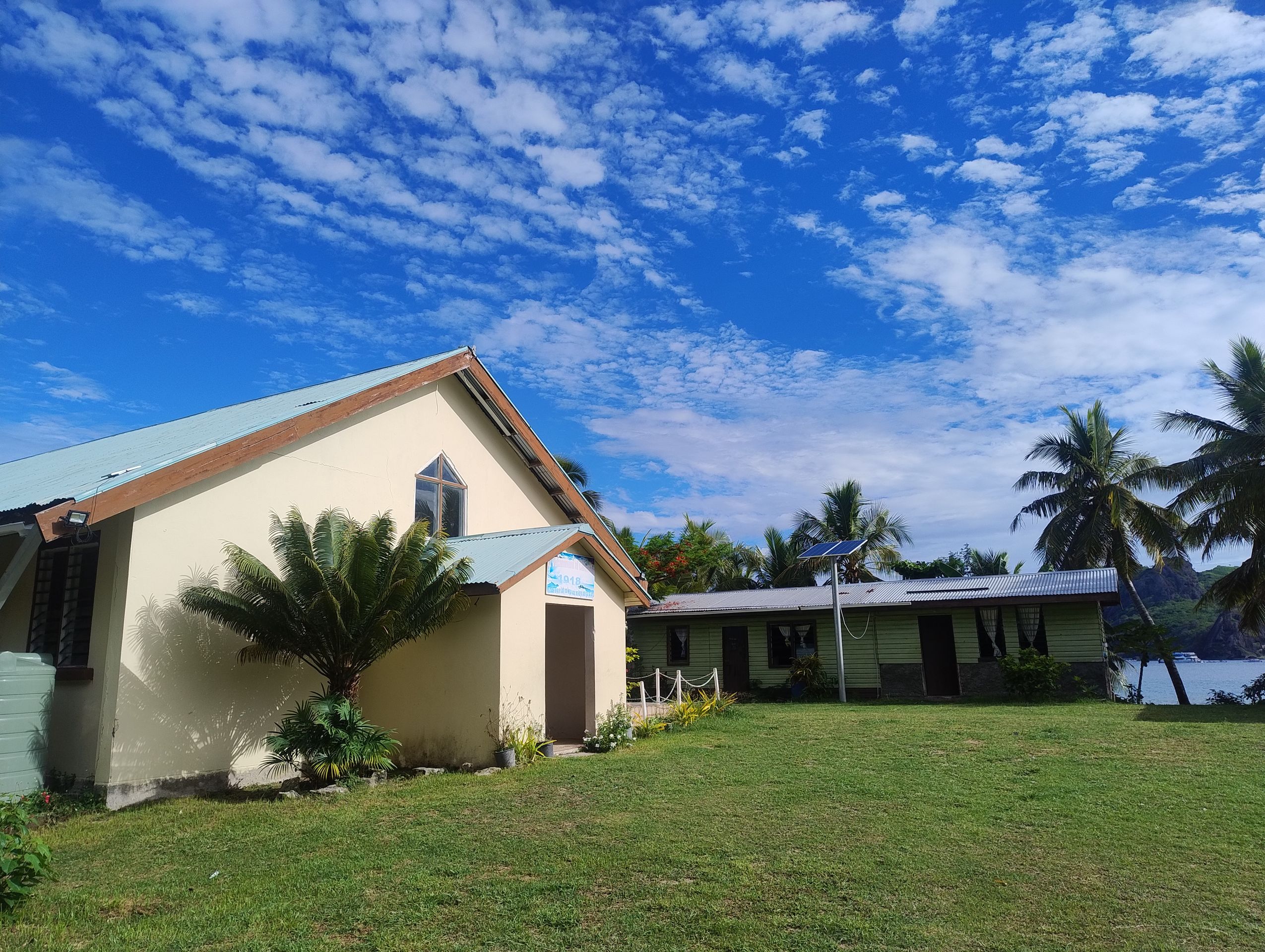
It’s Sunday. The Lord's Day. An employee from the resort takes us to the small village church. From afar, we can hear the children singing. The mass hasn’t started yet, but in the first rows, everyone from toddlers to teenagers sits together and sings gospel songs from the bottom of their hearts. Nicolas and I settle in one of the back rows. I glance at the rows of my fellow travelers. They are just as moved as we are. Taking a photo or even a video would not feel appropriate. The residents of Wayasewa have invited us as guests, not as spectators. We try to be as discreet as possible and make a few audio recordings.
[At this point, I would like to refer you to Nicolas's blog. The translation function in the browser works well if you, like me, do not speak French:
https://vadrouilles.xyz/?p=14140
On his own website, he has the opportunity to include audio which I do not have here. He has uploaded the gospel songs there.
His entries are also very readable and provide some insights into the culture in Fiji. Certainly more than I can summarize in my few paragraphs. Nicolas wants to take several months for Fiji.]
The children seem to sing of their own accord. After each of the Melanesian songs, a little while passes before an older child or an adult initiates a new song. Even the smallest children sing along. The church is well-filled. The children have to scoot forward a few times until a few of them sit right at the front on the ground. When finally, after 40 minutes, the pastor enters, the actual service begins. We don’t understand a word, but before the sermon, he greets us and gives a brief overview in English of the passages from the Bible that his following speech refers to. For communion, we are also invited to the front and receive a wafer and a small plastic cup with lemonade. Unlike in South Korea, they do not ask whether we are baptized or believers. The Lord in Fiji welcomes everyone.
The mass ends with a strong Adeste fideles / O Come, All Ye Faithful in Fijian as I hum quietly along. On the way back, we don’t say much; we are still very much in a reverent mood. Marianna, one of the two Norwegians, shares her impressions with us. At the children's singing, she couldn’t help but cry. She immediately thought of her recently deceased grandmother, who was very religious. We all agree that this gospel service has left no one of us atheists cold.
With a strong sense of faith, I let Nicolas convince me to go snorkeling. After my experience in Vietnam, where I constantly got water in my glasses, I had almost shelved the topic. But with the support of a professional and without the language barrier like on Cham Island, I feel ready to try again. Nicolas is a passionate diver and snorkeler. He goes into the water daily and even has a speedboat take him to more remote spots where reef sharks and sea snakes roam. Hard pass. No, thank you. For now, I’m very happy with the clownfish and colorful corals I can discover in the clear water off Wayasewa.