On the third day at the resort, it's time to say goodbye for the two Norwegian women and me. Tonia and Marianna take the ferry back to the main island. Fortunately, I still stay but switch to a homestay at the other end of the village. So I can come back, but I also listen to the farewell song 'Isa Lei' that the resort staff sing for us as a formality. Marianna and Tonia are taken to the boat that takes them to the ferry. Michael and Kalliope, a Greek who has just arrived but already belongs to the group because of her engaging personality, accompany me to my new homestay. Jolame and his wife Maria are my new hosts. A child asks which house we are looking for and leads us to the last bungalow in the village. Lassie and Marie explain to me that they are neighbors of Jolame. They are currently in another village for a ceremony for a girl who's getting her period for the first time. Lassie tells me that many of these life steps are celebrated in Fiji. Her mother would take me right there. A few of the other villagers are going anyway, so they can take me along. I ask if I need appropriate clothing, maybe a sulu. Lassie's mother straightforwardly sells me one of the traditional Fijian kilts, a wide cloth that is tied around the waist. Like many of the women on the small islands, she sells souvenirs to tourists.
At the house of another family, we wait for the speedboat that is supposed to take us north to the neighboring village. When would it leave, I ask somewhat impatiently as after half an hour only men, women, and children are coming and going, yet there's still no real sense of departure. 'Fiji time, my dear, everything is on
Fiji time.', Lassie's mother responds. In other words, it leaves when it leaves. 'Fiji time' describes two things: first, a time reference that means nothing concrete - food is served when the drums sound; the ceremony ends when the village elder concludes it.. secondly, it stands for the relaxed lifestyle of the islanders. Just like 'Bula!', you often hear 'Fiji time!' as you walk by. It is the Hakuna Matata or 'Take it easy' of Fiji.
In the small motorboat, I take a seat at the front on the wooden planks. Next to me sits an older man with refined features whom I recognize from the church service. He was one of the loudest singers in the front row. The boat sets off. It's not a gentle speed for tourists. The keel hits the waves with a loud bang. I cling to the edge. Lassie's mother looks a bit worried at me: 'Are you alright, Max?' 'Sure, all good!', I grin back at her. But it’s probably noticeable that I’m a bit tense. The gospel singer next to me is relaxed. Sitting cross-legged with both hands on his knees, he chats undisturbed with the man at the bow. A girl, whom I estimate to be about five years old, sits between two women on the wooden beam behind me and seems to be daydreaming. It reminds me of Vietnam: how the Vietnamese sit on the back seats of scooters without holding on, while tourists need to cling on with both hands to the handle to avoid falling off the back.
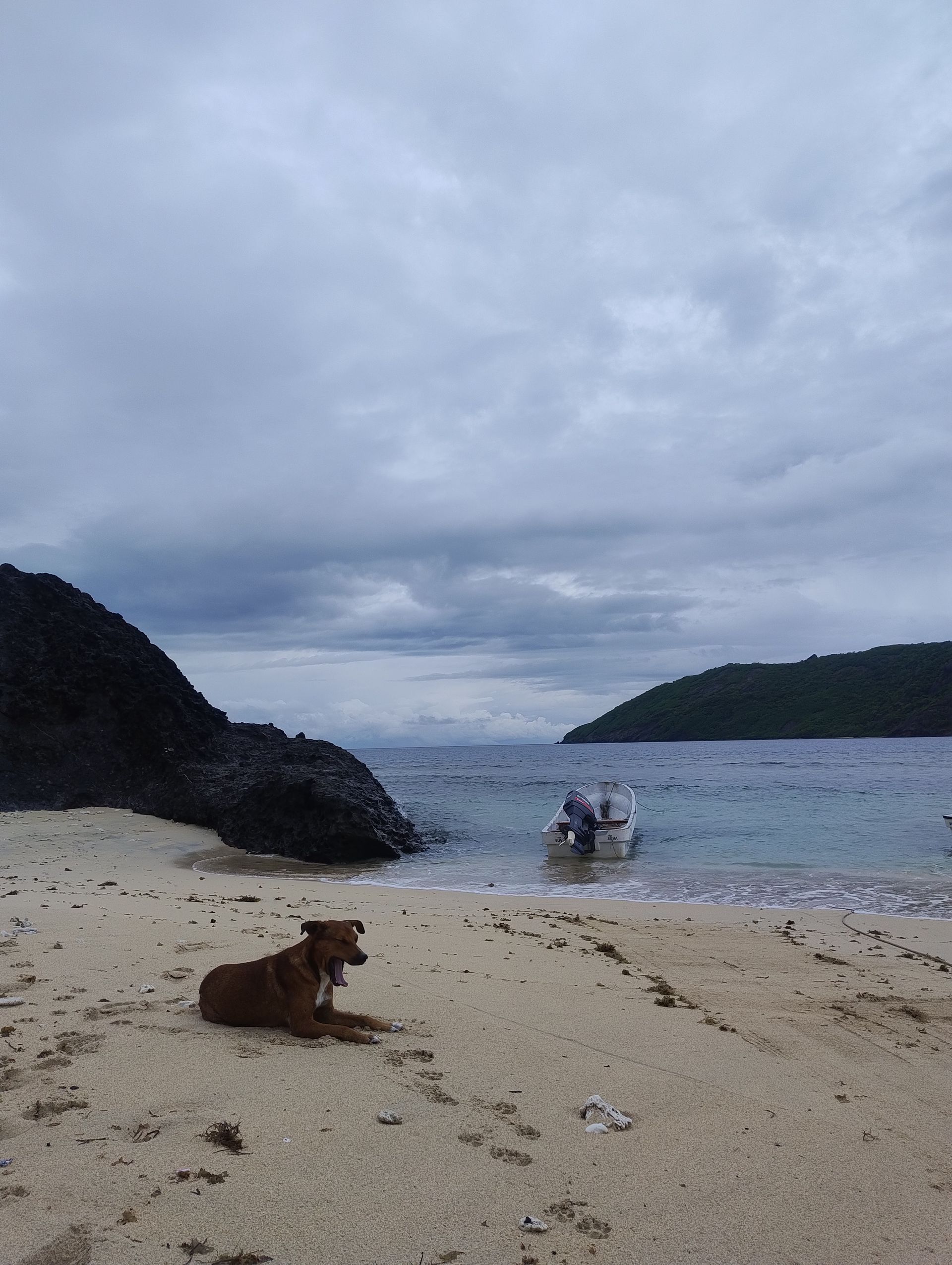
A boat is coming towards us. 'There is Jolame!', the others explain to me. My excursion to attend a Melanesian ceremony ends before it has begun. My hosts are already on their way back. So, I get into their boat and ride back to the village. I shake new hands, and names are introduced to me that I can't remember all. Only when I'm led to the house and stand in the living room do Jolame and Maria introduce themselves. A relative of theirs sits down with me for coffee. She seems a bit grumpy but shows hints of a smile when I tell her about the - at least for me - bumpy ride. She mentions that all children without their own school building in the village are driven to the nearest school daily. When they didn’t have speedboats yet, around 30 years ago, they would walk along the shore or use the old paths that now serve only for guiding tourists. Back then, they would navigate the sea in slow sailing boats and catamarans, similar to their ancestors. Here, too, I have to think of the development in Vietnam. From bicycle to scooter.
The woman tells me that the resort I stayed at used to be a school. A landslide destroyed it. From then on, children had to go to school in the nearest town. I think to myself that perhaps the lower birth rate is related to this. Lower means that an average family on the outer islands still has four to five children. But it used to be up to ten.
The resort was initially privately owned and then became the property of the village, I hear with surprise from Jolame's relative. Now it all makes more sense - the warm atmosphere, the kind Tailo, the numerous employees hanging out together in the main building watching rugby games. Everyone in the village contributes what they can. Some work as guides and offer diving trips, others play music, and so on. The income is then distributed among the village. Simultaneously, we guests have the opportunity to experience the culture of the islanders in a much more immersive way.
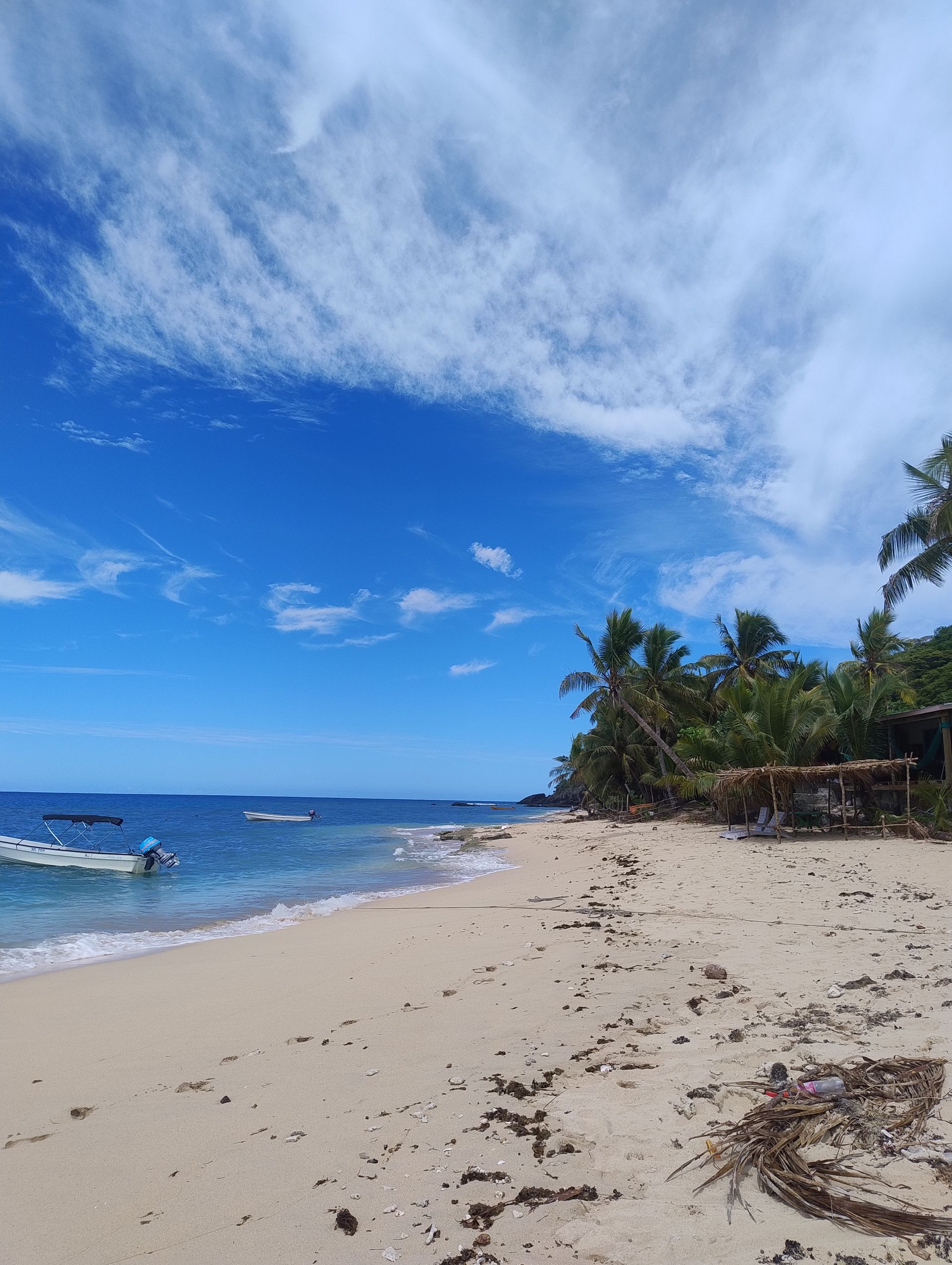
At the end of the island village, there are small tight pig pens set up. Behind the last cliffs, there's a lot of trash. Whether washed up or thrown away on purpose, I can't say. On the first day, I observed a father throwing a plastic bottle to his son on the beach. He missed, the bottle landed in the water, and just kept drifting without either of them picking it up.
There are also other downsides to progress. Tailo explains to us that sugar is a big problem for the Fijians. Of her nine siblings, five have died from diabetes. The industry is influential and floods the market with its cheap and addictive products. When I was at the resort during a ceremony for the children in the village who have reached primary school age, I observed how some parents gave their kindergarten-aged children a bottle of Coke. Before lunch, the first snacks were already being distributed; chips and chocolate were present everywhere.
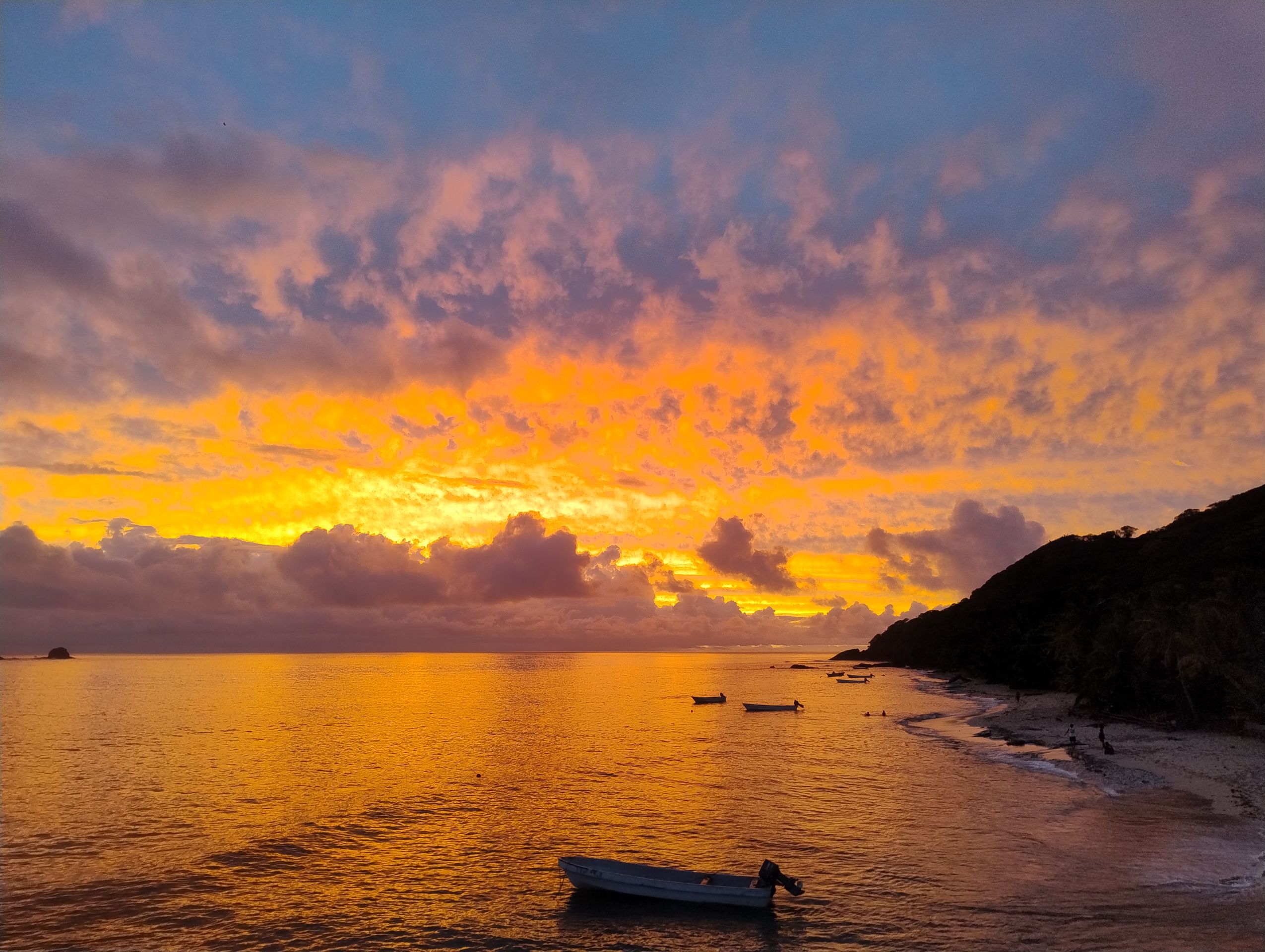
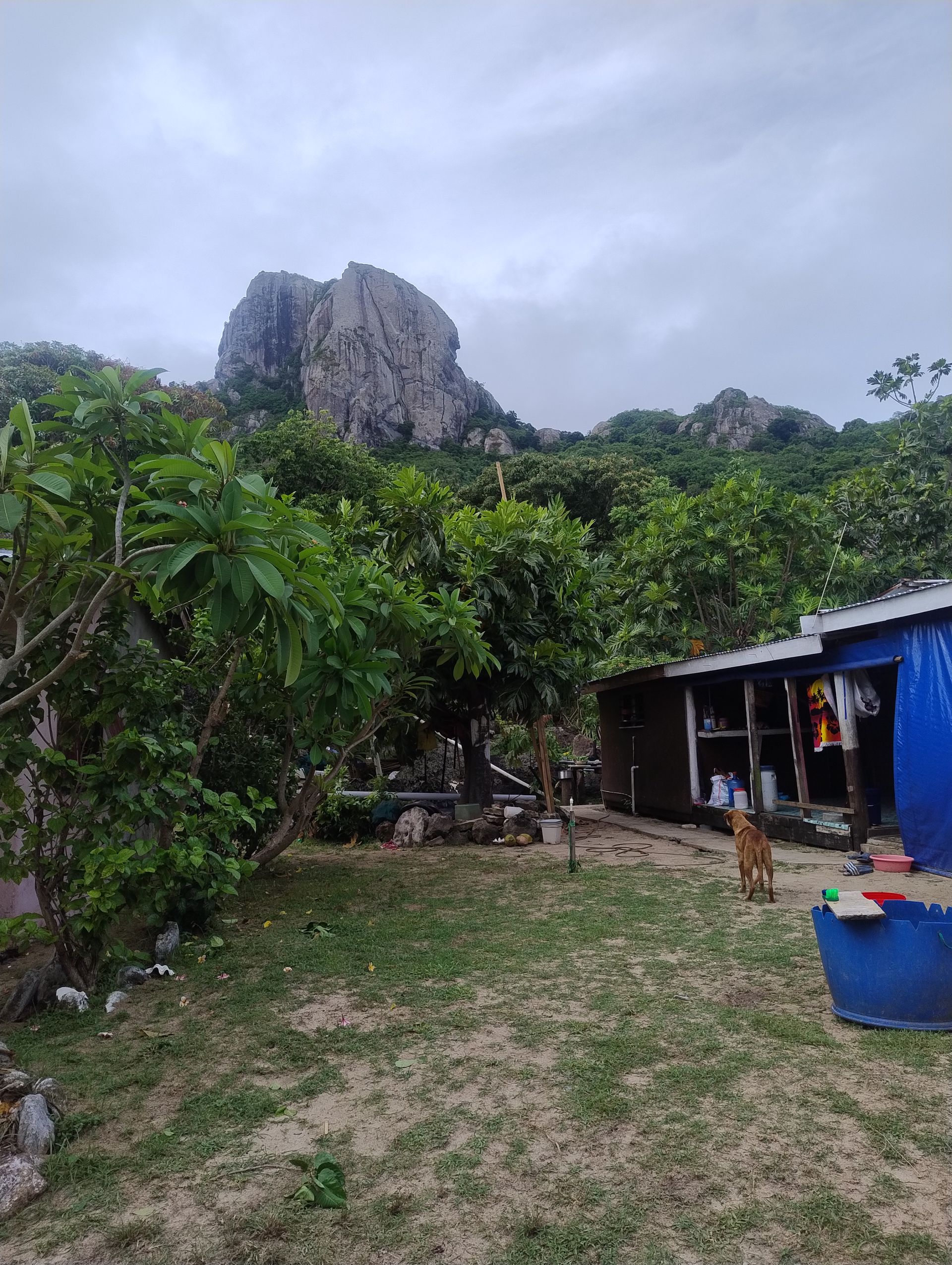
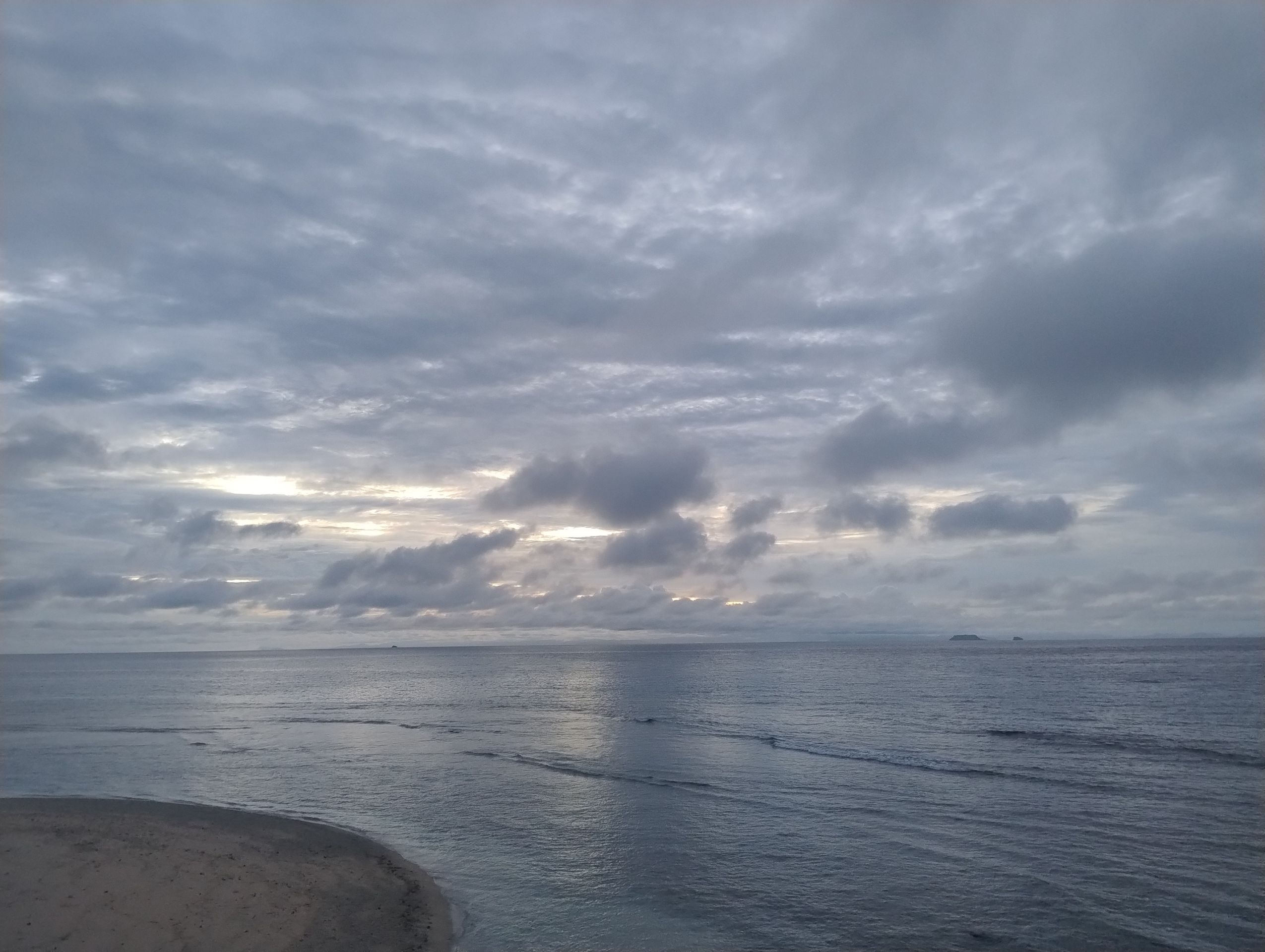
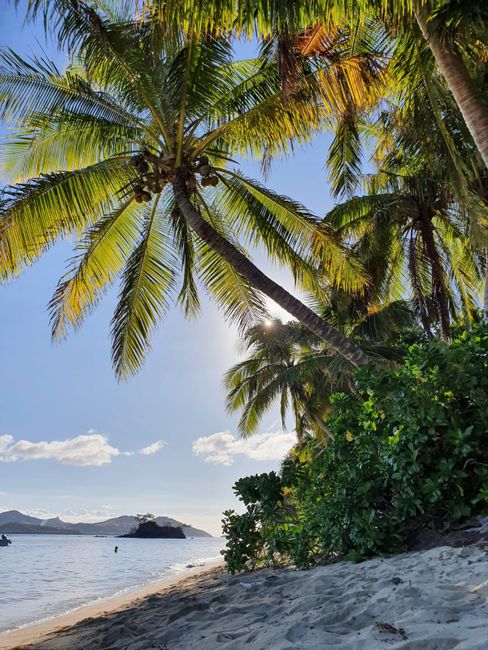
Jolame is a warm-hearted man in his 60s. His wife Maria cooks well, and the twenty meters to the beach make up for the simplicity of the accommodation. The only piece of furniture in my tiny room with thin particleboard walls is a single bed with a mosquito net. There is no light. If I need it, I can use the mobile electric lamp that hangs in the living room. The shower is a barrel located in a chamber at the back of the house, from which I scoop water with a ladle and pour it over myself. I would have preferred to do it the other way around. Get to know the village life first and relax at the resort last. Now it is this way, and I make a routine out of it. In the morning, I let the rooster wake me and run outside to climb on a black rock at the beach to see the sunrise from there. Afterward, I lie down again, eating breakfast at 8 AM. On the way to the resort, I go swimming. There, I lie down in a hammock, write postcards, and chat with others. For lunch, I walk back to Maria and take a nap. I walk the 300 meters back to the resort to have coffee with Nicolas, Michael, and Kalliope. After sunset on my monkey rock, I have dinner at Jolame's and then head back to the resort and back to the homestay. That way, I get my steps in for the day.
One evening, kava is tasted at the resort. The non-alcoholic drink made from a root of the plant, which grows everywhere on the Pacific Islands but whose export is strictly prohibited, has a slightly intoxicating effect. It calms and primarily makes sleepy. Kava is widespread in Polynesia and also has spiritual and cultural significance. In the ceremony that the villagers wanted to take me to, they wouldn't have needed to show up without a certain amount of kava. It is a gift for guests and a ritual medium. Between prayers and songs, full kava bowls are repeatedly distributed to participants. We now experience such a ceremony at the resort. We guests sit in a semicircle in front of a huge stone bowl, into which the kava maker pours a new portion every half hour. Two of the guys from the resort are responsible for serving with small wooden bowls. They appoint Michael as Chief and a chubby Pole as the Chief's Spokesman. The chief drinks first, then his spokesperson, then everyone else. The two Fijians at the trough scoop full bowls. 'Man's Potion?', asks me Kiti, the younger of the two provocatively. Of course. After every round, they play a song with the other resort staff who are sitting behind them. Each time the spokesperson loudly says 'Taki' from the chief, it signals the next round of kava. The Pole doesn’t wait long. 'Taki!', he calls as soon as the last note is played. They also play a few songs in English on request. It is impressive how seemingly all Fijian men can play the guitar and have an incomparable repertoire of songs. Kalliope grabs a guitar just to immediately get us to play. I cautiously signal that I can play guitar and sing along Norwegian Wood, one of the few songs I know by heart. I receive a warm applause. The kava tastes a bit bitter, almost like medicine. It slightly numbs the tongue and mouth. If we weren't under palm trees with the sound of the sea and guitar sounds, it would feel like going to the dentist.
It is raining in torrents. The raindrops crash loudly on the corrugated roofs of the village, and I sit on the veranda of Jolame's homestay. The children seem undisturbed. They dash back and forth on the only path in the village, stretch their necks up to drink the rain, and stand under gutters for a shower in the open air. Up front, the older ones continue swimming and surfing. After all, the waves are higher during a storm.
That evening, I climb down from my rock after the sunset wasn't so spectacular due to the clouds. A young villager stands below and speaks to me. They have their own homestay and currently have two French guests with them. Ve tells me about the relaxed island life. She wouldn't like it much on the main island; she would stand out quickly due to her sulu and overall, she doesn't feel comfortable in the modern cities. Boys would approach her on the street and invite her to drink. She doesn’t like to go to clubs. Such places don’t exist in her small village. She likes it peaceful. After my week on Wayasewa, I can relate to that.
On the last day, I say goodbye to Jolame and Maria and shuffle toward Wayalailai Resort, which arranges the boat ride to the ferry in the afternoon. I get to listen to the farewell song a second time. Only this time, I'm not just leaving the resort but the island. 'Bula, how are you brother?', a villager greets me on the way. 'A bit sad, cause I'm leaving today.', I reply honestly in German to the small talk question. 'Bon voyage!', he wishes me. 'Vinaka!'