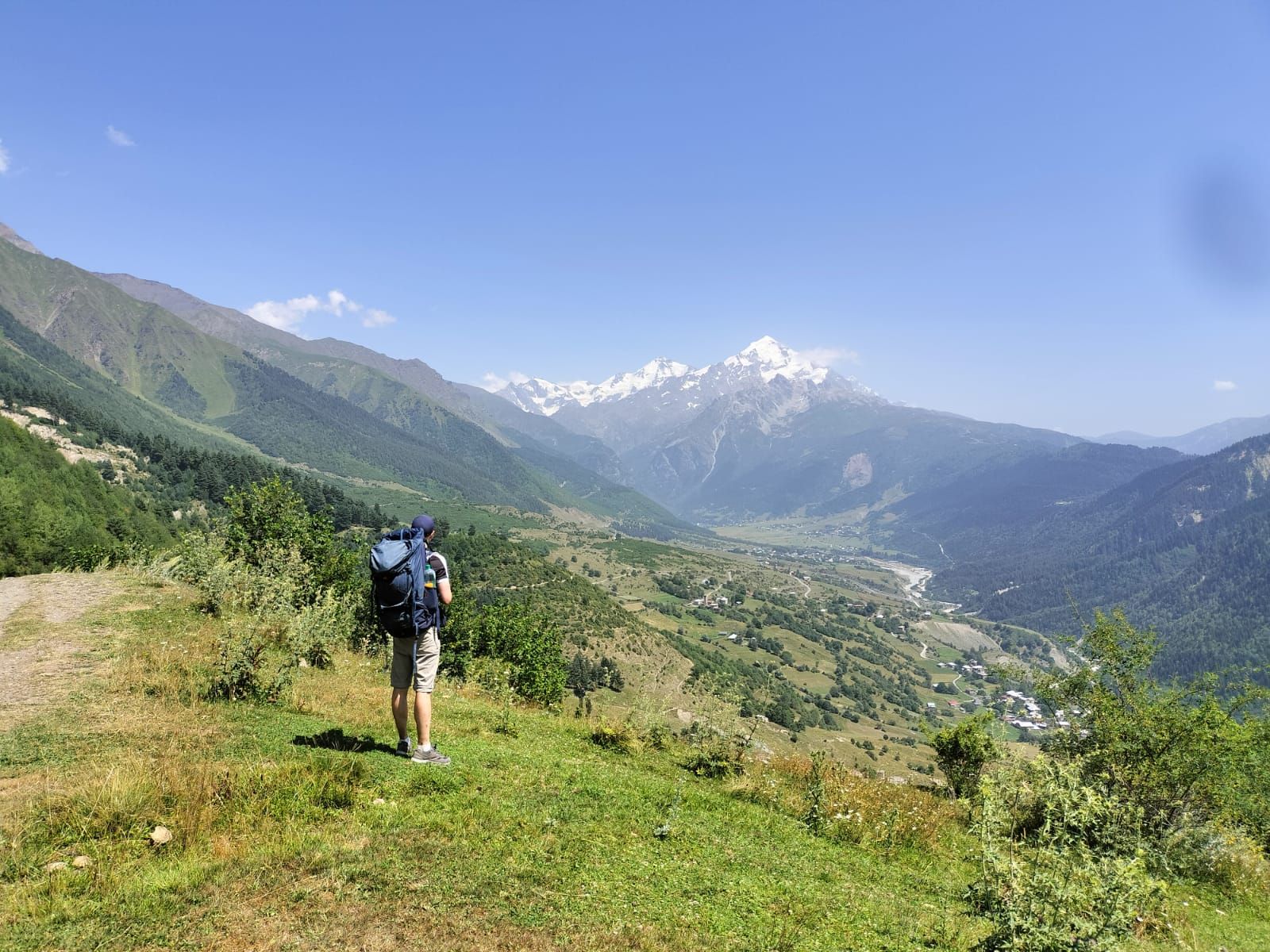
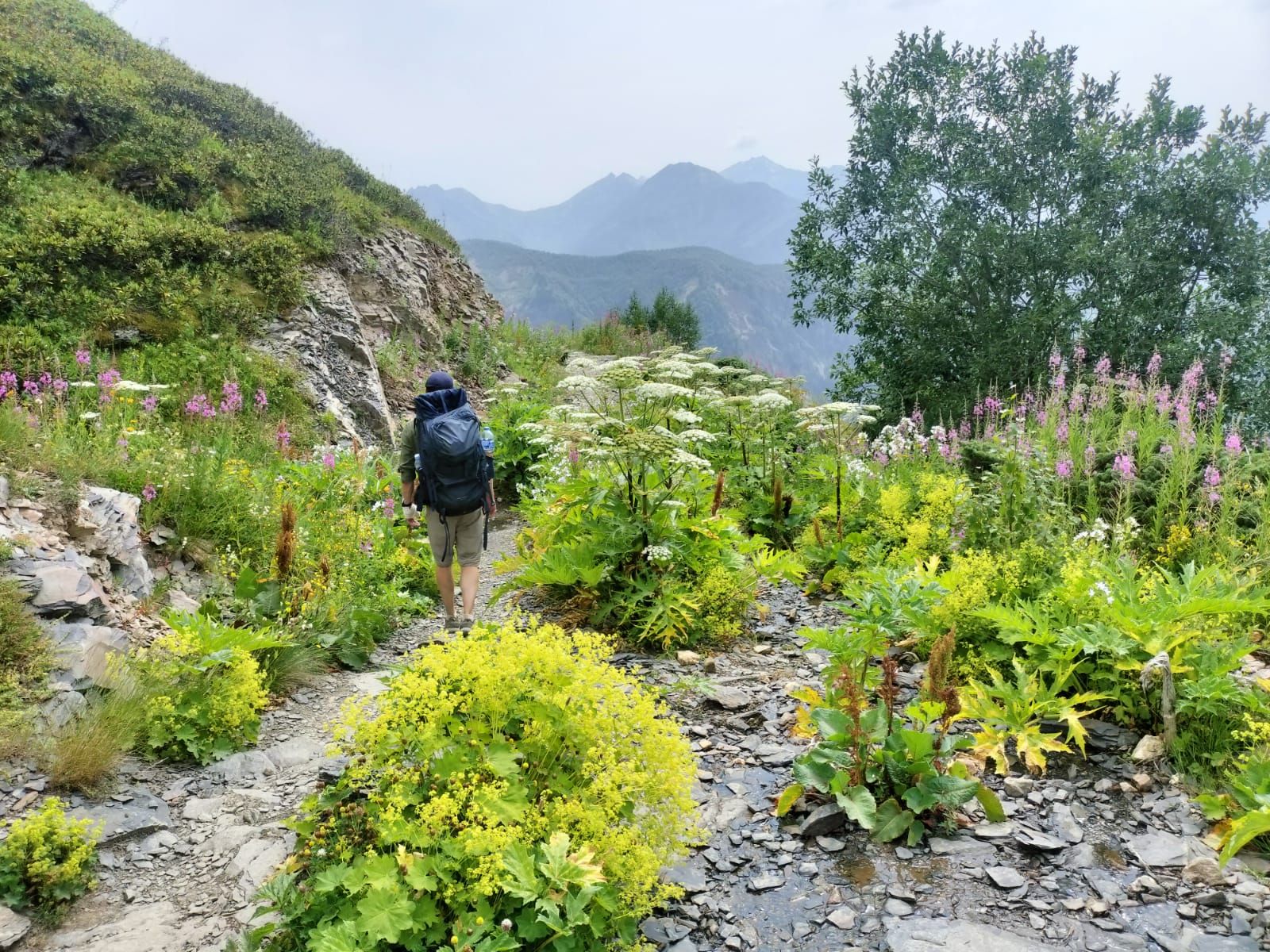
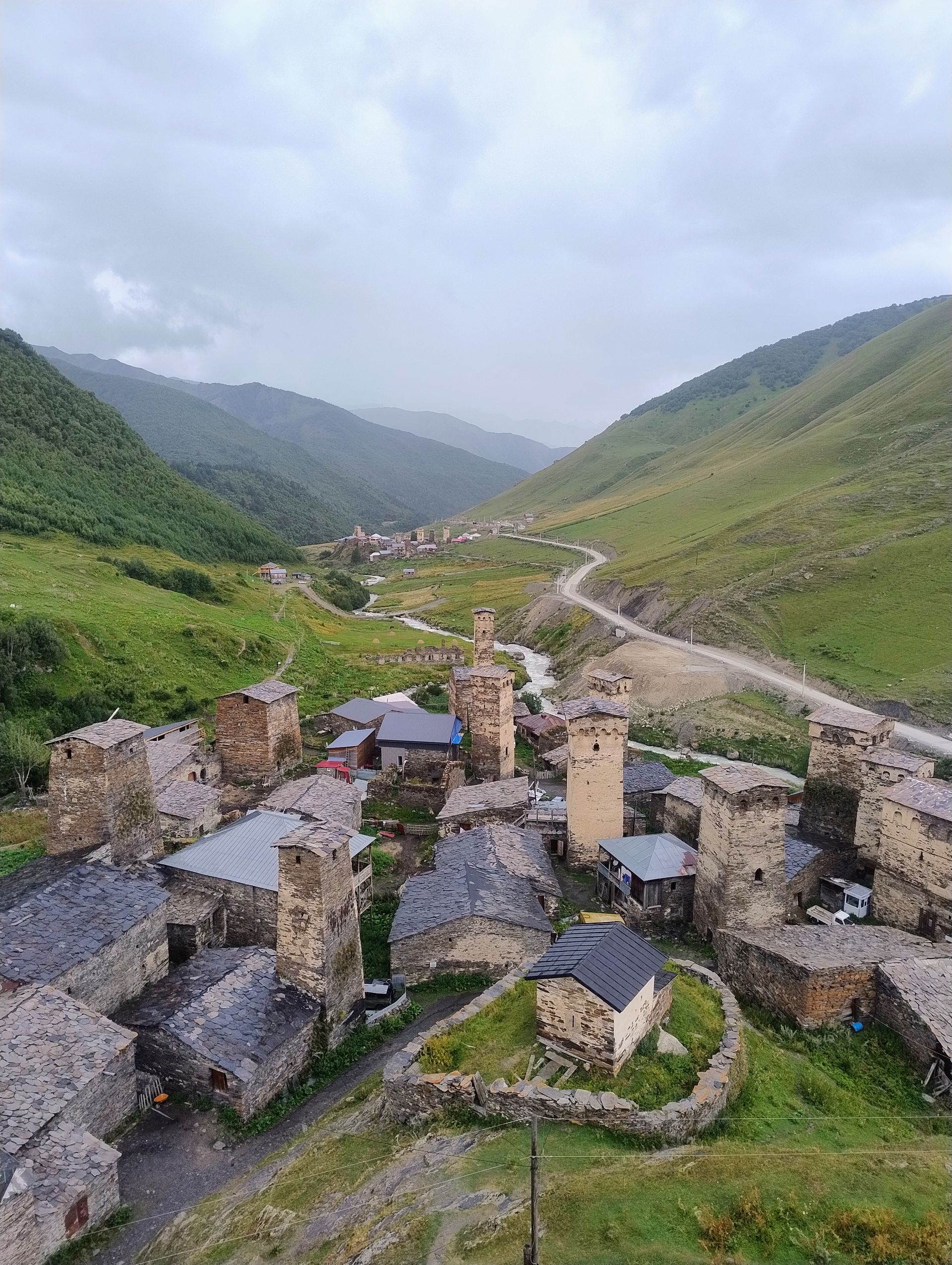
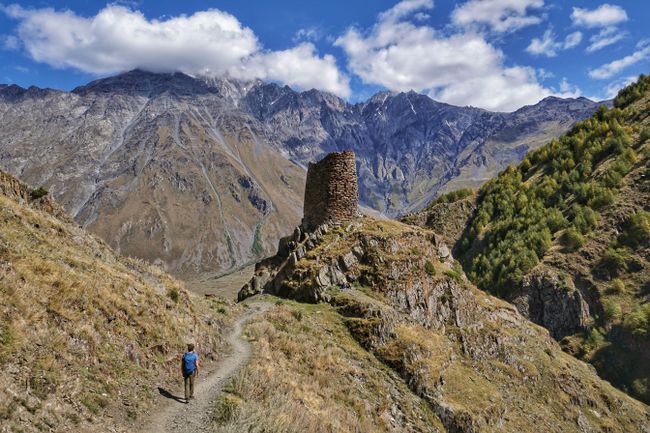
Several signposts to cafés compete for our attention as our hiking trail diverges to another village with Svan towers. On our four-day hike from Mestia to Ushguli, my Scottish hiking companion Darryn (see Göreme Episode 7) and I are given many opportunities for coffee breaks. Apparently, we have a good instinct here too, and we end up in a front garden where an 11-year-old boy acts as translator and entertainer while his aunt treats us to fresh yogurt, homemade apple juice, and cool wine. The lively Erakle, named after a Georgian king, speaks fluent English and tells us that he spends his holidays here in the small village of Zhamushi with his grandparents. 'Here', outside his hometown Tbilisi, 'you can be a man', he explains to us. We laugh, but he is serious and tells us how he started riding horses at 7, skis in the Svaneti mountains in winter, and tames wild horses on the hills in summer. I suggest that with his English skills, he could be a good tourist guide in the region. No, his heart beats for judo. A real jack-of-all-trades, and apparently, he’s also interested in history and politics. Darryn drops a few historical facts about Georgia, and Erakle immediately engages. When he learns that I am from Germany, the conversation quickly shifts, as is often the case in Eastern Europe, to World War II. 'I slowly have to find a second nationality to pass myself off as', I think, as he talks about Hitler and Stalin as if we were playing a quartet of dictators: 'I admire them, but I also hate them...'. 'My grandad loves Stalin,' he says, grinning, as he points to his grandfather. I raise my eyebrows in disbelief, as if I am trying to pay for my ice cream with nothing but a 100-lari note and the server can't give change.
The next café operators we meet are politically less controversial but much more business-savvy. Two 14-year-olds run towards us with a self-made menu just before reaching our destination. The two cousins have just opened their own café in their grandparents' garden, and we are their first customers. Of course, we support the two young entrepreneurs. The obligatory watchdog is correspondingly suspicious and barks at us, but the prices are much lower than in Erakle's established café. Looking at one of the tower ruins, I ask why these were built. Only for outer defense, after all, we are here within sight of the Russian border. Blood feuds between rivaling families? No, definitely not in our village. I’ve heard similar answers before. Strangely enough, I never seem to pass through a village where the towers are associated with murders and feuds...
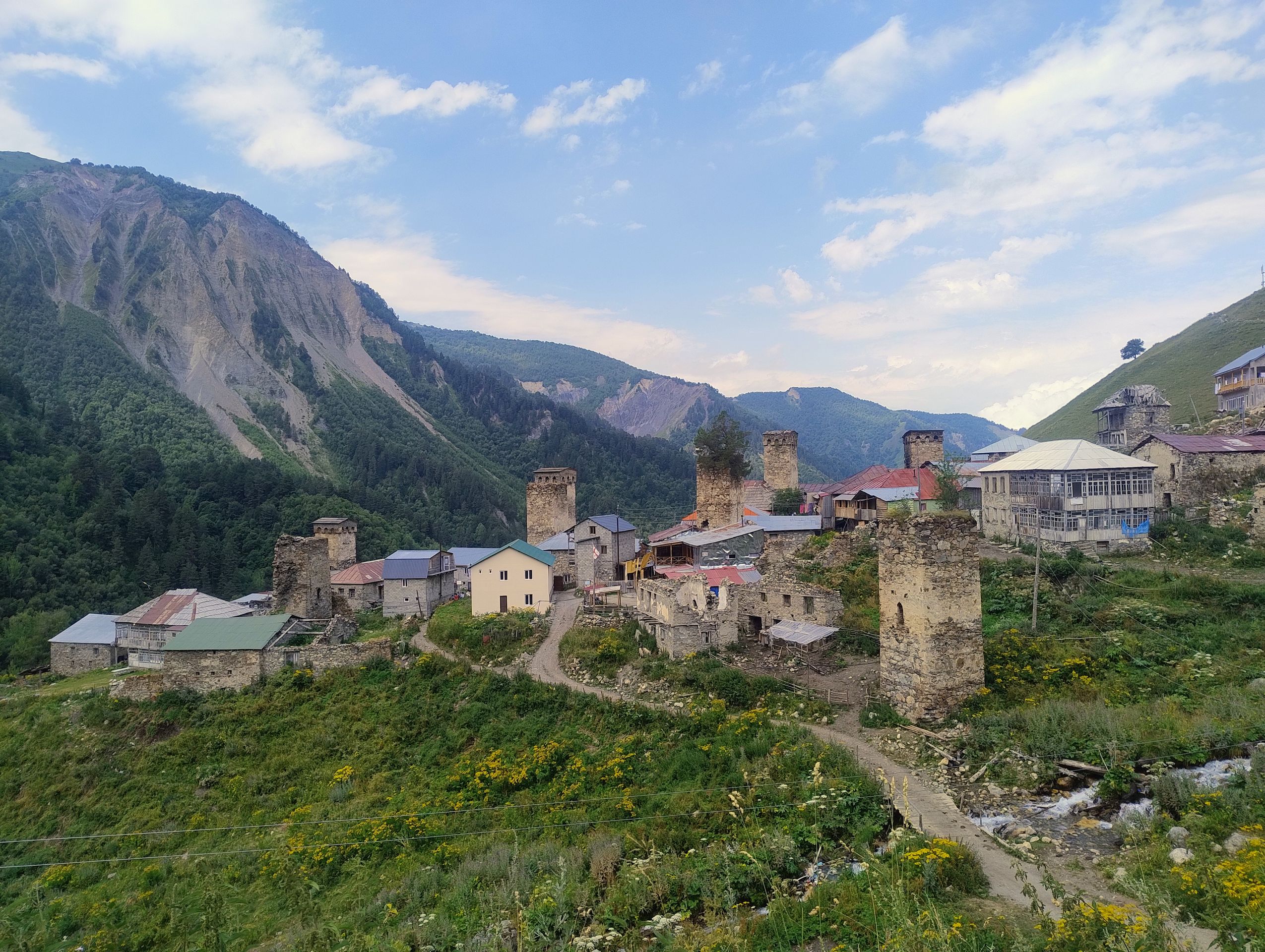
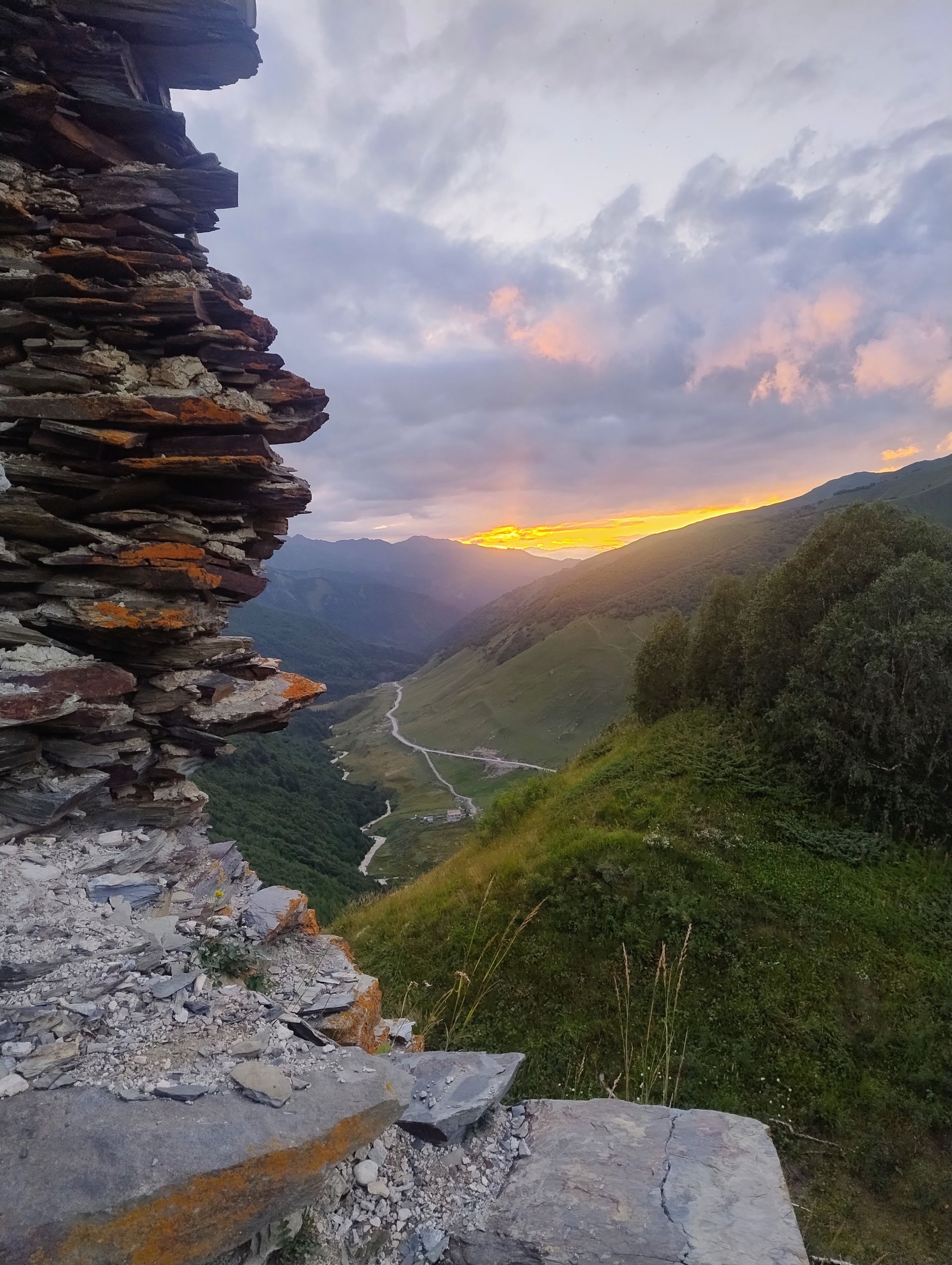
Day 2 of our hike leads us through a picturesque valley, where suddenly our halfway point Adishi pops up. The tiny village nestles against a rushing creek. The dozen houses rise from medieval ruins and broken Svan towers. Apparently, the place has been revived by hiking tourism. Each family seems to operate a homestay. We find an original café with a 70s to 90s playlist, run by a small man with a hooked nose and a smoker's voice, and we quench the hike with some wine and beer while the Georgian Al Pacino prepares our dinner, dumplings, and fries with Svan salt. We would come back after checking in, how long would he be open, we ask the one-man operation. '24/7', he claims, and that proves to be true when we find him lying in his hammock the next morning, and we ask him for a lunch box. There’s free coffee while we wait. In Svaneti, everything screams Eastern European Western atmosphere. Mountain slopes like in the Appalachians. Unbridled horses galloping towards us. Cows, pigs, and chickens in the mud in front of wooden facades. Teenagers riding with a cigarette in their mouth while their younger siblings sit behind. The smoking bartender in his hammock is just what gives everything a metaphorical cowboy hat.
The third leg, we read online the day before, promises some great views. However, it also includes a river crossing that is so fierce that, as always, the savvy Georgians step in to fill the market gap. A few riders are ready with horses and guide the hikers across to the other side dry-footed. Well, not completely dry-footed. On a sand island in the middle of the rushing glacial river, the second rider waits to receive the horses along with their riders. Afterwards, you still have to cross a narrow section of two to three meters wide.
Victor (known from Episode 9) is always a section ahead of us and reports back. He is hiking with two Swiss women, one of whom was swept away by the river the day before and crashed into a branch after 10 meters. The three had chosen not to use the horses and had tried to walk part of the way upstream. They are feeling better, but the knee is definitely injured. After hearing their story, we definitely decide for the horses, which will safely carry us over. After the second section of walking, which is safe to manage, we are nonetheless soaked from our feet to our hips.
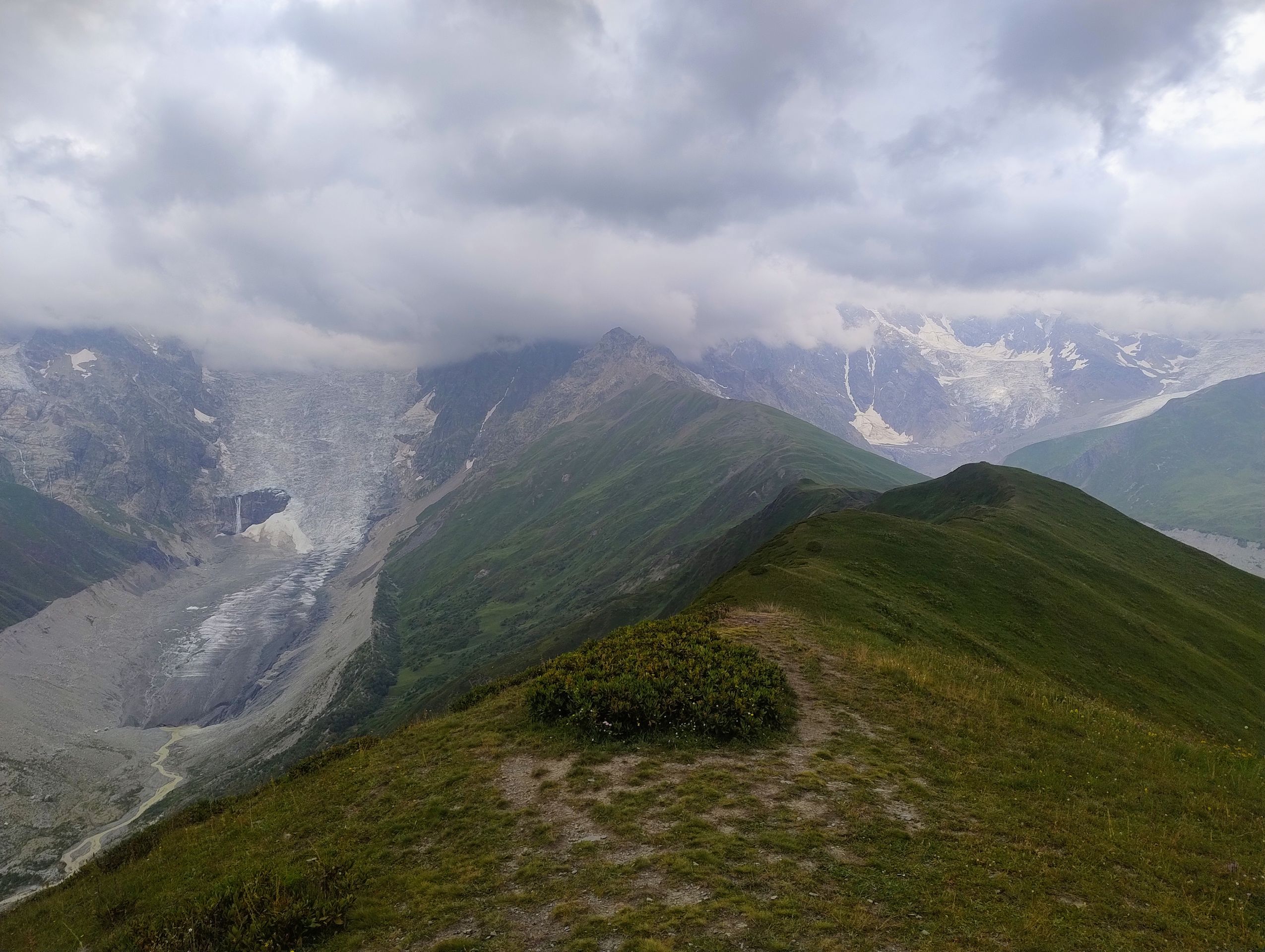
Doesn’t bother us, the sun shines. We dry off, picnic with the lunch box from the chain-smoking café operator in Adishi, and are in good spirits. After a short but steep climb of about 800 meters, we can admire the impressive glacier and the two neighboring valleys in a 360-degree panorama at the mountain ridge. Thunder rumbles from the glacier to us. But it’s not a thunderstorm. Instead, we watch as massive chunks of ice fall about 50 meters from the melting glacier and the thunder sound reaches us with a delay. We sit in awe watching the high mountains until we turn around and see that gray clouds have gathered in the south. Without delay, we get to work on the descent on the other side. The clouds are slowly spreading and following us like in John Carpenter’s 'The Fog'. Halfway down, rain begins. Darryn remembers that the tour description mentions huts that offer shelter right after the descent. We hurry and see that a slight panic spreads among the many other hikers. When the rain gets much stronger and finally hail begins to hit us, we find ourselves caught in a thunderstorm. This time, the rumbling is really thunder. An Asian travel group stands on the slope with their backpacks turned towards the hail as a shield. But we keep walking down and find our way through the torrents that were steep paths just 10 minutes ago.
‘Welcome’, a voice rings out from the hut through the downpour as I step into the shoulder-high wet grass. Two Czechs have reached the shelter before us. I share peanuts; they offer a sip of cheap Czech rum, which I gratefully accept, sitting completely soaked and shivering. I change clothes, but it helps little, as I have to put on my only hiking boots, which are now even colder and wetter than after crossing the river. Outside, it continues to pour on the roof.
As the sun shines again after half an hour as if nothing has happened, the world looks completely different. There are still about 8 kilometers to the stage destination, but it’s all downhill, and I tell Darryn that my last name means 'hailstorm'. When we reach a café, the storm that plagued us just an hour ago feels like a blurred memory of a nightmare. Hot chocolate and Snickers make it all the more forgotten.
The final leg to the final destination Ushguli only takes a morning and is completed after 10 kilometers. The small village Ushguli rises terraced, intersected by streams at the end of three valley bottoms that meet in a Y-shape. In one of the valleys, a 20-kilometer hike promises great views of a glacier. After the trials of the last few days, however, we decide to treat ourselves to a horse tour the next morning.
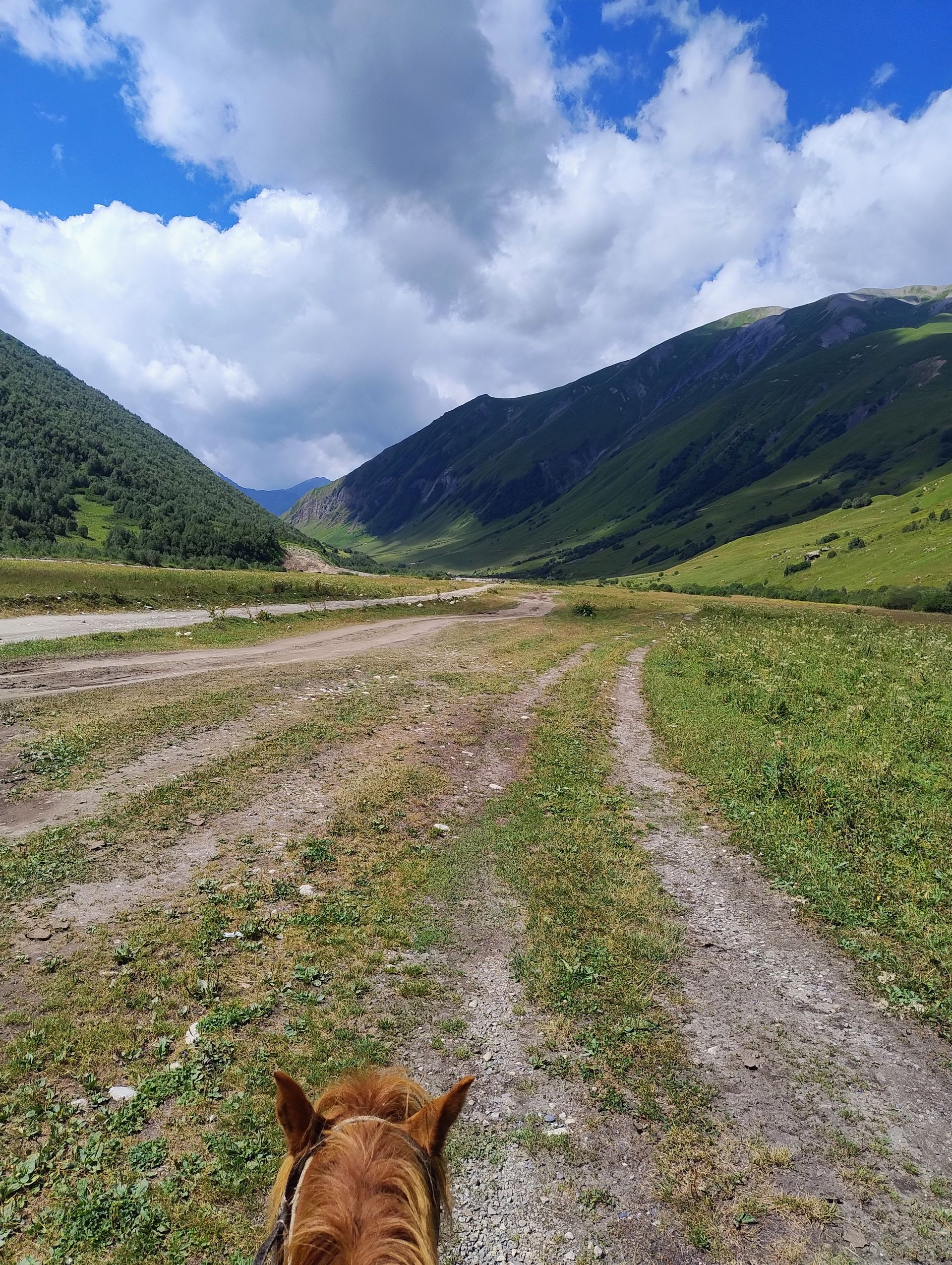
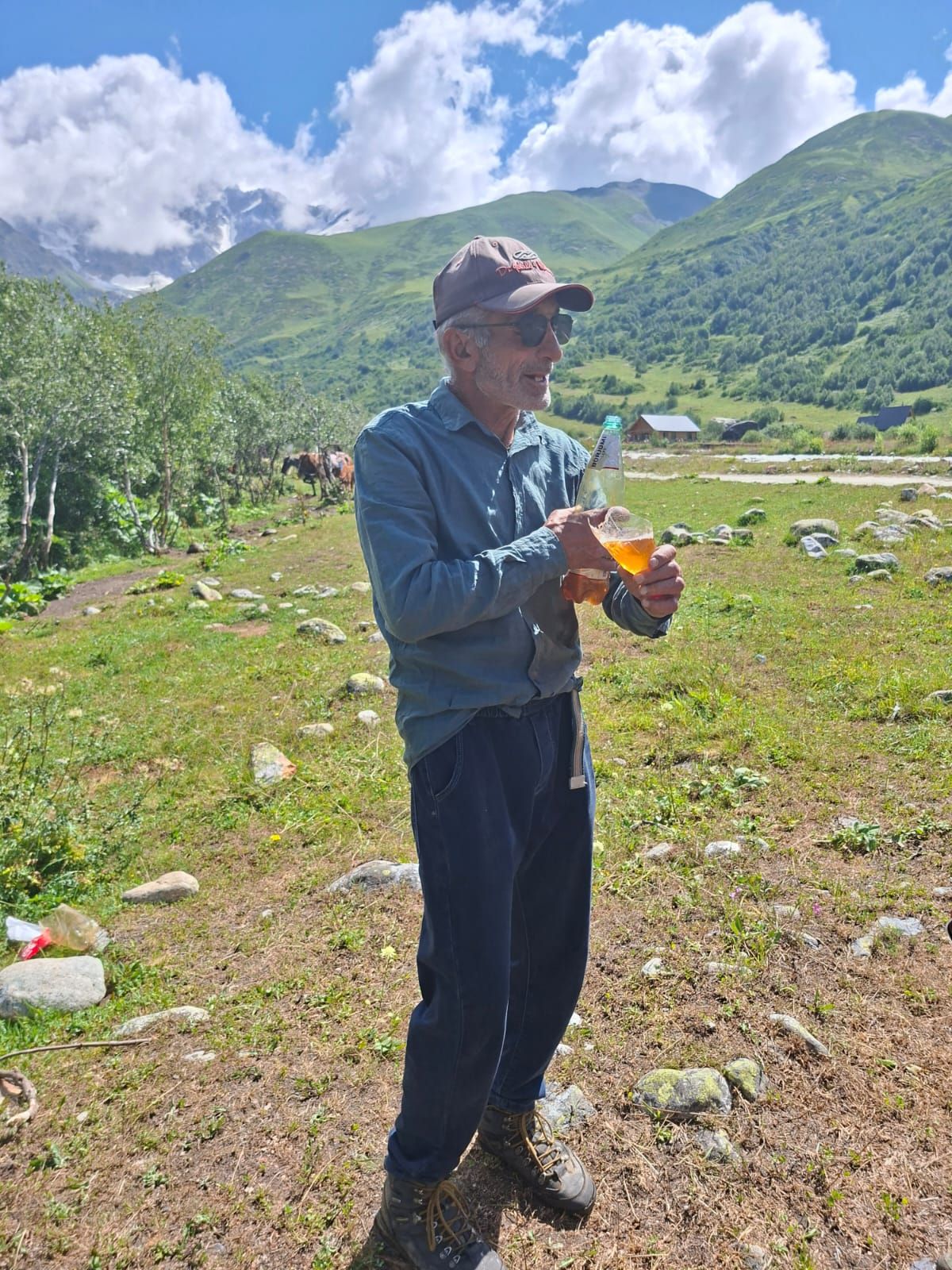
After helping me onto the horse, our guide briefly shows us how to ride with the reins. I feel a bit reminded of how our houseboat was explained to us in the summer of 2020. Press forward and backward, that’s the steering wheel, have fun. 'Left, right', and the word for forward sounds a bit like sneezing: 'Adshi'. Bless you. My horse is named Aladin and likes to stop to eat grass or wanders off the path, but with the reins and the whistles of our horse whisperer, it can be quickly brought back on course. No honking from motorized vehicles, no street dogs, and not even an oversized construction digger throws them off. With each horsepower, we make it to the starting point for the glacier. When we return to the horse parking lot after an hour, our guide is in conversation with an old man holding a worn plastic bottle of wine. The cut-off end of a discarded Coke bottle serves as a modern drinking horn, and soon it is shared brotherly. 'Amen,' a prayer is said between each round. Looking at the peaks, he pours the Uwe into the grass to placate the mountain spirits. 'Ushguli?', the old man asks us with outstretched thumbs, wanting to know how we like his homeland as we are about to get back on the saddle. 'Ushguli!', we reply in the same way. The spontaneous round of drinking, the view in the valley, and the riding tour leave us with little choice but to enthusiastically give a thumbs up.