At the end of my time in Kazakhstan, here are a few facts and impressions about the country:
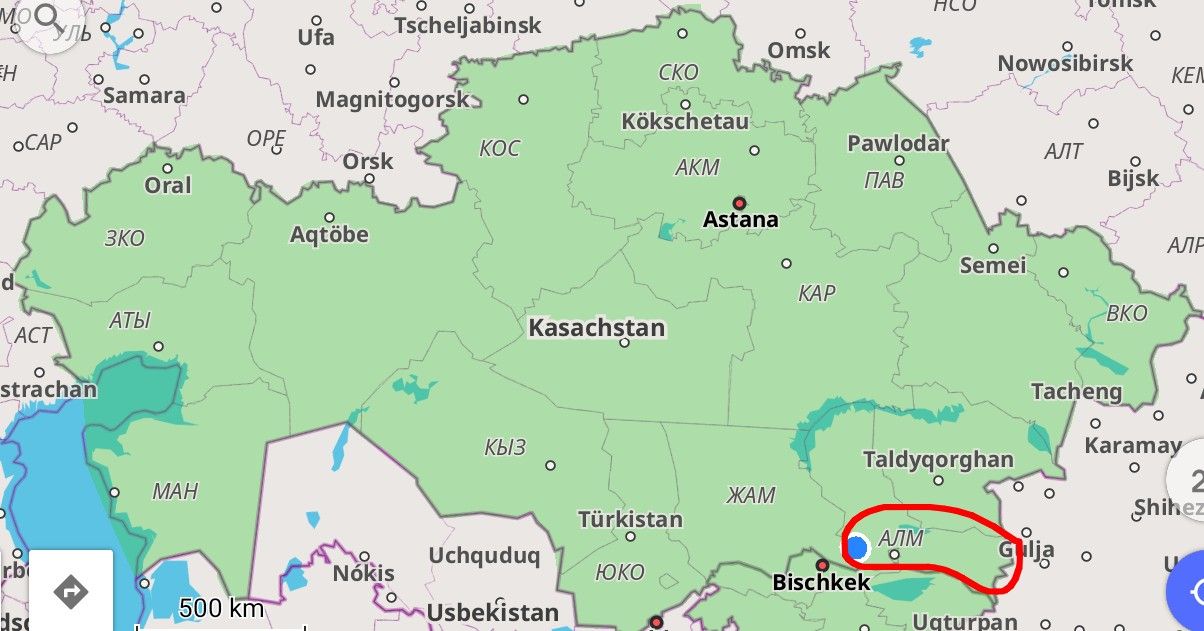
Kazakhstan is enormous, ranking as the ninth largest country in the world by area and nearly as large as Argentina. This vast expanse presents a significant challenge in establishing a comprehensive infrastructure (freshwater supply, sewage, internet, etc.). This leads to a pronounced urban-rural divide. Additionally, due to this size, I have really only seen a small fraction of the country during my three weeks here.
Even though Kazakhstan belongs to a completely different region in my mind, it borders China to the east. In the region around Almaty, Chinese influences are distinctly felt – for instance, in the traditional cuisine, car brands, and the number of Mandarin-speaking people. South Korean influences can also be observed. At the same time, the traces of time from the Russian Empire and the Soviet Union are unmistakable: many signs are in Russian, almost all the people we encountered spoke at least some Russian, and after Islam, the Russian Orthodox Church is the second-largest religious community. Almaty was systematically expanded during the Soviet era, and the architecture is heavily influenced by concrete panel systems. Nevertheless, it would be too simplistic to view Kazakhstan solely as a “former Soviet state” or merely an extension of Russia. Since gaining independence in 1991, a new national self-awareness has been developing: many people consciously prefer to speak Kazakh, the once-banned nomadic culture is experiencing renewed appreciation, and the cultural heritage, including memories of the time as part of the Mongol Empire, is being actively preserved.
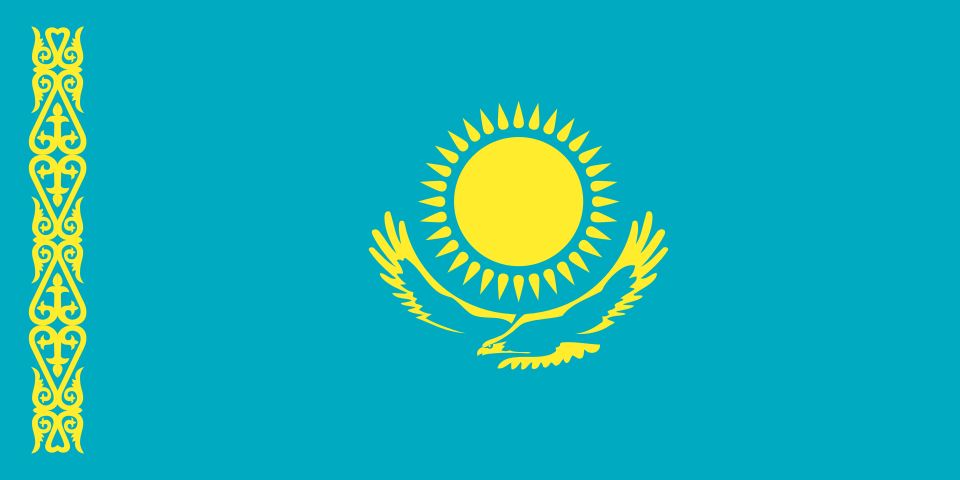
The Kazakh flag has become my favorite flag. Against a bright blue background symbolizing the vast sky of the steppe and thus freedom, shines a golden sun with a steppe eagle. The eagle represents the nomadic past and the time of the Mongol Empire under Genghis Khan. Along the left edge runs an ornamental band of intertwined plant vines and animal horns, a nod to traditional folk art. Looking at this flag makes me happy every time :)
Kazakh is a Turkic language. Although it is currently written in a special version of the Cyrillic alphabet, it is more closely related to Turkish or Uzbek than to Russian.
Since few Kazakhs speak English, I sometimes found it difficult to make contact. However, most people I encountered were very warm and helpful, and I had no unpleasant encounters. A particularly nice moment was a conversation with a group of students on the bus. They knew a few sentences in English and were eager to try them out with us. On the same day, two students invited us to a cheerful round of Uno in a mountain hut. These encounters showed me that people are very open and friendly once a common language is found.
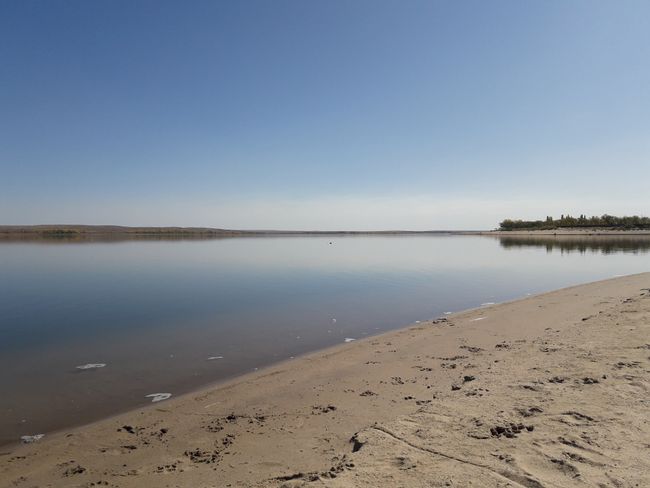
The landscape of Kazakhstan is incredibly diverse: everything from desert to steppe, grassland, forests, and high mountains is represented. However, hiking seems to be less common here than in Germany. Although nature truly invites exploration everywhere, there are only a few marked trails. It seems more typical to spend a day outdoors with a leisurely picnic, loud music, and a nap in the shade.
I did not perceive a major backpacker culture in Almaty. Many travelers are using rental cars or joining guided tours. Traveling across the country by public transport is nearly impossible. A quote from my travel guide summarizes it well: “One can hardly expect anything good from this wild land; however, with a sufficient supply of patience and persistence, anything can be overcome, and the harder the obstacles become, the more pleasant the victory will be.” Although this sentence comes from a traveler in the 19th century, I still found it relatable. Because the experiences I had here, especially in the breathtaking nature, were extraordinarily beautiful, and the effort of the long journey and the planning were definitely worth it!
At a glance
Automatically extracted from the post
Length of time
21 Days
Accompaniment
For two (2)
Mood
CulturalAdventurousOff the beaten track
Highlights
Kasachstan ist flächenmäßig das neuntgrößte Land der Erde.
Die kasachische Flagge wird als Lieblingsflagge beschrieben.
Begegnungen mit Schüler:innen im Bus und Studentinnen in einer Berghütte.
Die Landschaft reicht von Wüste bis Hochgebirge.
Reisen mit öffentlichen Verkehrsmitteln durchs Land ist nahezu unmöglich.
Topics
CultureStoryNatureRoad tripTransit
Sonne, Wind & BergeLike a newsletter: every new post arrives via email.