


SUMMARY CHINA 🇨🇳
Published: 26.03.2026

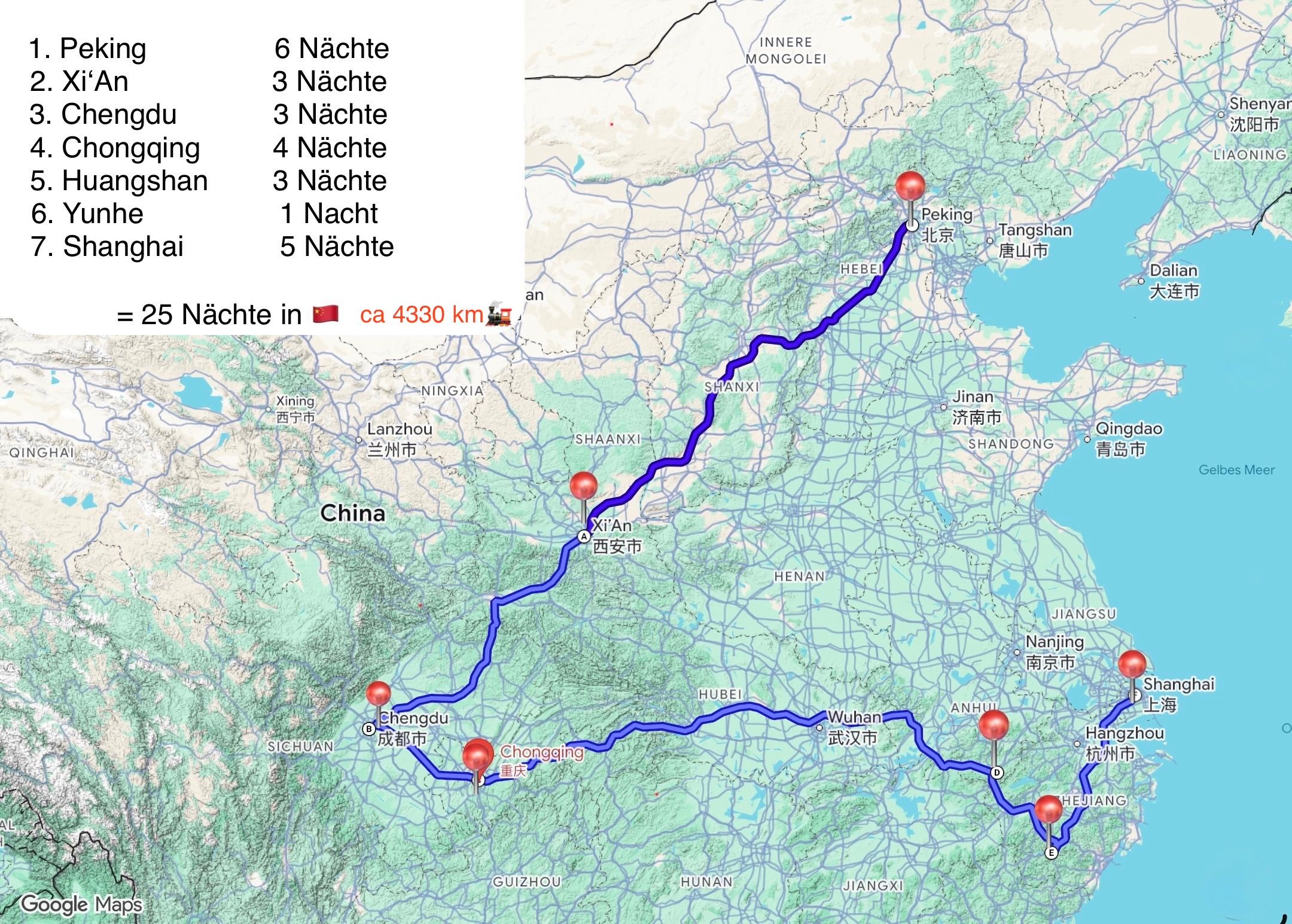
Tour
China-Reise mit Bullet Trains
Tour
Worth seeing
Peking
Peking, China
Worth seeing
Xi'An
Xi'An, China
Worth seeing
Chengdu
Chengdu, China
Worth seeing
Chongqing
Chongqing, China
Worth seeing
Huangshan
Huangshan, China
Worth seeing
Yunhe
Yunhe, China
Worth seeing
Shanghai
Shanghai, China
Summary China
In one sentence (warning irony): “The next vacation is to a lonely 5 square meter island.”
SUMMARY OF CHINA including tips for travelers
In Part 1, some tips and prices have already been provided.
Additionally, it might be interesting for you:
Our conclusion in short:
Due to the prior information, much was not surprising, everything more or less as expected.
Behavior of the Chinese:
It is always and I mean always loud. They constantly speak loudly and excitedly to each other. In addition, there are loudspeaker announcements on repeat everywhere. Peace can only be found in the hotel room.
There are people everywhere in confined spaces. They push all the time and everywhere, especially at sights or stations. They walk and shove their way wherever they want to go. People enter and exit the subway at the same time. But everyone finds that completely fine, no one looks at each other angrily.
The infamous spitting is indeed disgusting. If only it were just the spitting. You can always hear the loud gagging, or how should I describe it? Getting used to it was almost impossible for us.
Somewhat amusing, and we didn’t expect this: the staring. During our trip, we actually saw very few other “long noses”. We were indeed stared at repeatedly. Sometimes they stopped, turned around to us, and wanted to take photos with us. Some approached us to practice their English.
Regarding the language: Very few words English are spoken. It was also hardly possible to communicate with gestures or facial expressions. It only works with translation apps. However, the sometimes completely wrong translations also provide quite a few laughs,
such as “we should first hit our brother”.
Few signs are translated. This naturally makes everything a bit more laborious, and you need time for everything. But they are really helpful, always making an effort and not giving up trying to explain something. They may not seem super friendly, but they are not unfriendly either.
So you can say that you don't really need to speak English to travel in China, but you should be a little tech-savvy, meaning you should be able to work with various apps.
Regarding safety: Top-notch. We have never felt as safe anywhere else in the world. You can leave your bags or even phones alone on a table; there’s no need to keep an eye on them. This is partly due to the extreme surveillance. Cameras are everywhere, and you must always carry your passport. Luggage is constantly screened, and you are checked with a body scanner.
Many Germans would probably not find this so great. But it is certainly safe.
What we also found super practical is that you can simply pay everywhere with the Alipay app. Even at markets. The only time it didn’t work for foreigners was strangely enough at the subway in Chongqing. So we withdrew 100 Yuan in cash.
Also practical is that tips are not expected at all.
Traveling by train is super easy and well organized. Whether by train or subway. The same system applies everywhere, and you quickly understand how it works. All trips are punctual, and we always went through security checks quickly.
What is a bit of an adjustment is the incredibly long distances in subway stations. The size of these giant cities should not be underestimated either. Much looks so close on the map, or you might think: “Oh, a subway stop is also within walking distance.” No, no, everything is very, very far.
On the topic of ease and practicality, taxi rides fit in, or rather riding with a Didi. This is comparable to Uber. In the Alipay app, there’s a mini app for Didi included. You enter your destination there. It locates you, and usually, they are there a few minutes later. Payment is also made through the app. Very cheap. For our longest trip of one and a half hours, we paid €35. The drivers usually do not speak at all, often not responding to greetings, sometimes they get out to help with the luggage but often they just stay seated and only open the trunk. But that's okay, and we noticed that this way of interacting in general is common.
It’s also important to know that when arriving at train stations and looking for a Didi pick-up station, always follow the signs for “e-hailing” or a large lying “D”. Don’t go to the taxi stands.
For traveling, we would recommend suitcases rather than backpacks. You mostly see people with suitcases. But it’s better to pack as light as possible and also not to have too large suitcases, as it can sometimes be a bit difficult to stow them on the trains, and you also have to manage larger stairs with suitcases from time to time. All hotel rooms come with toothbrushes and toothpaste, shower gel, shampoo, combs, tissues, and slippers. So if you don’t want to forgo certain products, you can already save some weight while packing. Moreover, washing machines are almost everywhere in hotels. We managed to get by with about 18 kg per person for 8 weeks of vacation.
By the way, we were also impressed by the cleanliness. All rooms were truly clean and well-maintained. The showers always worked great too. All public areas were quite clean, and they are always cleaned; for example, in the trains, they are wiped down after every station. Although they just place bones or other leftovers on the tables while eating, the tables are always clean (or perhaps just because of that)
As for the food: Well, it’s a matter of taste. We think that more Germans would probably enjoy it. For our taste, it was often not so great. We found a lot of things very good, and some were just edible. You can often eat Hot Pot. Many people like that. We are just a bit too lazy and prefer to be cooked for. In addition, much is rather spicy, so don't forget to clarify that beforehand.
It’s also an adjustment that for example, duck is simply chopped up completely; you then spend longer nibbling on it, and that with chopsticks. Breakfast is also an issue. They eat warm and hearty breakfasts too. We did that too, but we often ended up in cafes like Starbucks instead. Fortunately, we didn’t see too extreme things like dog or cat. That might be eaten here, but less frequently and not in all regions. More noticeable foods were rabbit heads, chicken feet, pig intestines, and the hairy or stinky tofu were seen everywhere. We saw insects on skewers only once. As well as frogs and turtles. It’s not nice to see how such animals wait in small containers for their death. But honestly, we thought we would have to endure much worse regarding how animals are treated in China.
Restaurant prices: Hard to determine an average. You can manage to get a meal for €2.50. I would say we usually paid about €10 per person or sometimes more since we especially wanted to avoid typical food. Whether for breakfast or dinner.
Internet: As explained in Part 1, you need an eSIM with VPN. This is indeed important. Because there’s a lot of wifi available in hotels and restaurants, but it hardly helps at all. Almost everything is blocked. We could mostly only open emails with the wifi.
This already consumes a lot of data from the eSIM. We bought an eSIM from Airalo for €57.50 for 50 gigabytes and managed to last almost 4 weeks with it. We used this eSIM for both phones over hotspot. We consumed that much due to constant navigation and, of course, this travel blog. We rarely posted anything on social media.
Also important: power banks are allowed on Asian airlines only with the CCC mark. Our European CE are prohibited. But they are, of course, very cheap to buy in China.
One last small note: When you're traveling in China, it’s good to always have some toilet paper and hand sanitizer with you. Many public toilets don’t have any. And the most annoying thing is that squat toilets are found everywhere. Usually, there’s at least one normal toilet.
Regarding the sights, which was our main reason for the trip, I won’t write specifically. You can find it thoroughly in the individual daily reports. But to sum up: Everything was truly beautiful!
Expenses:
Prior to the trip, as described in Part 1, we had already booked and paid for most things.
For China, for 25 days, the expenses for food, transport, entrance fees, and a few purchases came to about €2000.
Additionally, we took approximately 4100 photos and averaged 20,000 steps.
We wish you who also want to travel through China a lot of fun.
We found it beautiful, adventurous, exhausting, and definitely special.
And now we are super excited for Japan.
So:
ONWARD ➡️➡️➡️ PART 7:
Welcome to Japan 🇯🇵
WildCompassLike a newsletter: every new post arrives via email.
Answer
Travel reports China