Last Day
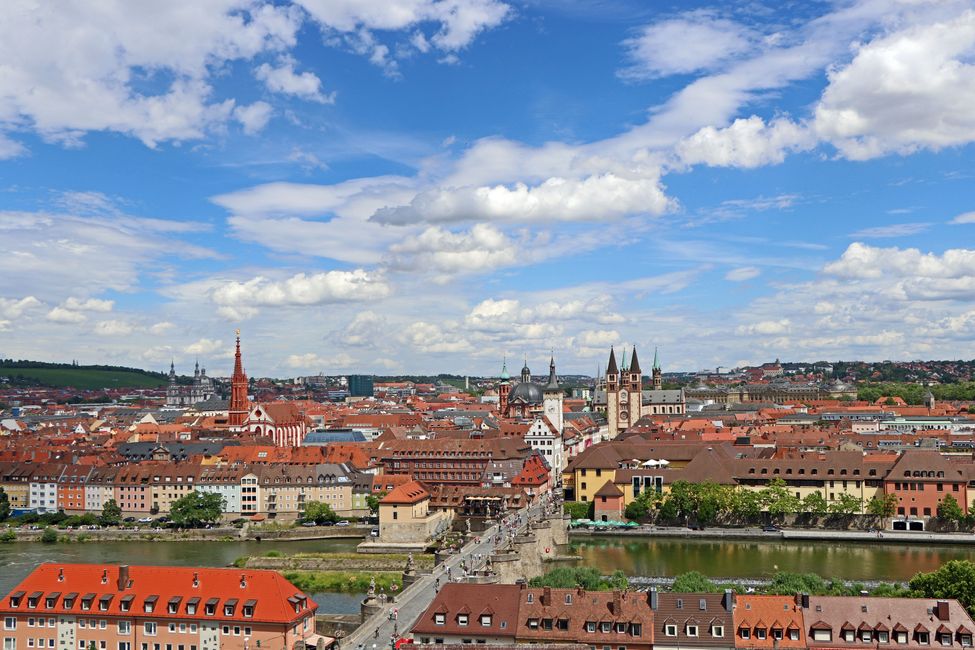
Today, as the weather was too bad to stay, we drove from Svinklov to Hamburg to Camping Wildpark Schwarze Berge, where we spent the first night of our journey on May 19th. In...

Published: 27.09.2026
Summary of Our Iceland Trip
As we did not convey many impressions and thoughts from our trip in the individual posts, also because they do not relate to specific events, we summarize them in the following conclusion.
We arrived in Iceland in Seydisfjördur on 27.05.2026 and departed again from there on 20.08.2026 with the Norröna, exactly 7 days short of 3 months.
Was it worth it? Is Iceland worth a thorough, long trip?
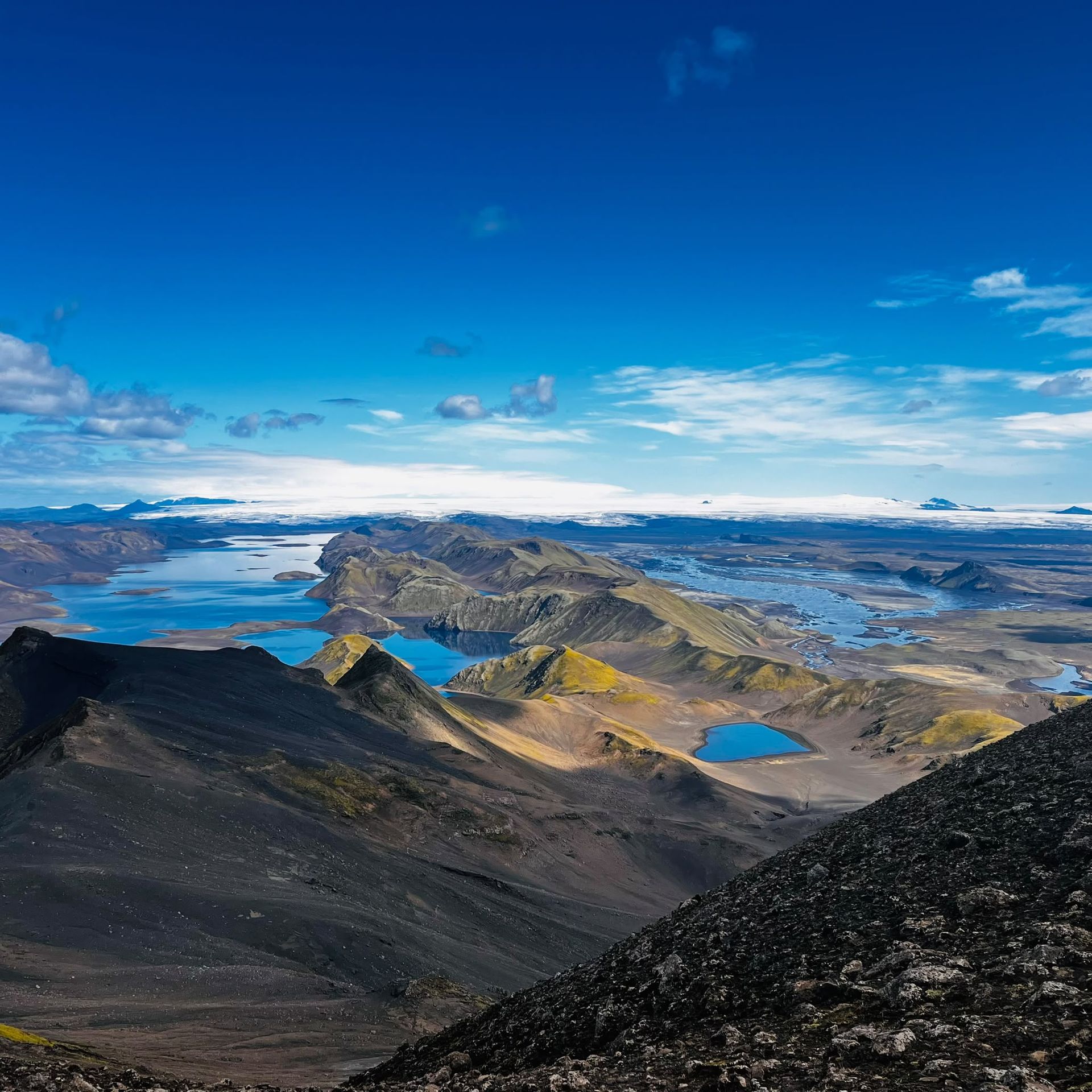
Yes, absolutely, as there are landscapes, impressions, and experiences that are hardly found in a similar way anywhere else. Some of them are truly breathtaking in the literal sense. It takes time to see the beautiful things, even in good weather, at least in weather where one can see something.
In the past, we repeatedly met people who had already been to Iceland, and when asked how it was, they usually gave an unreserved “Yes, superb.”
Unfortunately, we cannot say it quite so unequivocally, because there are quite a number of points that are really not very nice. We experienced it a bit “divided,” on the one hand with the unique landscapes and also some nice and interesting encounters, on the other hand, however, continuous, quite annoying charging, very limited friendliness, and at times, even by Icelandic standards, excessively inflated prices, and of course, often bad, sometimes very bad weather where one cannot really do anything meaningful – but even those days can be quite expensive. One can overlook some things, and we partly did, but an idealized romantic view of the whole situation did not succeed, nor did we pursue it.
Upon objective consideration, we believe that Iceland is not a hospitable country, at least not towards camping tourists; that is, one has to put up with quite a bit for the “beauties.”
We postponed our trip for a long time, several years, in order to have more than 3-4 weeks (departure and return by ferry takes about 10 days). On the one hand, this was right, as the long time provided many benefits, on the other hand, Iceland is getting more expensive each year and shows increasing mass tourism with corresponding disadvantages. This applies particularly around Reykjavik and at destinations that are easily accessible from there and from the Ring Road, where the “nature experience” also gets lost.
Duration of the Trip
Do you need as long as we stayed in Iceland?
No, almost 3 months are not necessary; we set off at the end of May, as the ferry crossing was still extremely cheap at that time, and returned only after the solar eclipse on 12.08. (of which we saw nothing, except darkness, as all of Iceland was under a thick cloud cover that day). Otherwise, we would have started one or two weeks later and also returned one or two weeks earlier.
Of course, in almost 3 months we did not see “everything,” but we were in all regions of the country, sometimes even multiple times, and saw and experienced a lot, also with the people, and can say that we have seen all of Iceland, and not just some tourist spots or parts.
In our estimation, about 6-8 weeks are required to discover all of Iceland, especially since one has to reckon with losing several days, a total of one to two weeks, due to bad weather.
On some days, we passed a number of sights and regions because the weather was so bad and we had the opportunity, due to the long duration, to come back later in better weather.
The saying “there is no bad weather, only inappropriate clothing” does not help here. Firstly, even with good clothing, at 4-5 degrees with strong wind and rain, it is no pleasure to look at something in peace, and secondly, the critical criterion – one really sees very little, or almost nothing. At first, we traveled the East and Southeast coast in bad weather to find milder temperatures in the south. Six weeks later we traveled the same route again and were amazed at how it looked here, as we saw almost nothing on the first trip, except fog and low clouds, over several hundred kilometers.
We repeatedly felt sorry for the “Ring Road” tourists, who were there for 1-2, a maximum of 3 weeks, and ticking off their spots in every bad weather with their “tight program.”
Camping
The campsites in Iceland are very different; some can hardly be called campsites and have nothing but a toilet and cold water, while others have quite good sanitary facilities (toilets and showers) and communal areas with kitchens, often fully equipped.
This has nothing to do with the price; the most expensive campsite only had toilets with cold water (also without light in the bathroom) and wanted an additional 1,000 kr (about 7 euros) for a shabby shower.
What applies to all campsites is that the sanitary facilities are far too few; in some places, the only washing options are in the few toilets, which are then occupied for rather long periods. It is best on campsites that are at most half full.
On many campsites, there is often only the bare minimum, and even in minimalist form. One often searches in vain for an effort to make the guest feel comfortable, starting with small details, such as the absence of coat hooks in the sanitary area (not everyone goes for a shower and shave at 5 degrees and in cold wind in a t-shirt or shirt) and not stopping at sinks with only cold water. We ultimately perceived these things as “unfriendly to guests.”
A truly positive exception to all of this is the camping card, which, if fully utilized, allows you to stay for just under 10 euros (2 people with car/motorhome/tent including tax). At some of these sites, the shower is even included, and there is a communal room with a kitchen – that is truly unbeatable cheap, but there are only very few campsites.
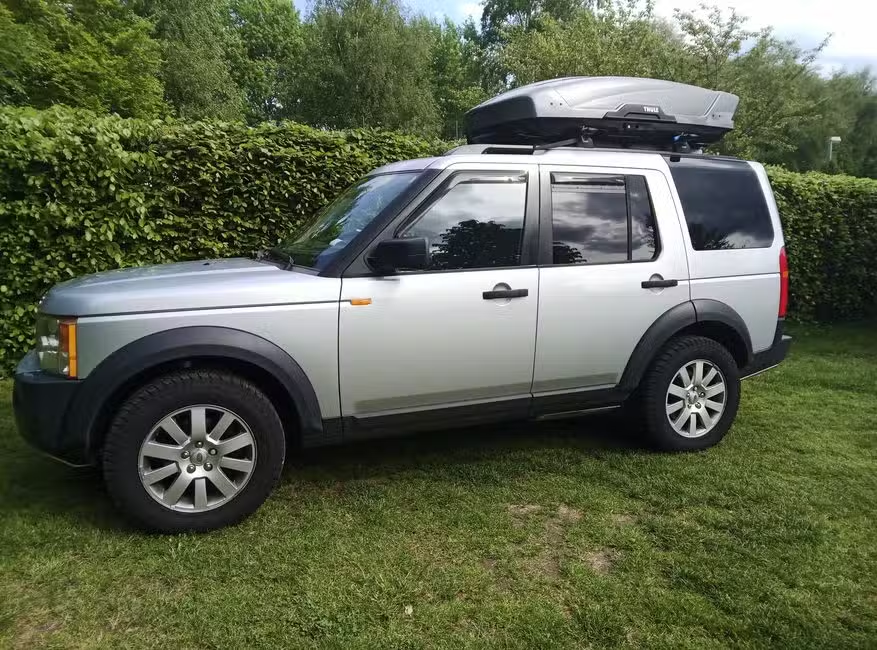
The costs for electricity at the campsite are almost outrageous, they charge for it; electricity costs between 7 and 10 euros per day – and this despite the fact that electricity in Iceland generally costs only about half of what it does in Germany. We installed a second battery in our vehicle for the fridge, so we never needed electricity; otherwise, we would have paid about 700 euros for electricity on our trip.
Weather
We already knew that good weather in Iceland is rather rare.
We still underestimated it, as the wind ultimately plays a bigger role here than the temperatures.
The wind “blows” these quite significantly away, at 12 degrees it feels only like 5-6 degrees, and 6-8 degrees already feels like below freezing; and we often had that.
So, even in the Icelandic summer, it can at least feel like winter; because we underestimated that, we bought a few warm clothes.
Fishing License
I must say upfront that I have no fishing experience; nonetheless, I bought fishing gear and also purchased the fishing license advertised on the internet for Iceland. Iceland is marketed as a “fishing paradise,” and with the fishing license, you are allowed to fish in many lakes, and in the sea, it is free anyway.
The reality is a bit different.
The fishing license is not valid at over 90% of the lakes you drive past.
At most of the approximately 38 lakes, you cannot fish at the entire lake, but only at specific sections of the shore, and sometimes you even have to register somewhere beforehand. Although I have no fishing experience, I noticed that the water at most of the shores I visited was quite shallow and partly weedy, and I often had to cast against the wind. To get right to it, I did not catch any fish. However, I did get the impression that the water owners report the more “difficult” lakes and shores for the tourist fishing license.
A knowledgeable acquaintance, an experienced angler, caught only 2 fish in three months,
Another peculiarity that I cannot explain:
During our entire time in Iceland, we did not see a single fish in a lake, river, or at sea; not even small ones or any other creatures.
Of course, there are fish and fishing spots where you can catch something, but the costs are partly very high – up to 1,000 euros per day for certain salmon rivers.
Prices
Iceland is an expensive travel country, the price level is significantly above that of Germany. Nevertheless, one can get by reasonably well if one caters from supermarkets.
The price level has nothing to do with the nonsensical argument “everything has to be imported.” We have found that imported goods are generally the cheapest products. The high price level is essentially self-made; there is a permanent annual inflation of 4-6% which is then offset by wage increases – i.e., in Iceland, the wage-price spiral runs rather unchecked. The exchange rate remains relatively stable due to some favorable circumstances for Iceland (which we researched). This means that for Icelanders, prices relative to wage levels are no higher than for us, but for tourists, it is very expensive, and it will continue to get more expensive.
Additionally, there is also a partially completely unchecked tourist scam. For example, I want to mention Landmannalagur, where a bed in a guesthouse costs about 110 euros for one night and one person (mind you, in a dormitory). “This is justified by the remote location in the highlands.
This needs to be clarified; it is not high at all, everything takes place at an elevation of 400-600 meters. And remote, yes, it is farther away from the nearest city, but the whole area is accessible by all vehicles, including buses (a dozen come daily) and trucks. In contrast to the mountain huts in the Alps, which maintain their own cable cars and are supplied by helicopter, there is really nothing high and difficult to reach, and a bed in the Alps costs about 25 euros a night.
These partly really absurdly inflated prices have nothing to do with the services provided; even though we didn’t need it, we still perceived them as quite unfriendly to guests.
What was particularly annoying
Pay Zone
Really annoying and very expensive and also frustrating are the pay zones for parking; especially in the south, there is a pay zone for parking at almost every somewhat interesting spot. The parking fee for a car is usually 1,000 kr, which is about 7 euros. Cynically, parking is allowed for the whole day, knowing full well that the corresponding visit usually takes about 1-2 hours. If only half of the vehicles parked for just half a day, there would be far too few parking spaces. For some of the attractions, you do not even need 30 minutes to explore them thoroughly. Most tourists visit about 3-5 of these attractions a day, that’s up to 35 euros in parking fees per day. Iceland advertises that the natural attractions are free, but you end up paying for parking. The parking fees can theoretically be avoided but are hardly practical; one then has to walk several kilometers, which is not possible for most visitors due to their very limited stay.
So far, toilets at the parking lots are free. However, we have already encountered a parking lot that costs 10 euros with an additional 2 euros for toilet usage; the fear that this will become a trend is not unfounded.
The pay zones are all equipped with cameras and license plate recognition; some are even on the public road, which only leads to the parking lot, but you already pay before you see exactly where you are going and perhaps do not even want to stay. Some tour operators have their shops at such parking lots, meaning you first have to pay 7 euros and then inquire about a typically overpriced tour.
The parking fee is, of course, also due if you consume and/or shop in the very large visitor centers (restaurants, souvenir and clothing shops).
We, of course, visited the main attractions anyway; you see them in television documentaries and tourist guides for many years, and once you are there, you just don’t want to miss it. But we saw it and are glad we don’t have to go there anymore; these attractions are certainly worth seeing and sometimes impressive, but in comparison to what we perceive as the real highlights of Iceland, they are just fairly nice.
This is also because at those spots the “nature experience” is no longer present. At Geysir and Gullfoss, the parking lot and visitor center are much larger than the attraction, and many busloads are carried there between the barriers. It’s just another attraction.
At a certain point, we also consistently ignored these pay zones for the above-mentioned reasons and surely missed nothing particularly important.
We also found that some “attractions” are primarily those just because they are near the Ring Road and the round trip distance from Reykjavik; in comparison to other beautiful landscapes/attractions, they are at least partly rather inconspicuous.
We always wondered where the people were being ferried to with buses to see something, just because it is easy to reach.
The pay zones are primarily in the south; in the Westfjords, in the north, northeast, and east this is (still) not the case.
Environmental Protection
At every attraction, there are many signs telling you to pay attention to nature, to stay on the path (flora protection); visitors are also reminded of their behavior concerning nature conservation in all national parks.
As a tourist, it is conveyed to you that you are a potential environmental destroyer that must be prevented from harmful behavior.
This is really annoying.
The reality is different.
There are certainly individual tourists who do not behave very environmentally friendly, but the vast majority behave quite considerately and responsibly, not destructively.
Here are a few facts and observations:
Only about 2% of Iceland's area, including traffic infrastructure, is developed; on probably over 90% of Iceland's area, there will be no one apart from sheep, as the land is quite inaccessible in wide stretches, and there are no meaningful destinations.
So, Iceland's nature is truly not in danger.
One can also take a look at the Icelanders' treatment of nature; this is a bit sobering. We have seen several junkyards about the size of 3 football fields where everything just seeps into the ground. In many agricultural operations, old machinery sits in the meadow and rusts unabated. In our country, one would have been reported for environmental pollution for leaving an old car parked 50 years ago. We also noticed that vacation homes are scattered all over the landscape. We then looked into how Iceland deals with wastewater, even in large cities – sensitive souls might want to avoid that.
That the culture in Iceland does not strongly embed environmental protection is not surprising. The people had to fight for survival in this very harsh nature for centuries and did not protect the “threatening” nature. To be clear, there are certainly individuals and groups in Iceland who are genuinely committed to environmental protection
and probably do not agree with the behavior of their compatriots, but in Icelandic culture overall, it is rather limited.
And as we have been confirmed several times by people who have known Iceland and the Icelanders for decades:
The Icelanders are not so much interested in nature, but much more in the money that can be made from it.
If someone believes they can cash in more, the flora protection is soon completely disregarded, and something is built, whether it's just a larger parking lot or a new visitor center.
I don't want to criticize the behavior of the Icelanders, but it is simply not okay to primarily shift the responsibility for environmental protection and the endangerment of nature onto the tourists, who bring the country great prosperity, and to handle the whole thing, to put it nicely, very relaxed.
What is good/cheap:
Water
Everywhere in Iceland, at every campsite, sometimes in supermarkets, and basically from every faucet comes very good drinking water. We did not buy a single bottle of water during our entire trip; this often cost us several hundred euros on other trips (Southern Europe).
Olis
If you buy the camping card, a discount chip for Olis gas stations is included. With this, you get a discount on fuel when refueling and can also get 2 cups of coffee at the Olis station for 1 euro. A large gas cartridge with the discount costs about the same as if you buy a single one with us. Likewise, snacks are also discounted. Apart from that, the Olis stations are set up like typical diners, and the staff was always very friendly. We always enjoyed going to the Olis gas stations; unfortunately, there are only a few of them.
Camping card
As already described above
Final Conclusion in Summary
Iceland is definitely worth seeing, as described at the beginning, but you have to put up with some really unpleasant things for it.
Would we go again?
We have discussed this a lot and do not fully agree.
I would like to go again for 4-5 weeks, but primarily to the north, northeast, possibly the Westfjords, and of course the interior of the country. We would not visit the touristy south again – the ratio of effort to experience value is simply no longer interesting.
However, if the cashing practices (pay zones, etc.) of the south spread there and everything gets significantly more expensive, then probably not. There is a limit beyond which even very beautiful things simply become so expensive that they no longer bring joy and pleasure.
If this happens, I would be very sorry. And it would be a real shame if this partly truly fantastic nature were only reserved for the well-to-do.
Even with some distance – I often think of the beautiful experiences in Iceland and always wish to go back there.