

The First Day
climate.” From a huge vat, I scoop whey and curd onto a giant stainless steel table where the cheese molds are standing. Something must have gone wrong during the curdling or...


Published: 17.05.2026
Milk – true milk – comes from animals. Mostly from mammals. How humanity has come to make cheese from this milk over the millennia, I gladly leave to the historians.
Today I'm focused on goats, as they are milked. And on a bull. You don’t milk a bull – it’s better to run away from it. But more on that later.
For there to be milk, there needs to be offspring. Only when goats have kids do they produce milk. However, they produce more and longer than the little beasts want or can consume. So, it gets pumped out.
In theory, it sounds quite simple:
You lure a specific number of animals with feed into the milking parlor, secure them there, and while they are feeding, you sneak up on them and draw off the milk. So far, so good.
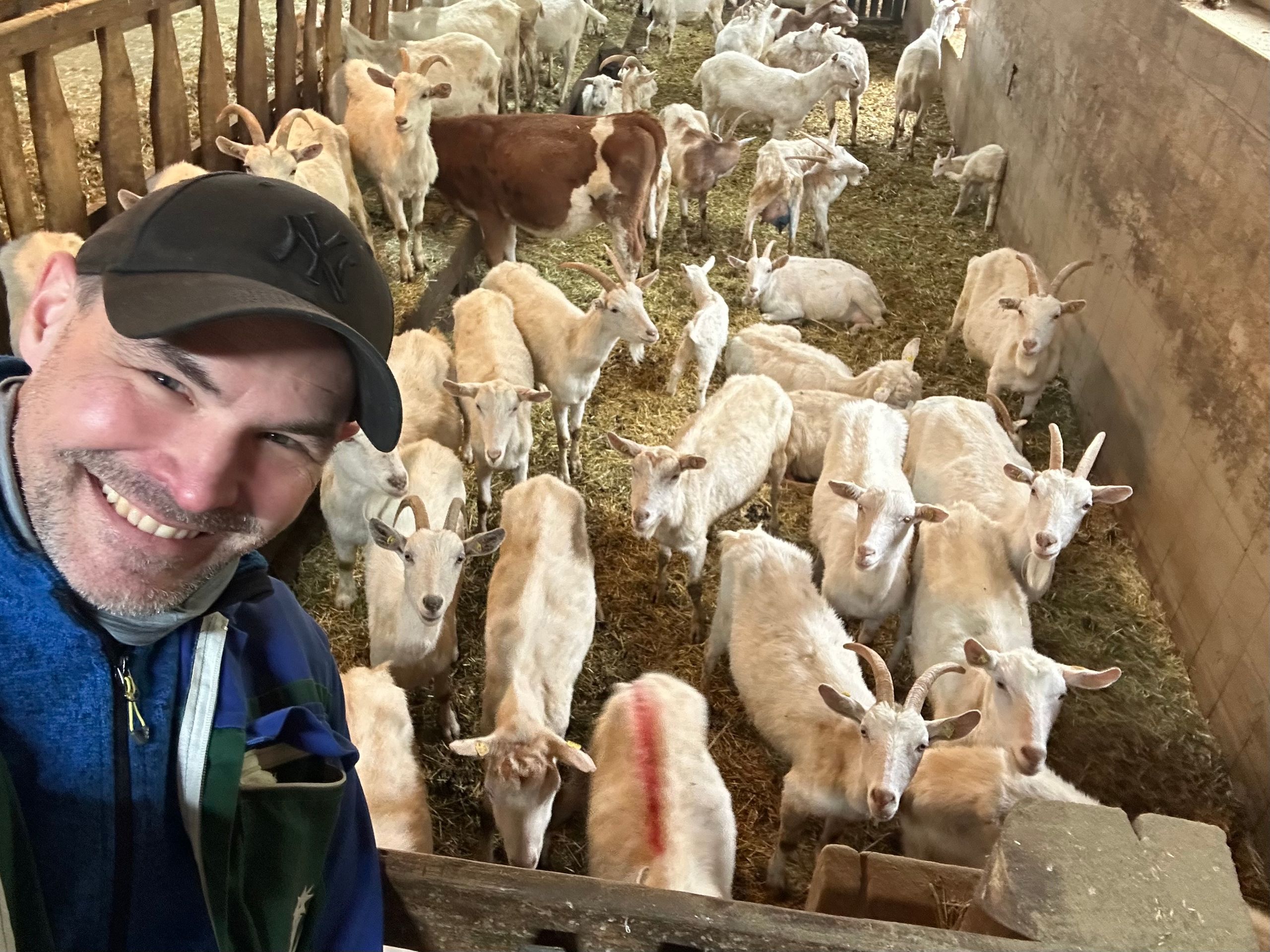
In practice, however, goats have their own idea of cooperation. Especially when they don’t know you, like me. And instead of being herded into the milking parlor, they stare with that goat gaze. Chewing and unimpressed. They remain unfazed by my presence. Milk yourself.
The plan is therefore adjusted. First, the animals should be led into the outdoor pen, from there then individually into the milking parlor.
I make my way through the herd in the goat barn to the back door, step outside, and find myself ankle-deep in goat dung. The smell is overwhelming. Tears well up in my eyes – not from emotion.
Franzi, the farmer's daughter, drives the goats outside. And I close the door and pragmatically wedge it with a large pile of manure. Then I climb over the fence and trudge back to the milking parlor.
The door to the milking parlor opens. It has space for eleven animals, eleven, twelve, or even five animals push through the door, jostling for a spot and inhaling the feed. A board is lowered from above and gently secures the heads of the animals, their horns can’t fit through now. At eye level are now eleven goat butts, more or less. The first step is taken.
Milking
Well, the udders of the animals hang roughly between their hind legs. The shortest route to the two teats – goats have two teats – is from behind. And to reach that well, the animals stand on a platform, at eye level.
You might think, you just attach the milking machine to the udders, wait a moment – and it’s done. Unfortunately, no.
First, the teats are cleaned with warm water. Right here, it becomes evident that one or two goats react sensitively to touches. Very sensitive. They are ticklish.
“Don’t be afraid,” Franzi whispers to me. However, I don’t perceive my approach as fearful, but rather respectful. After all, it is the first time.
After cleaning, the udders are “pre-milked,” a few squirts of milk are obtained by hand from the udder to – technically speaking – flood the passage. I shape my hand around the teat and – the movement of the fingers isn’t really describable. In fact, a stream of white milk shoots from the teat. Proudly, if only for a moment.
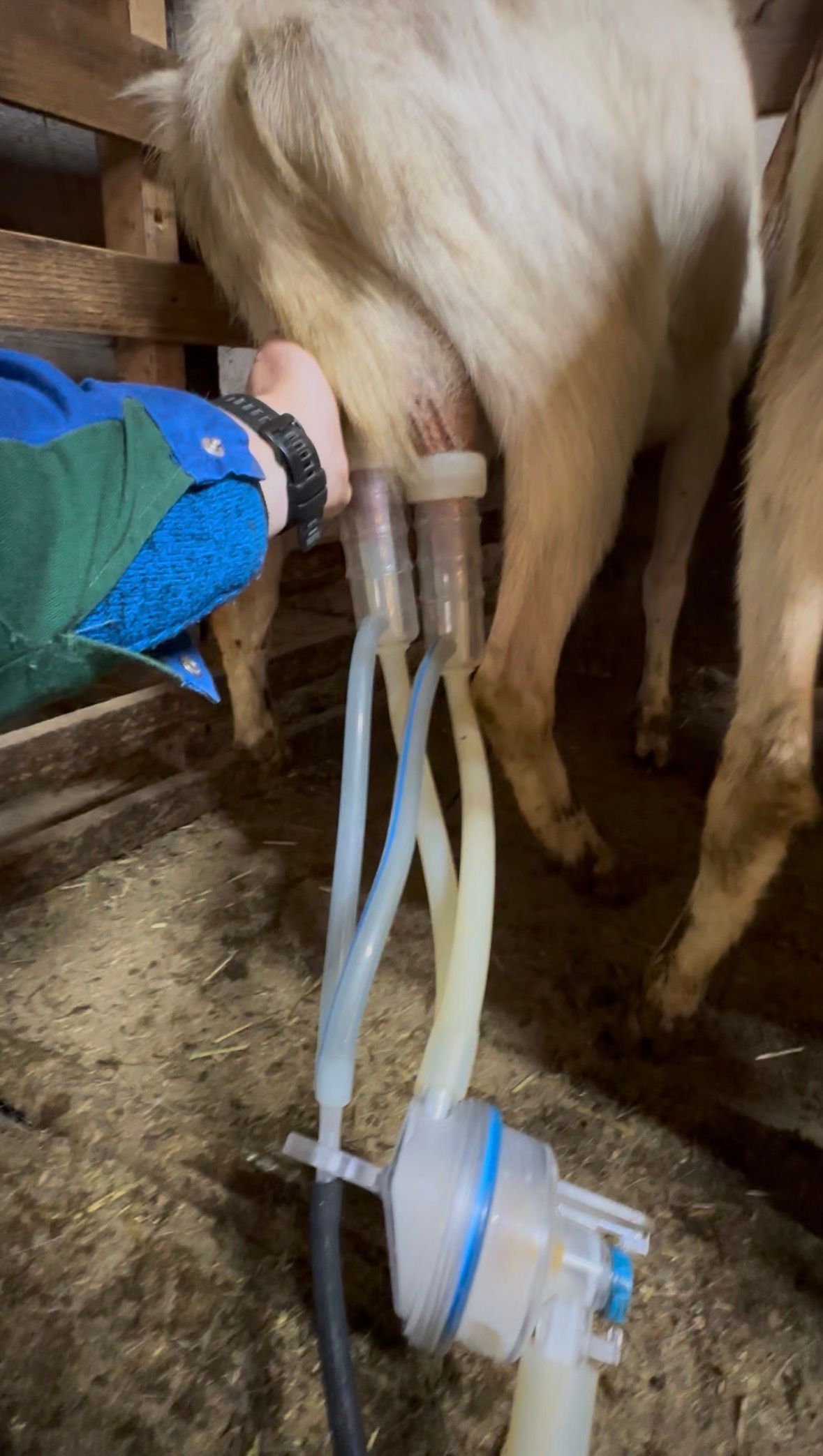
Then the milking apparatus is put in place. A completely mysterious suction-and-blowing mechanism to me. When applying, the thing needs a vacuum so that the suction cups stay on the teats.
When removing, the vacuum must be released, and air must be allowed in. Otherwise, you might injure the animal when taking the cup off. There’s a button or lever that you have to press, turn, push, or pull. The devices differ somewhat in their mechanics. Somehow, I still manage to get the things on and off.
As already mentioned, some animals react sensitively. They flinch, kick out, or squat down. When they do that, I worry that they’ll let their metabolism run free while I stand behind them.
“You need to calm the animals,” says Franzi, guiding my hand to the udder. Hairy and warm. We leave it at that.
Not every animal is so easily convinced. Some step on the milking hoses and tear off the cups. Then, it has to be re-sucked. No goat leaves the parlor unmilked.
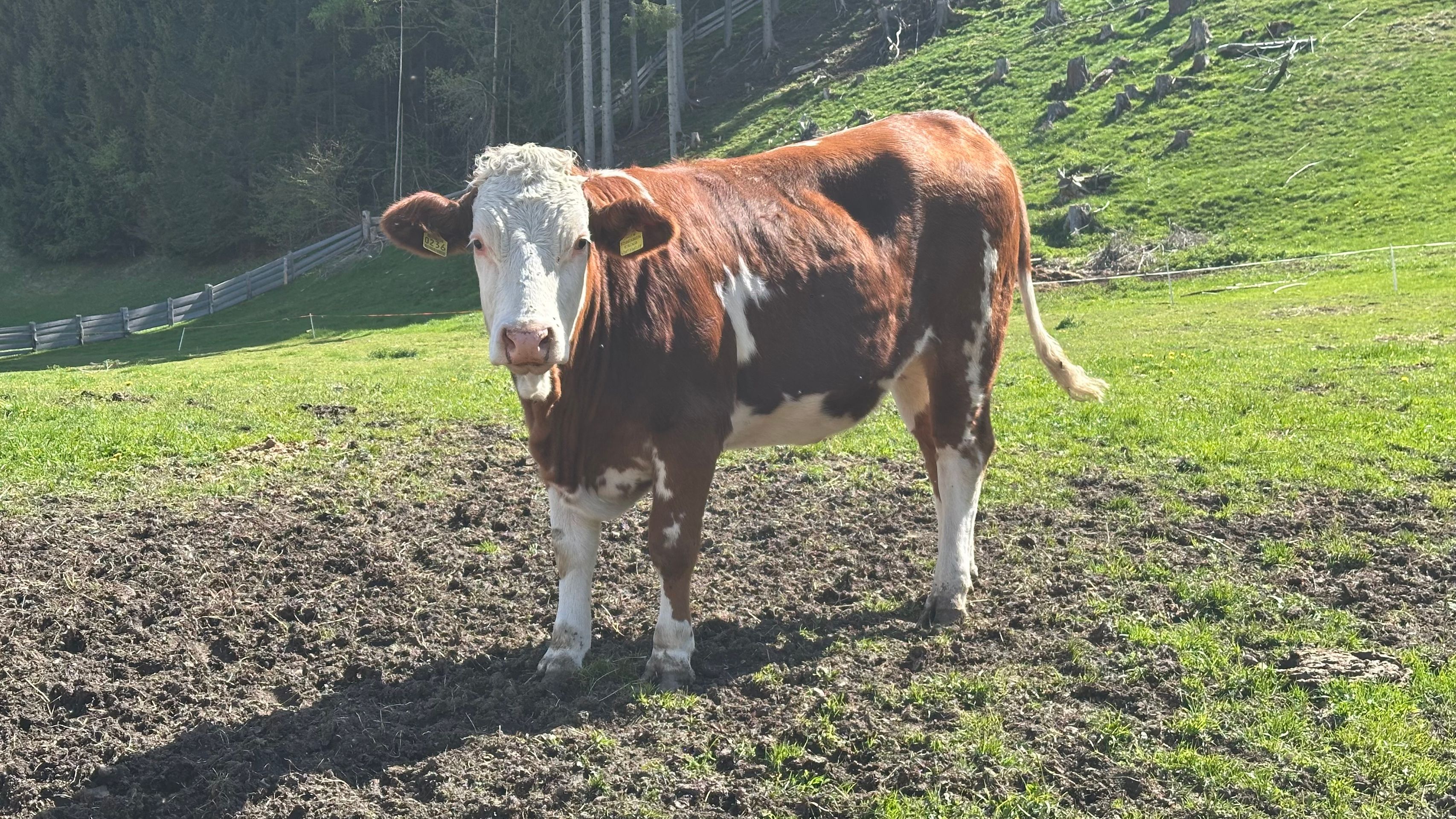
The milking goes smoothly, nearly 50 animals gave their milk today. I’m dispensing hay from the barn and feeding the animals when Franzi comes into the barn with three cows and a bull from the pasture. Only, they are supposed to go back outside to the pasture. Actually.
Because the creatures find it cozier in the barn. It’s warmer here, they’re not standing in the rain, and the feed tastes better than the greenery outside. The animals have no reason to leave the barn. So, we drive them back out. Actually.
Between the pasture and the barn, there are about twenty meters of open ground. My task now is to drive the animals forced from the barn to the pasture and secure the twenty meters.
Now I’m ankle-deep in cow dung, holding an old witch broom in my hand and waiting for what’s to come.
Suddenly, two cows and the bull come out of the barn. They are indeed walking toward the pasture. Franzi has piled up a mountain of hay. Persuasion work.
I close the band of the electric fence and go back into position. Franzi fetches the last cow.
Then suddenly, the bull is right in front of me and wants to escape. Brave, I stand in its way, holding the broom crosswise in front of me. My “HEH” or “HOH” or “OUT, UP, HOSSA” are ineffective.
And then the stupid animal lowers its head and begins to paw the ground.
I am not a cow whisperer. My knowledge about bulls mostly comes from western movies or short videos of various bullfights – the funniest videos in the world.
However, I think I know that the body language of the animal is not a good sign – at least for me, standing here before it.
Where is Franzi? No idea. The animal now also thunders its head against the barn. Oh yes, I have respect and wish that the broom in my hand were from Harry Potter.
“Without fear,” I remember from milking the goats. OK, “Without fear!” I tell myself. Once, twice. Nothing happens. Three times. The bull roars. It doesn’t seem to work.
An adult bull is, quite objectively, a good deal larger than me. And the idea that a ton of beef with speed X is charging toward my body Y sounds less like a math problem, but more like an ER visit. I grip the broom tighter. And it shoves me.
Confucius says: “Consensus instead of confrontation.” And even if it’s not a quote from him, that’s my new strategy. I lay down the broom and speak kindly to the animal. Soothing words, scratching its head, patting its forehead.
Indeed, the bull calms down. And all of a sudden, it leaves me alone and trots into the barn. Only then do I feel like I begin to breathe again. My heartbeat returns. All is well.
Fortunately, David, the farmer, comes and sorts everything out. He is not squeamish, not even with the bull. “Then they can just stay in the barn. I’ll drive them out again tomorrow!” We should have thought of that ourselves.
I tell him about my tête-à-tête with the bull. He just smiles and says, “Well, it’s a bit spirited right now. It’s spring after all.”
Nice for him.