Bogotá
After a good 6 months in South America, we conclude our trip in Bogotá. As the capital of Colombia and a metropolitan area with over 10 million people, Bogotá is just massive...

Published: 24.03.2025


After a long journey, we've finally arrived in South Africa! Even from above in the plane, the fantastic panorama of Cape Town by the sea stands out, framed by the Table Mountain massif. In fact, 'Table Mountain' consists of a long mountain range that stretches about 50 km down the Cape Peninsula.
As a starting point for our journey through Africa, Cape Town is an exciting place: it is a modern city with about 5 million inhabitants. The colonial period and the traces of apartheid are an important part of the history. Right on the outskirts of the city, there is a lot of beautiful nature to experience. There are so many facets to this city, so this report will be more detailed.

We check into a quiet B&B guesthouse in the middle of Seapoint, a lovely district right by the coast.


At the end of February, we are still in the South African summer; the sun shines really intensively and lifts our spirits! However, my spontaneous idea to first go to the beach quickly fades: hardly arriving at the promenade, my gaze extends over a rough rocky water landscape - unfortunately, I can't just jump into the water here 😁


So, the next day, we drive to the stunning city beaches Clifton and Camps Bay in the south of the center. We immediately feel how cold the Atlantic can be! Compared to that, the North Sea feels Caribbean warm... The best strategy seems to be: run quickly from the beach into the water, jump to cool down directly, and quickly get out 🥶 However, we can ascertain: the view from the beach towards the jagged mountains is simply breathtaking!


In and around Cape Town, you can experience the most amazing things! Whether visiting food markets with delicious food (there's basically a different one every day), hiking in the mountains, strolling along the waterfront, or beach visits, the possibilities are very diverse! We definitely live on the sunny side here; further down, I will also discuss the downsides...
Here are impressions from the food markets:


After warnings from our hosts and online research, we allow ourselves to be accompanied by a guide for our hike to Lions Head. There have been armed robberies on this route repeatedly.
The path up is simply fantastic! It circles the rock mass and proceeds comfortably at first, then becomes rocky-steep in the upper part. Upon reaching the top, we have a 360-degree panorama!


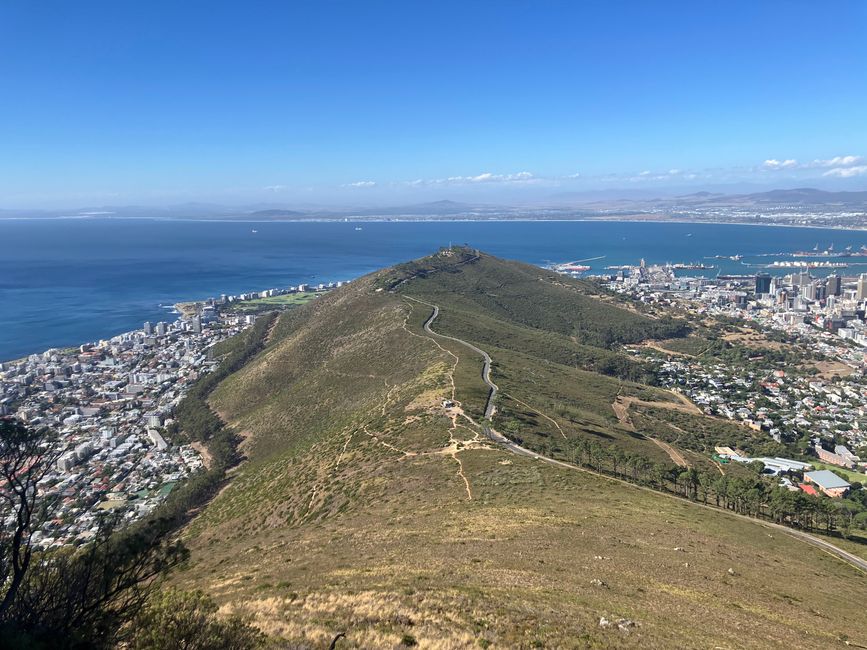

We realize: In hindsight, it would have been easy to do it alone, as the path is very safe during the day!
We also explore the promenade near the harbor, where most tourists are drawn!


Now to the downsides: Even today, the effects of decades of apartheid are still clearly visible! There is still a separation between Whites and Blacks and Coloureds. The term 'Coloured' was introduced by the apartheid system (alongside White and Black) and refers to the population groups that formed during the colonial period among Europeans, Africans, and Asians. Today, many Africans who are neither white nor black identify as Coloureds.
The contrasts in living conditions are extreme in Cape Town: on the beautiful beaches, in cafes and restaurants, we find ourselves almost exclusively in the company of white people. We see Black people or Coloureds more often in service jobs: they work in service, in low-paid jobs, such as Uber drivers (often this is one of the few earning opportunities for migrants from neighboring countries like Zimbabwe). Many work as housekeepers or gardeners in white households.
Among Blacks and Coloureds, there is great poverty; the unemployment rate is about 35%, and for young people under 24, it is even over 60%. About half of the Black population lives in townships. These were established during apartheid when non-whites were relocated.
Often, Blacks and Coloureds live in corrugated iron shacks under difficult and dangerous conditions. They have little chance of getting a good education and a better job and are still socially disadvantaged. This has also not changed with the ANC, the liberation party in which Nelson Mandela was active. On the contrary: structural corruption is a massive problem. Especially former president Zuma and other party friends stuffed their own pockets! Thus, the state-owned power company Eskom lost billions due to diverting funds. For example, coal was resold, and the company was sold inferior goods mixed with stones. Even today, load shedding is a permanent reality: due to a lack of electricity, entire neighborhoods or regions are temporarily disconnected from the grid on a rotating basis.
South Africa is the country with the most unequal distribution of wealth in the world (rank 1).This situation is also clearly visible on the streets of Cape Town. Homeless Black and Coloureds are seen everywhere.
Due to the great poverty, thefts and armed robberies occur repeatedly.The security situation is only really good in wealthy or tourist areas. Many neighborhoods are considered dangerous. This has led most people to use Uber taxis to get from A to B. Especially at night, no one likes to be outside. There are guarded areas like in the city center or at the beach, and there are also special guards for the parking lots to ensure that nothing happens to the car. Residential houses are secured with high, barbed-wire-covered walls and metal grilles on windows and doors, often with electric fencing.

For tourists, there are various behavioral recommendations. Whether exaggerated or for good reason - many people advise us to be cautious. In the safe neighborhoods, we move almost exclusively among white people. However, we are always served by Black and Coloureds. Undertaking a hike on our own at the city outskirts is considered unsafe. This makes us feel somewhat like we're in a golden cage because we can explore very little on foot. Especially in the evenings, it's recommended to take an Uber even for a few hundred meters.
However, the warm and friendly interaction makes up for a lot. South Africans of any background are always very positive and friendly.
On the fourth day in Cape Town, we are shown the township Langa by a guide. It is one of the oldest townships and quite safe. It is manageable and can be compared to a village where everyone knows everyone.
In Langa, residents are making efforts to upgrade the area and escape the cycle of unemployment and poverty. With outside support, there is a cultural center, an art café, and a music studio. A large restaurant is currently still under construction. Otherwise, there are a wide variety of housing options: corrugated iron shacks without water, communal houses where each family occupies one room and shares kitchens and toilets. The street where larger single-family homes stand is called Beverly Hills.


We also engage with the tumultuous history of South Africa. First, we visit the Iziko Slave Lodge (a historical building on the theme of slavery). The next day, we then visit Robben Island (the prison island where Mandela was also imprisoned).
Cape Town was founded as the first colony on the African continent and was an important harbor for shipping trade routes. The Dutch VOC (Vereenigde Oostindische Compagnie) brought thousands of slaves to Cape Town since the beginning of their rule in 1652. They were cheap labor and formed the economic foundation for colonization.
The building of the Iziko Slave Lodge long served as accommodation for the slaves in Cape Town. They had to live under inhumane conditions and perform forced labor every day. The slaves came from East Africa, Madagascar, India, and East Asia - as the Netherlands owned many colonies in Asia at that time. The group of the local Khoikhoi had resisted enslavement, but like the San and Zulu, they were gradually displaced and fought against.
Today, South Africa is a multicultural state with 11 official languages (English, Xhosa, Zulu, Afrikaans, Ndebele, Northern Sotho, Sotho, Swazi, Tsonga, Tswana, and Venda). Afrikaans - it sounds like Dutch - is still spoken, but as the former language of the colonizers, its use is declining.


Even after the end of slavery in the 19th century, the apartheid regime later further cemented inequality. The predominantly Black population was resettled into separated areas (the current townships) and was massively disadvantaged. After many decades, vigorous protests finally led to the end of the white minority's rule - Nelson Mandela and the ANC party were finally able to take power in 1994.


From the harbor in Cape Town, we reach the offshore former prison island Robben Island in just about an hour. It was long considered the most notorious prison in South Africa for political prisoners. Nelson Mandela and other leaders of the resistance against apartheid were imprisoned here for many years. Mandela himself was imprisoned for 27 years, including 18 years on the island - in a 4 square meter solitary cell.
The prisoners had to work hard every day in the quarry on the island and were exposed to the weather conditions, especially the sun and the glaring light of the bright sandstone, without protection. Initially, they slept on only thin mats on the cold stone floor. Through intense protests, the prisoners eventually managed to improve their living conditions. They were allowed to study. Nelson Mandela took advantage of this limited freedom by taking distance learning law courses and encouraged other inmates to begin studying as well. Therefore, they also referred to the place as 'Mandela University.'
Nowadays, former inmates are responsible for the tours on the island. This makes the conditions of that time feel much more tangible for us.


Next, we drive to the Cape Peninsula and visit the wine regions near Stellenbosch!