
Everything is a matter of perspective
Yesterday afternoon, we board a boat on the Chobe River with guests we already met during the morning jeep tour. The boat has about ten seats and seems relatively small compared...

Published: 16.08.2026
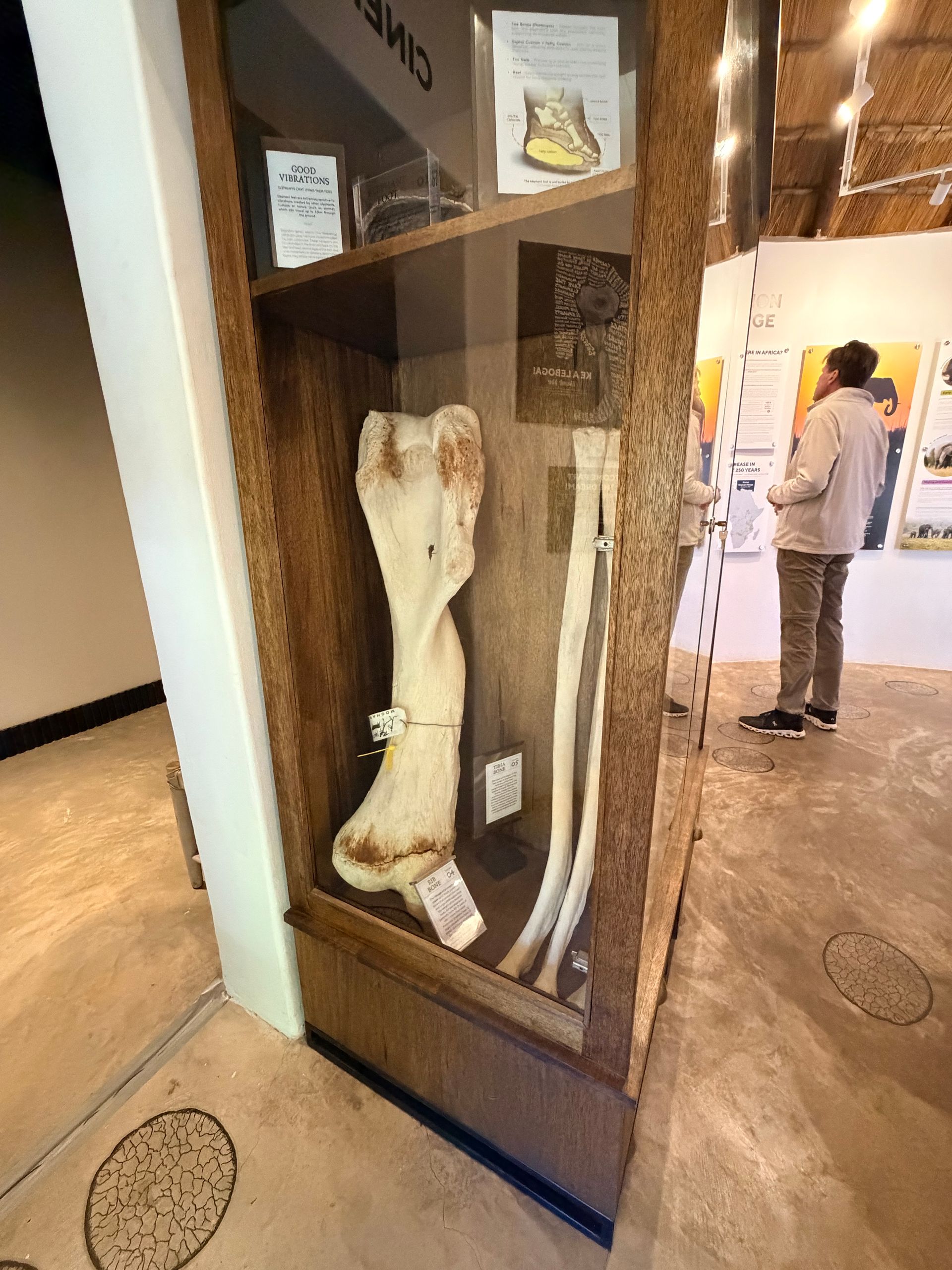
Next to the lodge, there is an "Elephant Museum." Here, we see impressively large bones, learn about special receptors in their front feet that allow elephants to detect vibrations from fellow elephants, humans, or even approaching storms, and read that the little ones must first practice handling their fascinating trunks – which we had already suspected during our observations. 😊
Although there are indeed many elephants here in Chobe and throughout Botswana, the Africa map is truly alarming: over the last 250 years, the habitat of elephants in Africa has been reduced by nearly 70 percent.
This also gives the ongoing destruction of vegetation, which often catches my eye, a different significance. There aren't simply "too many elephants." Rather, in some regions, a very high number of animals concentrate on a progressively limited and fragmented habitat. Moreover, climate change, with heat and longer dry periods, is making water and food scarcer. When there is less grass available, elephants increasingly rely on trees and shrubs.
The statement from our taxi driver, "Elephants destroy everything," suddenly appears in a different light. It also reflects a conflict between humans and animals that has even been given a name here: HEC – Human-Elephant Conflict.
During our drives on land and water, we also passed by strictly secured anti-poaching areas. For their own protection, the guide explains, entry and photography are forbidden there. The anti-poaching units must protect their locations, work methods, and likely also their identity or movements. Poaching remains a significant problem.
We read on the boards today that over the past 15 years, around 30,000 African elephants have been killed illegally each year for their ivory – an average of more than 82 per day. The international commercial ivory trade has been largely banned since 1989 by CITES, yet the illegal trade continues.
Thus, the initially quite simple image of the worthy-of-protection elephant becomes rather complex: climate change, diminishing and fragmented habitats, conflicts between humans and elephants, and poaching are interconnected.
Of course, much of this also applies to numerous other large and small species whose habitats are under pressure.
And while we sometimes feel that elephants are simply everywhere here in Chobe, the map shows how extraordinary this impression actually is. 🐘
Tomorrow, we leave Chobe and fly with a small plane to the Okavango Delta. The weather seems to want to be kind to me: I am a bit nervous and I don't really care for additional turbulence. I'm soooo excited 🤩