Il ne pleut jamais du côté nord d'Ikaria
Aujourd'hui, juste après mon réveil, j'ai entendu que quelque chose était différent. Et d'une certaine manière, cela me surprend encore à quel point mon sommeil est profond, ou à...

Publié: 25.09.2026
On the early morning of July 17, 1912, two armed groups of Ikarians set out to start a revolution.
At that time, Ikaria was part of the Ottoman Empire, which was not doing particularly well. Italy was at the doorstep attempting to gain control over the Mediterranean, while Greece had already ceded significant territories.
The groups, led by Ioannis Malachias, coordinated an action to simultaneously detain all representatives of the Ottoman Empire on the island, including the governor, the customs officer, and several gendarmes.
A violent confrontation occurred with Chrysostomos during which the 44-year-old Georgios Spanos was fatally wounded. According to the latest findings, likely by friendly fire, but this story will not be told here.
Otherwise, the uprising remained bloodless. About 40-60 Ottomans were taken to the nearby Turkish coast and released there.
The revolutionaries had actually hoped for years to join Greece. However, Greece hesitated because it still had some lingering conflicts with the Ottomans that it wished to resolve.
But now, as the dissolution of the Ottoman Empire seemed increasingly imminent and the Ikarians did not want to fall under Italian rule, they took proactive measures. Within a few days, they had to improvise a functioning state on their own: the Free Republic of Ikaria, declared on July 18, 1912, with Ioannis Malachias as president.
In just a few weeks, a revolutionary government, administrative agencies such as courts and customs, a police force with armed units, a postal service with its own stamps, schools, a national flag, and anthem were established. A commission was even appointed to draft a constitution.
At that time, about 15,000 people lived on Ikaria, and the revolutionaries' plan from the outset was to have themselves annexed by Greece as soon as the time was right.
The story fits somehow into this overall picture that I have come to gather about this island in recent weeks. The people here are practical. They act together and in solidarity, with the goal that everyone has a good life. I have experienced this here in the mountains while making wine and the naturally practiced neighborly assistance. I have read a lot about the communists and hippies, held discussions, and participated in Panigiri. There are now even scientific studies on how the events of this summer influenced the integration of the exiles and dropouts.
The republic existed for four months. On November 4, 1912, the Greek fleet arrived in Ikaria, having resolved the diplomatic difficulties more or less, and effectively ended the Free Republic. A few months later, it officially united with Greece, sealed by a ceremony in Evdilos.
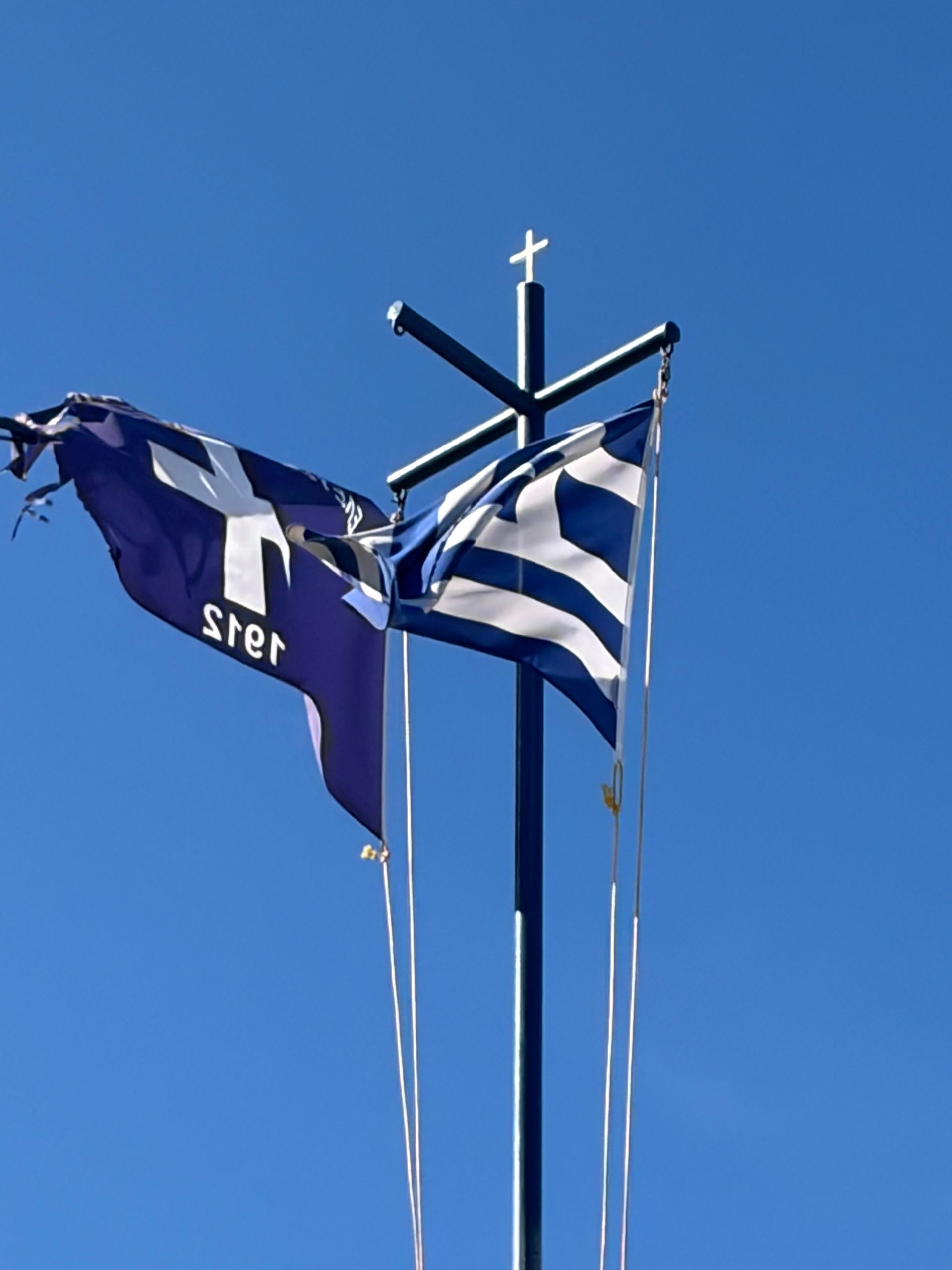
The figures of the revolution, such as Malachias and the fallen Spanos, are still revered here as heroes. The flag of the free republic flies everywhere alongside the beautiful Greek flag and even in