
Of Battles and Heroes
four in a row!

Published: 15.09.2025
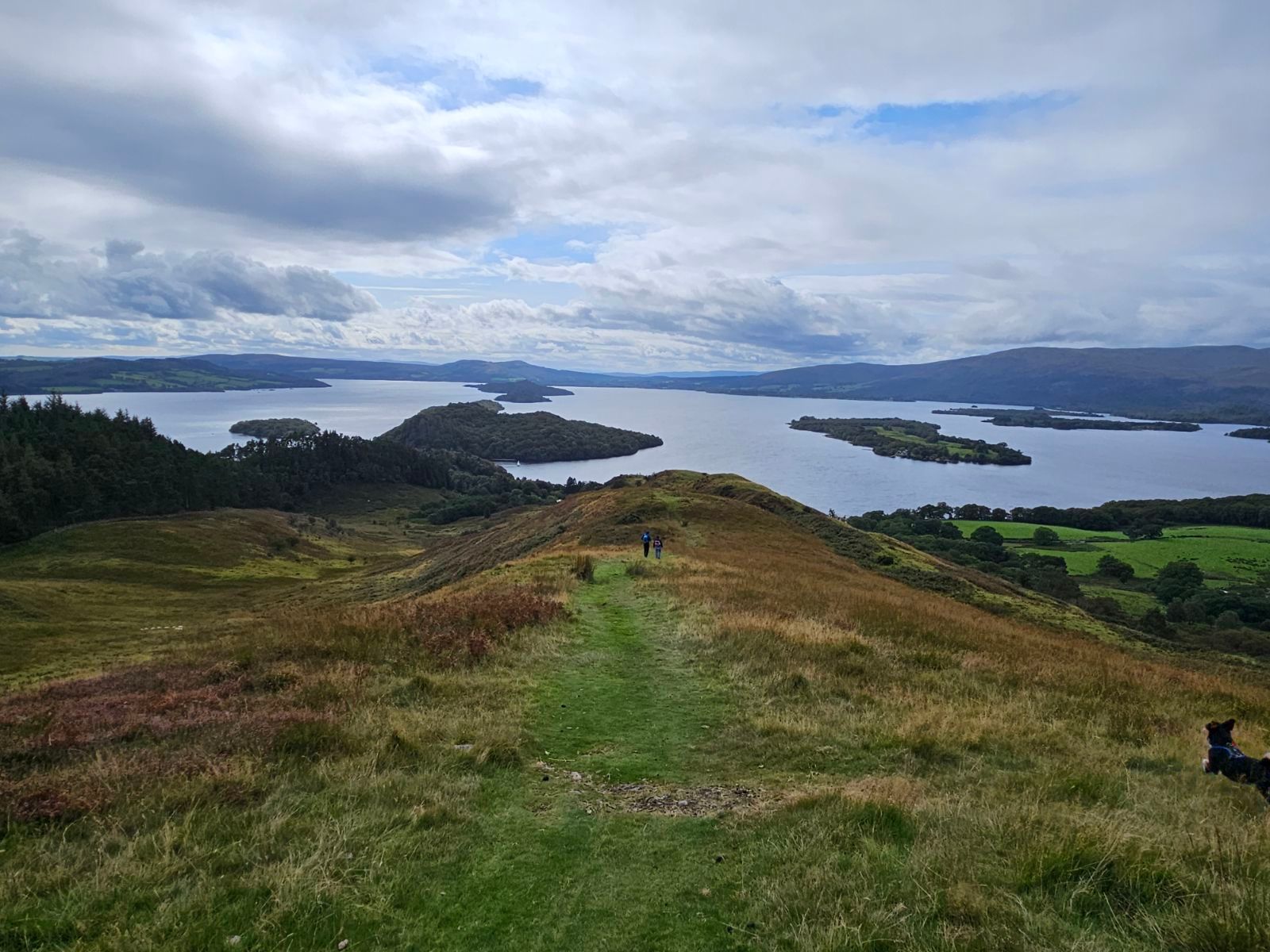
Two days ago we left Scotland – a good time to draw a conclusion. We all like Scotland incredibly well. The most outstanding thing about the country is definitely its landscape. Those who only think of the Highlands are greatly mistaken: Yes, the mountain landscapes that stretch across the entire western Scotland and reach far into the south are breathtakingly beautiful. Everything is green, there is this beautiful reddish-purple heather everywhere, and you can also see several waterfalls. The landscape is sparsely populated and intersected by many rivers and lochs that lay at the feet of the mountains. When you drive through the Highlands or – even better – hike, you often feel like you're in a movie set, the scenery is that stunning. To my frustration, this beauty can hardly be captured photographically, at least with a simple mobile phone.
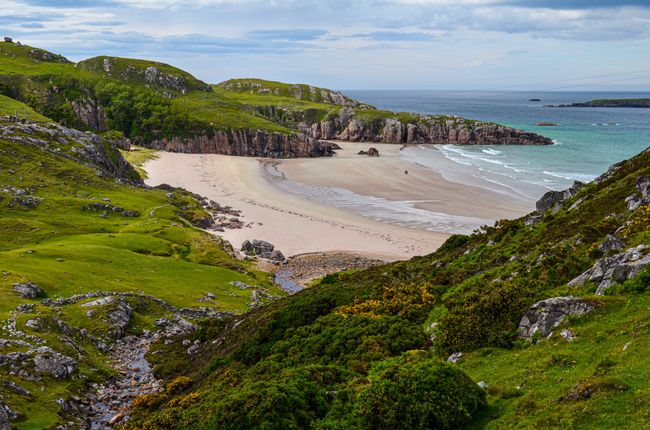
Besides the Highlands, Scotland has much more to offer naturally: For example, there’s the east coast with its sandy beaches and cliffs, forests, the west coast with the Outer Hebrides (islands in the northwest of Scotland) and the Orkney Islands. We will explore the Outer Hebrides and the Orkneys, as well as the entire northern part of Scotland during our next stay here.
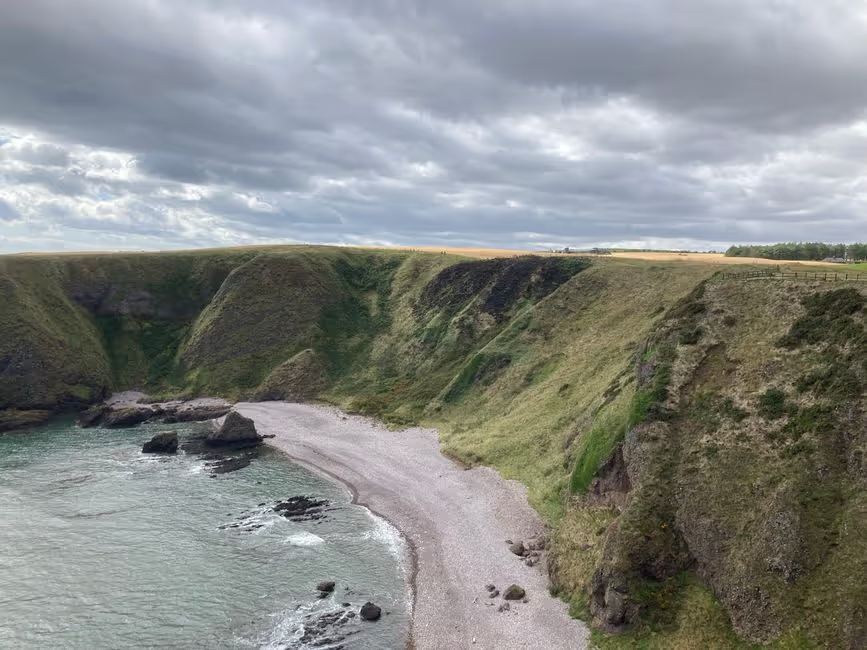
The east of Scotland is often overlooked, yet there are beautiful coastal villages, the highest density of castles in the country (e.g., Dunnottar Castle), many stone circles, and not to forget: Aberdeen. Aberdeen is the third-largest city in Scotland and my personal favorite city. Sure, Edinburgh is very special; dramatic, historically interesting, and simply beautiful. For this very reason, it is unfortunately teeming with tourists. On the Royal Mile, hardly a Scot can be found. For those who still want to go: A must-see is the
Edinburgh Castle, which majestically overlooks the city, Holyrood Palace at the other end of the Royal Mile, where Charles stays during his visits, Mary King’s Close – an experience that vividly shows how things looked in Edinburgh in the past - and the Scottish Parliament, which is architecturally outstanding. Furthermore, one should definitely take part in a “Ghost Tour” – Scots are brilliant storytellers, and even if you don’t believe in ghosts, it’s spooky in the catacombs of Edinburgh. From Arthur's Seat (a hill in Edinburgh), there is a fantastic view over the city.
But enough about the capital. As I said: I like Aberdeen the best. Not only because the city is very beautiful, I think it is also very authentic. There aren’t too many tourists, and there are human abysses to see.
I also like Glasgow. The city is much more beautiful than its reputation and offers a lot of culture alongside the only subway in Scotland.
In conclusion regarding the landscape and the cities, one can say: Scotland is beautiful everywhere!
However, for those wanting to get around the country, there is a somewhat bigger challenge: the roads. They are mostly terrible. The problem is not the left-hand traffic; you get used to that very quickly. No, the dimensions and condition of the roads are challenging. Narrow, narrower, Scottish roads. The worst are the so-called “Single Track Roads,” that is, one-lane roads with oncoming traffic. The locals speed along at 60 miles per hour (almost 100 km/h) and come to a full stop when faced with oncoming traffic. You then pull into passing places to get by each other. Really NOT FUNNY! Often, to increase the claustrophobic factor, there are also meter-high hedges on the left and right that make you feel like you’re in a tunnel with no way out. By the lakes, it seems that space was also an issue when the roads were built. There is heavy traffic density there, combined with roads barely wide enough for two vehicles to pass each other. Besides, it’s so winding that you feel like you're on a mountain pass. Reto once jokingly said that the Scots' favorite traffic sign is “Caution Curve” or “Watch for Winding Road.” However, the roads are not only narrow and winding, many are also in poor condition – full of potholes and strange elevations – guaranteed roller coaster feeling! When it does rain, which doesn’t happen often in Scotland, you constantly drive through mini-ponds, the water splashes up to the roof, and you feel like you're on a safari – much to the amusement of our children.
We spoke with many Scots and found that they also find the roads dreadful and prefer to avoid the narrow ones. So, be warned: A two-hour drive in Scotland feels like a four-hour drive on the highway in Switzerland!
Now I would like to say a few words about the Scots themselves. I would describe them as warm-hearted, helpful, funny, and unflustered. Without much fuss, they are friendly and never short of a witty remark. And yes, they like to talk about the weather. That makes sense, because there’s a lot to say about it. In one day, you can experience all seasons in Scotland – it’s not just a running gag, but simply true. During our six weeks, we had rather atypical weather: It was often sunny and very little rain. There were even some summer days.
But back to the Scots themselves. Everywhere we went, we felt welcome. We were not looked at strangely or treated poorly anywhere. This is remarkable, considering how long we were traveling. Even when I had a medical issue, I was met with a lot of warmth and understanding. I felt especially comfortable in the cafés in Scotland: They are often very small (e.g., the one where we got to enjoy our wonderful afternoon tea) and it feels like you’re sitting in someone’s living room. And that’s how you’re treated, too.
A topic that always works is history. Scots know a lot about their own history, are proud of it, and like to talk about it. For me, as a big history lover, it's a feast. Throughout the country, great importance is placed on making history visible. Everything is well signposted, documented, and mostly preserved. Larger sites (e.g., castles) always have a so-called “Visitor Center”; there you can find additional information, a café, and a shop. I wish Switzerland would also deal with its history as exemplary and make it more accessible, so that even the little ones can come into contact with it.
By the way, we hardly had any communication problems; most Scots have a bearable accent. The very worst came at the end: In the region of South Lanarkshire, south of Glasgow, they speak what I would call “Endboss Scottish.” We felt like complete beginners in English! So incomprehensible, so amusing we found the dialect too. So, for those who need a linguistic challenge: Head to South Lanarkshire!
The last thing I want to briefly write about is the food. As everywhere in Great Britain, there is often beef or lamb, beans, peas, coleslaw (cabbage salad – incredibly delicious!), and last but NOT least: potatoes, often called Tatties in Scotland. The Scot thinks that one cannot survive without potatoes, therefore there’s hardly a menu without them. Even if you order pasta, you get chips (the delicious thick fries) with it. In the “pubs” or “inns,” you eat the aforementioned in the evenings, in cafés you have various cold or hot sandwiches, soups, or “jacket potatoes” (stuffed baked potatoes). There, you are also faced with the dilemma of choosing between scones with cream and jam, numerous shortbreads (a crumbly pastry with different toppings), and delicious cakes and tarts.
Besides the traditional offerings, there are of course also Italian, Indian, or other restaurants. We definitely had no complaints; even for us vegetarians, there was always something available.
Conclusion of the conclusion: We will miss Scotland and will definitely come back!
(by Olivia)