

Tag 127-132 - Ready for the island
It is very exciting to spend our last days in Greece on Crete, as the island differs in many ways from the mainland - although not in the typical Greek coziness and driving...
Published: 01.02.2019




Hello and welcome back to aexcursion about the beautiful island of Crete. Our second week herewe didn't just use for climbing, but also to inform ourselvesthoroughly about the eventful history of Crete (andthat's not just because I was sick and terriblybored). So let's get started right away to share all theinteresting information we have read - believe me, the list is long. Because, to quote Nico:"On Crete, a lot was going on."
The starting point for a history asoccupied and resistant as that of Crete is the strategicallyadvantageous location of the island. It is 294 kilometers to Africa, 180 kilometers toAsia, and only 97 kilometers to the European mainland, everything that thesea power heart desires. As a result, the position of power onCrete was fiercely contested and changed as often as the island's population.
Although Crete was settled earlyon, it only became really interesting with the Minoan culturefrom around 3000 BC. It was thefirst high culture in Europe. Its cultural and economic upswing was also due to the cleverlocation of Crete, as the predecessor cultures were further developedby influences from seafarers and immigrants from Asia Minor. The timeis named after the mythical king Minos, who, although he was theking of Crete, is the subject of many Greek myths.According to them, Zeus was born in a cave on the Cretan mountain Dikte.After he had abducted Europe to Crete, he fathered threesons with her, who fought for the position of the king.One of them was Minos, who asked Poseidon for help and promised to sacrifice everything that appeared from the sea. Poseidon sent a powerful bull, thanks to which Minos became king. But he sacrificed a different bullinstead, which angered Poseidon so much that he punished Minos' wifePasiphae with the desire to sleep with said bull.From this rather unusual connection (I don't judge) the man-eatingMinotaur and with it material for many more myths arose (which I spare youat this point).
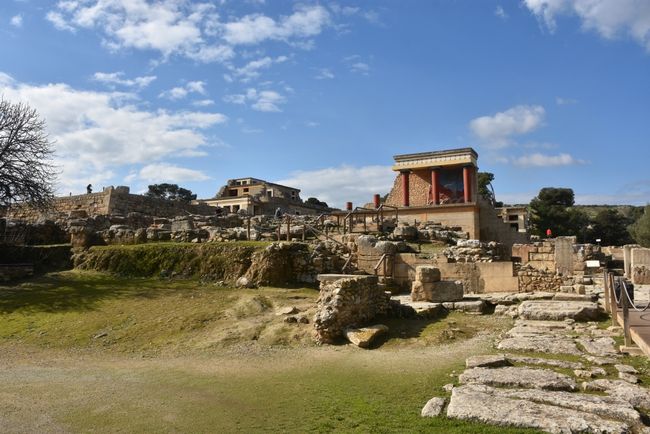
We got a sense of the Minoan architecture during a visitto the Palace of Knossos, which is considered the historically mostimportant place in Crete. (Luckily, we were there in winter, in summeryou can hardly find a parking space.) After the end of the MinoanAge, the rule of the Mycenaean Greeks began and with it the first Greek-speaking population of Crete, who took over theexisting palaces.
After a short period as aRomanprovince, the first conquerors of Arab origin arrived on the island. Around 10,000 rebels fromIslamic Spain used Crete as a base for theirpirate raids from around 824. They called the island Al-Khandag and used the laterIraklion as their capital, which has held this status to this day andis now the fifth largest city in Greece.
In 961, the island fell back to the Byzantine Empire, until the Republicof Venice bought Crete for the official price of 1000silver Marks. From 1204 to 1669, Crete was the most importantVenetian colony and around 4000 Venetians settled there.Under Venetian rule, many typical elements of architecture and art developed,such as the Cretan school, a certain type of painting. Cities likeRethymno, Iraklio or Chania with their Venetian ports andfortresses are still influenced by this period today. The Cretansresisted the occupation in about 10 rebellions, all of which ended in failure.Nevertheless, Venice never managed to introduce Catholicism on Crete.
In theWar for Cretebetween 1645 and 1669, the Ottoman Empire finally wrested control from the Republic of Venice.Iraklio, then known as Candia, fell last and held out for a 21-yearsiege. The Ottomans even built their ownfortress outside the actual (Venetian) fortress of thecity for that purpose.
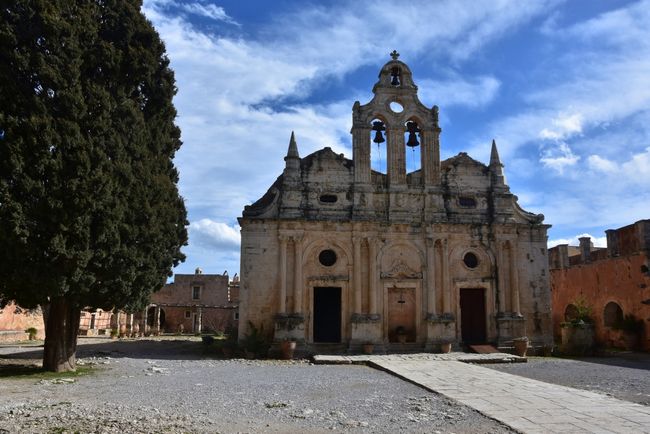
UnderOttoman rule,some Cretans converted to Islam and many Arabs settled on Crete,soon about 70 percent of the population in the cities were Muslims. We experienced the importance of theoccupation for the inhabitants of Crete impressively at Arkadi Monastery, where monks and villagersfortified themselves during the great Cretan uprising and eventuallyblew themselves up together with the invading Ottomans. Throughout theoccupation, there were repeated uprisings, one of which led to the Greco-Turkish War between 1896 and 1897. Thekingdom of Greece supported the Cretan uprisingand even though the Ottomans won, Crete received extensive autonomy in the subsequentpeace treaty as a protectorate of Prince George of Greece. This de facto independencedid notlast long, because as part of the Greco-Turkish War after the endof World War I and the beginning dissolution of the OttomanEmpire, Crete was united with Greece in 1913. As a result of theunion with Greece,all Muslims had to leave the island - including those of Greek descent.
Inthe SecondWorld War, unfortunately, the German Reich also recognized the strategic importanceof Crete and captured the island in a large-scaleairstrike in 1941. For the Cretans, this marked the beginning of a terrible time full ofincomprehensible war crimes, where homelessness, poverty,executions, forced labor, and food shortages were the order of the day. The partisan fighting of the Cretans, supported byspies and saboteurs from the Allied countries, led to somesuccesses such as the destruction of German airplanes, butalso to increasingly cruel measures on the part of the German occupation.The German soldiers killed civilians, executed entire villages, andburned down houses. Prisoners of war, rebels, and Jews were supposed tobe shipped to concentration camps, but the ship sank onthe way there due to an attack by the British, and the prisonersdrowned. Crete was under German occupation until autumn 1944, during which time about 8000 Cretans perished and only four people from theJewish population are said to have survived.
Afterthe end of the war, poverty was still not over and the residents used war materials in their everyday lives. Helmets became feeding bowls, bombs became bells, and parachutes and tents becameclothing.
Unfortunately, the suffering did not endthere, and Crete, together with all of Greece, suffered from the consequences of theCivil War after the end of World War II and themilitary dictatorship from 1967 to 1974. It was only in 1974 that more peaceful times returned to Greece with democracy andto Crete as well.
What a dramatic history forsuch a small island! Despite the unfortunate periods ofCretan history, a deeper insight into these backgroundswas really very interesting (and hopefully for you as well). We now have a better understanding of how Orthodox churches, mosques, andVenetian lighthouses fit together within a harbor and weadmire how warmly all the people here welcomed us despite the terrible roleour home country played in the history of Crete.
No matter where we parked our cars,no matter how deep we accidentally drove into the pastures and olive grovesof the farmers, we were greeted friendly everywhere.
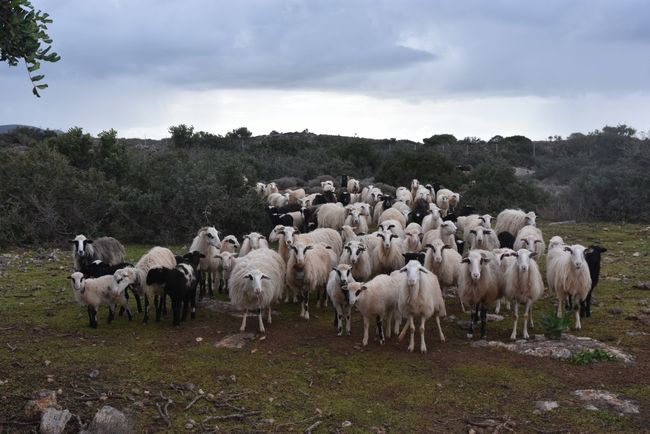
We did explore quite a bit ofCrete. After a few days of climbing in VoulismenoAloni, a stay in Iaklio, and a detour to Retyhmno, we still had time to explore the beautiful beach of Elafonisi. Thanks to the dubious navigation of Maps, Gretchen had to use all her off-road skills to get thereand in the end, we had to walk the last few kilometers anyway. But at least we got to enjoy a nice hike right through the herds of sheep andgoats to the even more beautiful beach. In summer, it is definitely not an insider tip, but at this time of the year, it was pleasantly empty.We hardly encountered anyone except for a little turtle on the shore. The water is turquoise blue, the sand is white, and the water in the bay is so shallow that you can wade to the oppositeisland Lafonsi. Elafonisi is rightly anature reserve that will hopefully be preserved and kept clean for a long time.
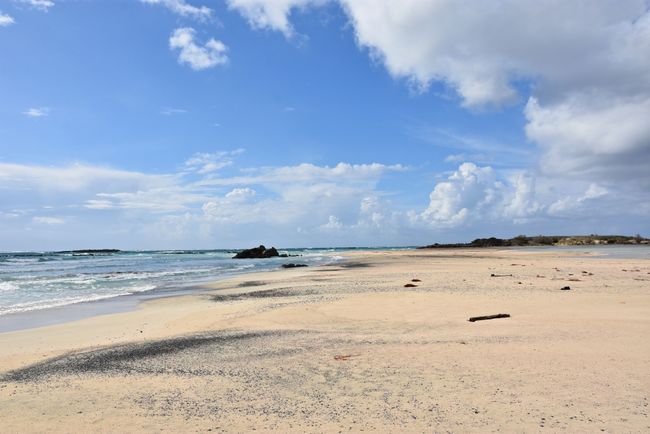
We then made our own small contribution to a clean sea together with Nico in Chania,where we collected five bags of litter from the beach in 15 minutes. It's crazy what people leave behind and what gets washed up. From stuffed animals to petrol canisters, everything wasthere. Not only this experience has made us think a lot lately about how we can live in a more sustainable and environmentally friendly way, in the van and in the future. (A blog post onthis important topic is in progress.) Nico was able to contribute a lot to this, thanks to his studies in the field of renewable energy, and we are very grateful for his input! Not only on this topic, but also for climbing tips, camping recipes, and card games. Have a great time on the road, we'll see you again in Berlin!
We are slowly but surely headinghome. The ferry ride from Crete to Athens will soon be followed by the longer crossing to Venice, and yes, then our trip will actually be over. We still have a few more days, which we want tospend near Patras.
Until then, history on!